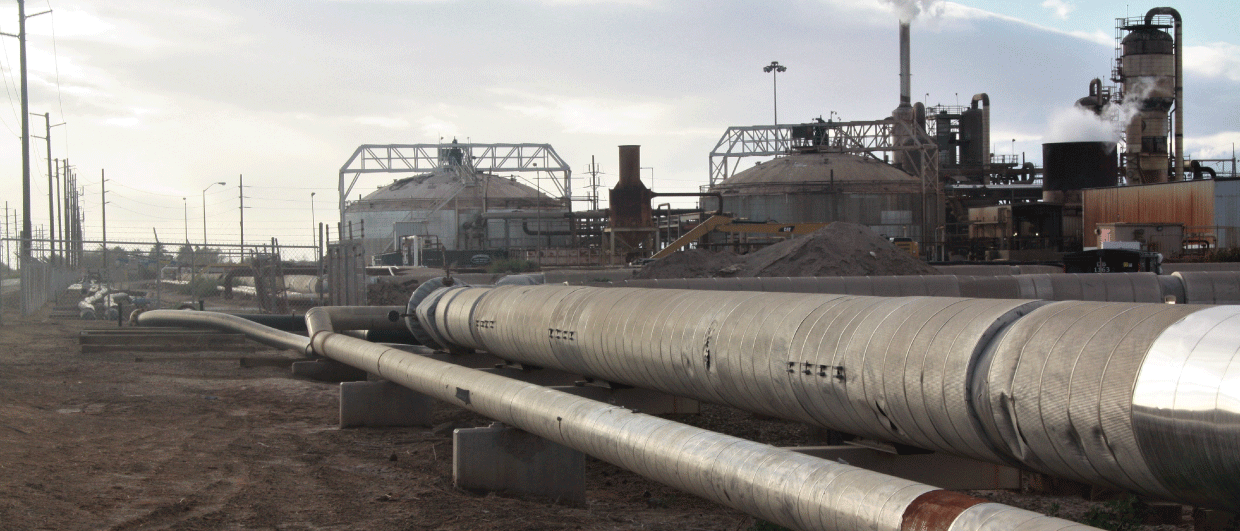
Fiskebäck, Gothenburg, Sweden. Photography: Mikael via Adobe Stock.
Why high oil prices can also be a bad thing for the energy transition
An update from Sweden – a shallow geothermal hotspot


A lot can happen in two years. That’s how long it is since I spoke to Signhild Gehlin, CEO at the Swedish Geoenergy Centre (read our previous interview here) So, it was great to catch up with her to hear about what has changed in the world of ground source heating systems, or the shallow geothermal business, to describe it in that way. And why is that interesting? It is interesting because Sweden is a major player in this sector. (read our previous interview here)
“2024 was a dramatic year in terms of ground source heat pump sales,” says Signhild. “First of all, there was a general decline in the building industry, which led to a slump in installations. Secondly, an EU stimulus programme to boost heat pumps was delayed, which further dampened the market. Also, and that is not so visible in the statistics, we know that in 2024 and last year, about a third of the newly installed ground source heat pumps were replacement pumps. That means the borehole is in place already, with no additional work for the drillers. As Sweden embarked on ground source heat pumps already in the 1980s with a peak in the early 2000s, heat pumps are now increasingly getting towards the end of their lives.”
About a third of the newly installed ground source heat pumps were replacement pumps
And there is another surprising development that one wouldn’t guess straight away. Where you might think that a higher oil price is good for the geothermal business, in fact, it isn’t. There are two reasons for that. First of all, the drilling rigs run on diesel, and secondly, the loops that are installed into the boreholes are made of plastic. “The price of plastic raw material for loops increased by 40 % since March, which obviously puts a damper on the economics of these systems,” says Signhild.
Then there is the competition from district heating networks. Signhild has compiled countrywide data that enables her to map the differences in operating costs between ground source heating systems and district heating networks in different regions. “In some places in Sweden, the operational cost between ground source heating and district heating is quite small, but in other places ground source heating is much more favourable,” she says. And that gap is widening even more, driven by the fact that access to biomass is getting more restricted. “Some people saw it coming,” she says, “but it is becoming a reality now, and the problem is only increasing. One district heating company even sent a letter to its customers stating that prices won’t increase more than 20 % this year.”
Finally, where two years ago there was not much discussion about deep geothermal potential in Sweden, the pendulum has now switched in its favour again. A couple of companies have floated ideas to drill very deep wells and produce electricity at depth. “I don’t think these outfits have a very realistic idea as to how expensive drilling to these depths is compared to the potential for actual low-temperature power production in Swedish geology,” Signhild says. “I remain sceptical, even when I’m always a supporter of looking into these things. My problem is that they seem to be so pervasive and manage to attract investors into something that seems very far-fetched in my honest opinion.”
I’m already looking forward to catching up with Signhild in two years.