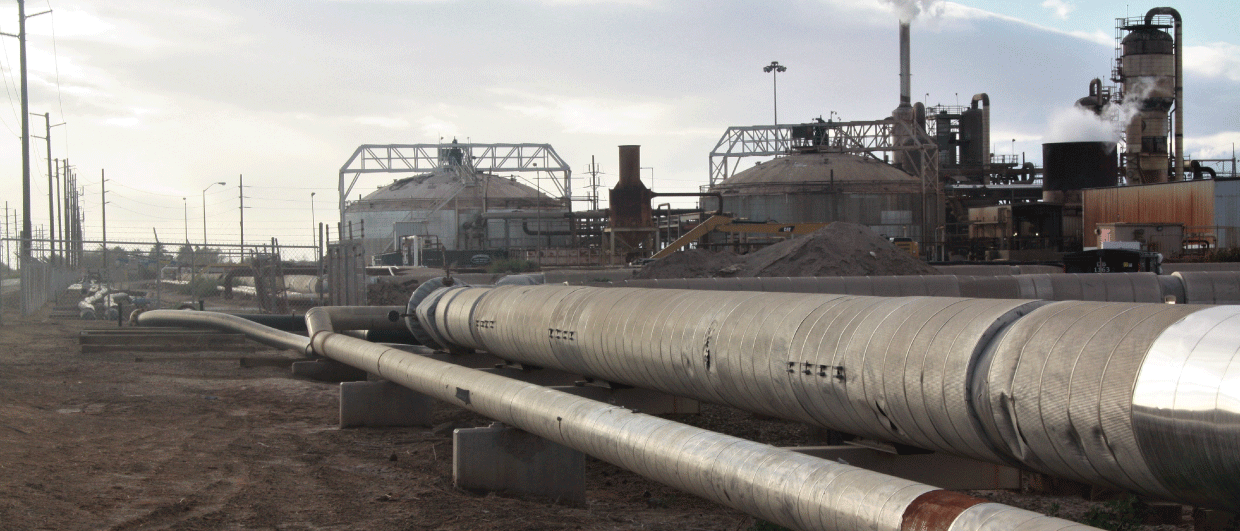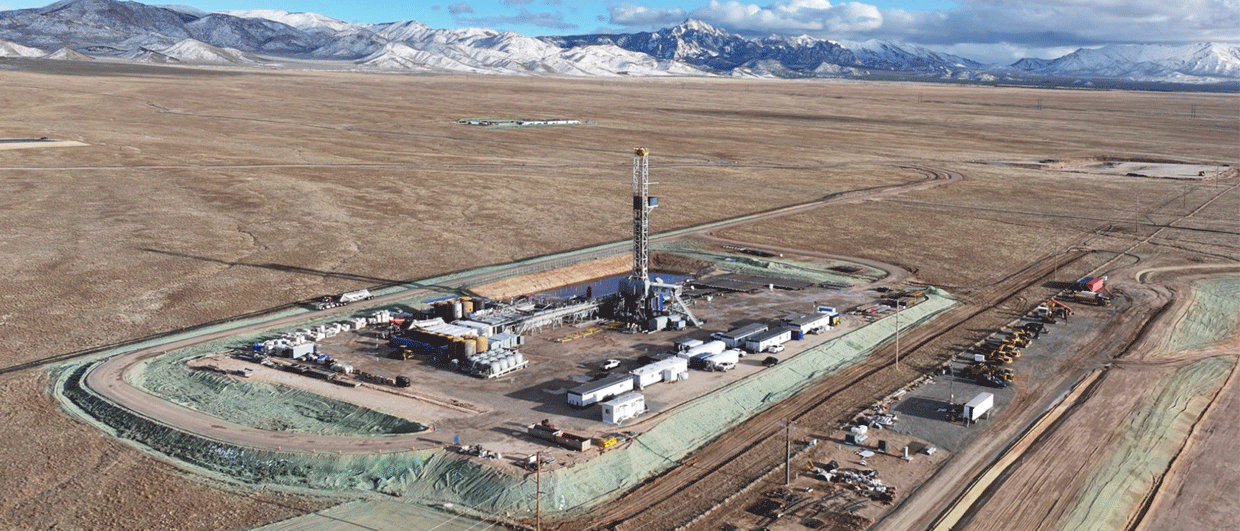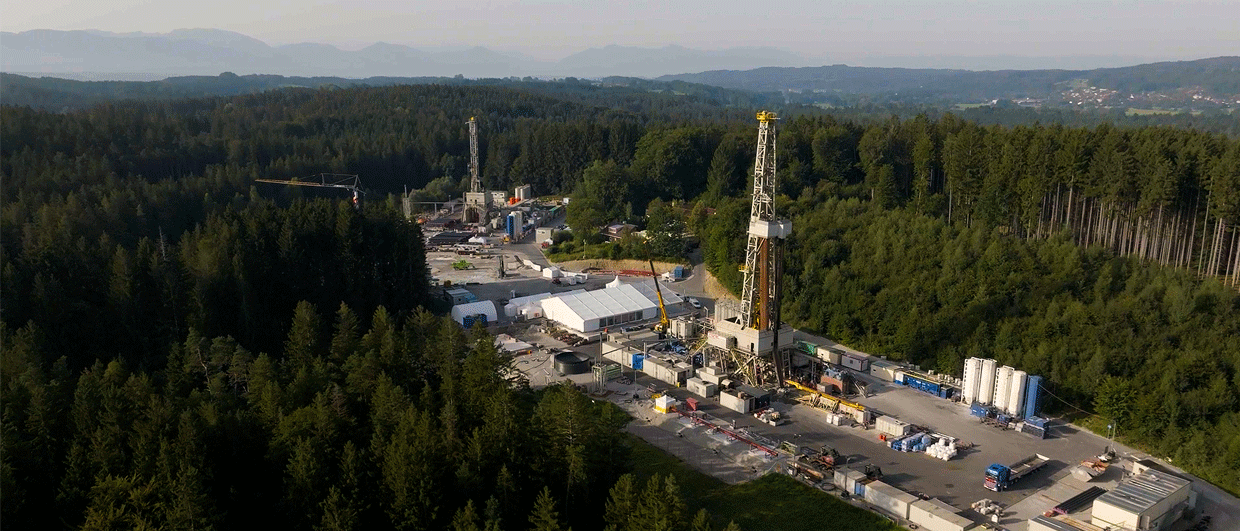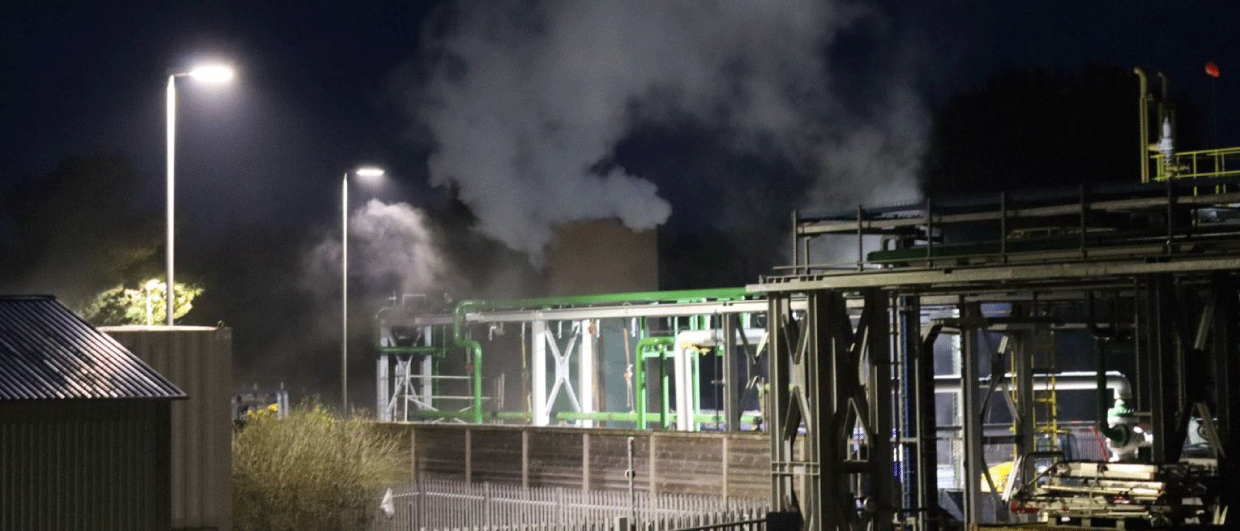
Geothermal well testing at the United Downs project, Cornwall. Photo: GEL.
United Downs – it is too early to uncork the bottle
How a geothermal project turned into a lithium mining exercise and why all the celebrations around its start-up are a little premature

Maybe it is because I am connected with Ryan Law on LinkedIn, but the number of posts about the success of the United Downs geothermal project was unstoppable for a good while. And it still continues. So many people and companies are celebrating the first energy delivered by this project, which has been in the making for such a long time. And yes, it is an achievement that the project finally got going after what must have been many hurdles to cross.
But to call this a success for the energy transition is too early in my view.
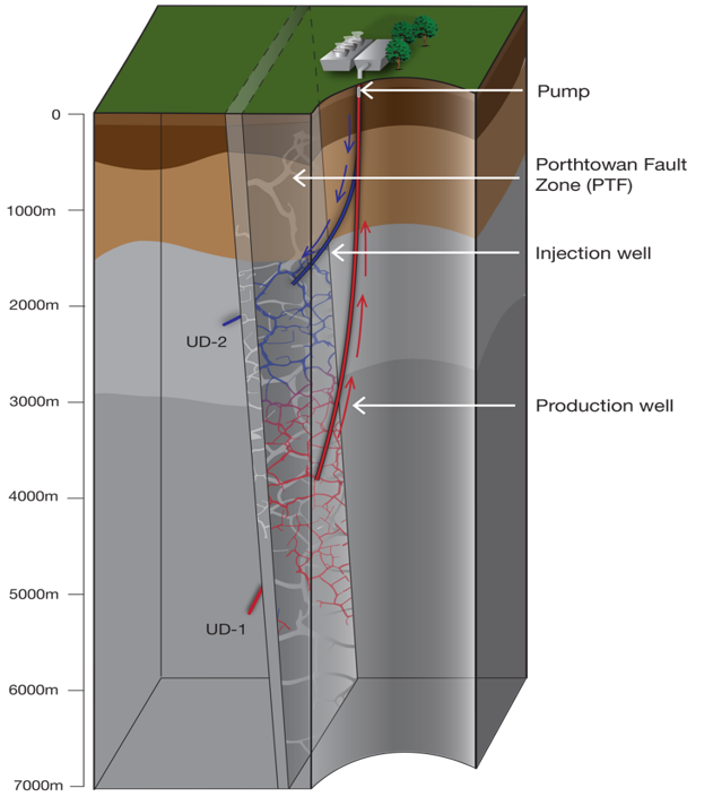
This project – which relies on the production of hot brines from a 5 km deep well drilled through a fault zone – has materialised because it was commissioned in a wealthy country where policy and decision makers care more about the green image of a project than the ratio between money invested and energy returned. There is no other way to see it.
In an interview with ThinkGeoEnergy, CEO of Geothermal Engineering, Ryan Law, was quoted as saying, “Sometimes you have to act on instinct, not just on numbers”. I think this is not good advice, in this particular case. If there is no confidence in the potential to make money with your endeavour, the only way to explain the fact that it doesn’t collapse is because there are major subsidies involved. And that is the root of the problem straight away.
It is for a reason that the BBC, in their article about the project, wrote that even the British Geological Survey (BGS) is of the opinion that this project might be hard to repeat due to the high costs. And that while the BGS is otherwise a promoter of the use of geothermal energy.
Yet, the number of people celebrating its success, as well as the number of articles doing the same, is increasing steadily. Hardly anyone is asking the question: Is this all worth it?
Is it worth it?
Let’s start with the supposed 3 MW of electricity generation this deep geothermal project delivers. That’s very little for a project costing at least £50 M. As someone noted on LinkedIn, it is more expensive than nuclear power from one of the UK’s most costly reactors currently under construction – Hinkley Point C – at about £25 K per kW installed for United Downs versus roughly £13 K per kW for Hinkley Point.
Just using the 3 MWe output as a benchmark, I arrive at £17 M per MWe for United Downs, where Hinckley Point would be in the order of £15 M per MWe using the latest cost estimate of £50 B and an energy output of 3,200 MWe. And to prevent any confusion, Hinckley Point is being used as an example project for cost overruns.
To those who call this geothermal energy project baseload – wait until the SLB submersible pump breaks down. There is only one production well in the system, and a workover is required to swap the pump. It is way too early to call this baseload energy.
On top of that, it is even questionable if the project actually makes 3 MW. Ryan Law seems very keen to talk to the media that agree to simply copy his claim that the project delivers 3 MW and powers 10,000 homes, but he did not respond to the various emails I sent in which I asked how much the project is actually delivering to the grid as we speak. Nor did his media team, who were responsive a while ago, until they told me about the failure of the ESP that I subsequently reported on. I have not heard from them since. Nor did the energy company – Octopus Energy – that is buying the electrons from United Downs, even when a representative initially seemed happy to engage.
And there are more reasons to assume United Downs is not delivering 3 MW. The contract for difference the company was awarded only went up to 2 MWe. Also, in a recent presentation at the SPE’s Geothermal Conference in Aberdeen, Ryan Law said that the lithium mining exercise that is now associated with the project is much more lucrative than the electrons sold to the grid. Then there is the ESP. As Elliot Yearsley pointed out in one of his recent articles for this magazine, pumped geothermal projects sometimes consume around 20% of the energy they produce. In other words, is the 3 MWe quoted taking that parasitic load into account? And in this article in the Financial Times, the author writes that “any excess energy” will be sold to Octopus following consumption by the lithium extraction process.
Of course, this is all just circumstantial evidence, but for me, the signs are there that the 3 MWe is only an upper limit that could be achieved if everything lines up, and possibly when the lithium process would cease. Why would Ryan Law not be more forthcoming replying to my enquiries if the plant produces as the press release states?
The geothermal turned lithium project
Then there is the lithium aspect to this project. Let’s first realise that at the outset of the whole exercise, lithium was not in the picture at all. It was all about geothermal energy.
But then, lithium came along. The brines from the deep United Downs wells turned out to contain healthy concentrations (360 ppm) of the element for which the price has seen a steady rise since late last year. The project secured even more funding to build the extraction plant and now aims to produce up to 100 tonnes of lithium carbonate per year.
Even though that is only a minor amount, given that Ryan Law himself confirmed that it is much more profitable than the energy sales, you can only imagine how pleased the team must have been when the lithium “discovery” was made.
With the price of lithium carbonate now hovering around USD 23,000 per tonne at the end of March, United Downs would make USD 2,3 million per year with the currently stated production numbers.
Why this project should be looked at with caution
In conclusion, it is my opinion that the United Downs project is yet another (partly) publicly funded project that should be perceived with caution rather than with too much of a celebratory tone.
If decision makers choose to continue supporting these projects, it is important to realise the sheer costs of it, and that the claim of baseload energy is only partly true. The geological risk, which I did not even discuss here, is also very high for a project of this cost. What about induced seismic events, what about cold water breakthrough, what about clogging up the fractures? In my view, the geological risks alone could already be prohibitive for an investment of this kind.
Proponents cite the advances in drilling technology and the associated cost reduction that can be realised. That is very true, and I want to keep an open mind to that. But so far, it must be stated that the project has not demonstrated that it can deliver energy in a cost-competitive way. Rather the contrary. It is therefore too early to open the champagne, the more so if you realise the effort required to arrive at just 3 MW. It took 15 years to reach this point, how long will it last for this to scale given the unique geological setting?