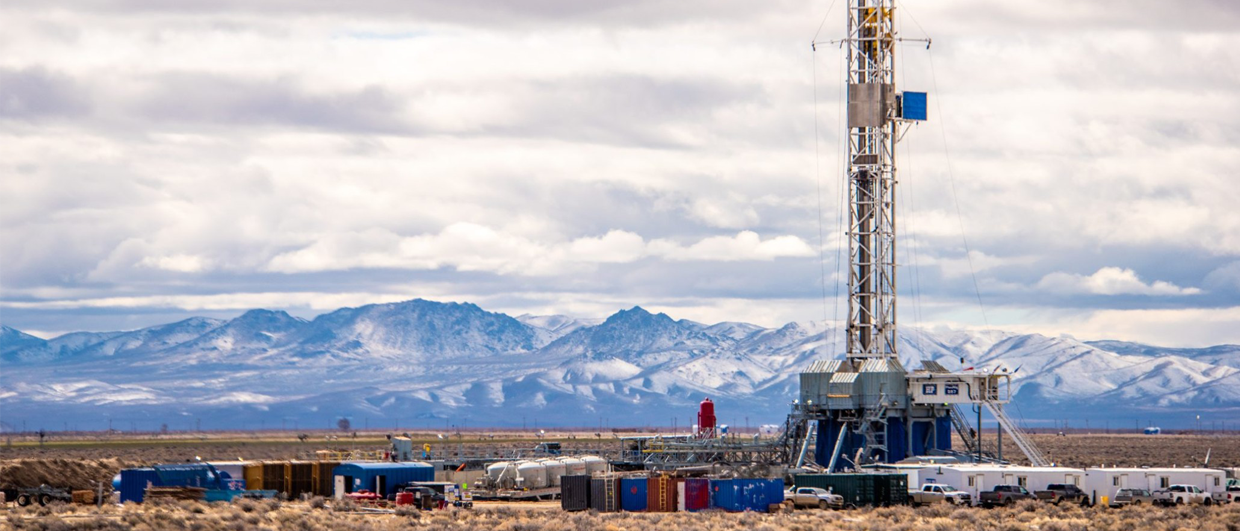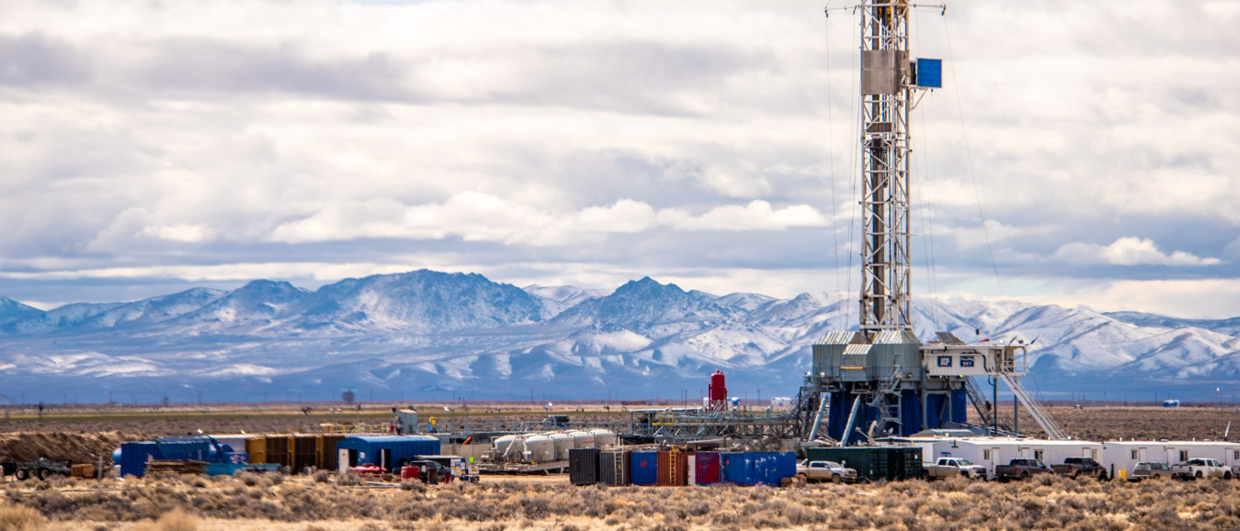
Project Red drilling site in Nevada. Photo: Fervo
Has enhanced geothermal been proven at scale?
Comments and opinion based on information released by Fervo on Project Red

A few days ago, Fervo published production data from their geothermal Project Red in Nevada that answers some of the questions posed in previous GeoExpro articles. However, it also raises others.
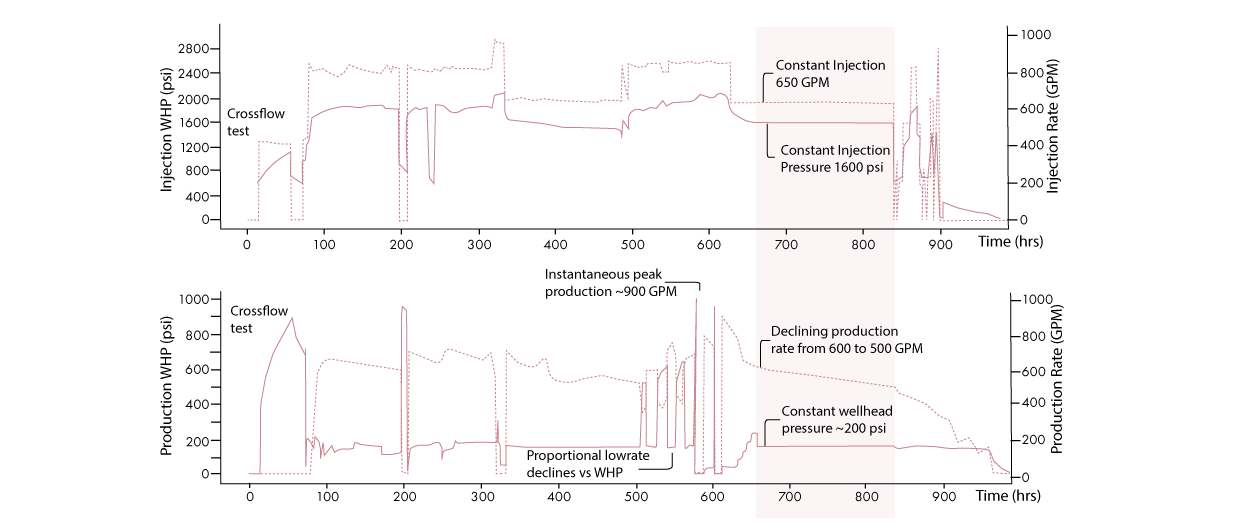
In our first article discussing Project Red, we suggested that the power output from the well, on a net basis, was likely to be about 1.3 MW compared to the 3.5 MW that was widely quoted. Fervo have now released the production data for this project and stated that the average net output over 614 days of operation was 1.4 MW, confirming our initial estimate.
We agree with Fervo’s statement in their S-1 filing that “Project Red was a limited-scope, proof-of-concept initiative designed to demonstrate certain technical capabilities rather than a commercial-scale development”. This is, however, at odds with the headline used to announce the Project Red data release: “Enhanced Geothermal Has Been Proven at Scale”. This will surely have to wait for the results from Cape Station – still some time off. In the meantime, let’s see what two years of production data will show, and the implications for Cape Station.
Production rates
The Fervo ‘White paper‘ for the Project Red well test, posted in July 2023 reported that “Production rates typically ranged from 550 gpm [gallons per minute] to 750 gpm with a maximum production rate of 970 gpm”. The production data just released show that stable production could ultimately be achieved during periods of constant injection at the low end of this range at 550 gpm (31 kg/s), but an injection rate of 45 kg/s was required to maintain this rate. Production could be marginally increased (to 35 kg/s) by also increasing injection, but tended to decline again if injection was curtailed.
Based on this, it is reasonable to assume that a Cape Station production well may also stabilise after some period of constant injection, although we don’t know what that production rate is yet, or the injection rate required to maintain it, as Fervo have yet to show the full well test results. We now know from initial Project Red reporting that Fervo tend to quote higher production rates that are not sustainable.
Temperature decline and make-up water
The temperature decline of 2.5 F that Fervo note for Project Red occurs in the last 100 days. This is a concerning rate of thermal decline if it continues (9 F per annum). Most geothermal pumped well projects in Nevada experience some thermal decline, which tends to average about 1.5 F per annum. Fervo indicate that the thermal breakthrough at Project Red was expected and not representative of commercial scale EGS, but this remains to be seen.
Fervo also note an average 70% “recapture rate” of the injected water, which means that for a new project, a constant source of make-up water would have to be found, produced, transported, mixed, and re-injected to maintain production (in the order of 30,000 to 40,000 gpm for a 100 MW project alone). We are told that this is expected to be reduced to only 1%, but that also remains to be seen.
Productivity Index
Another matter raised in the first GeoExpro article on Project Red was our estimate of the Productivity Index of 0.4 GPM/psi, which suggests that the flowing pressure drop between injection and production well was significantly higher than indicated by Fervo. We think this is important and will explore this for Cape Station in an article that will soon be published.