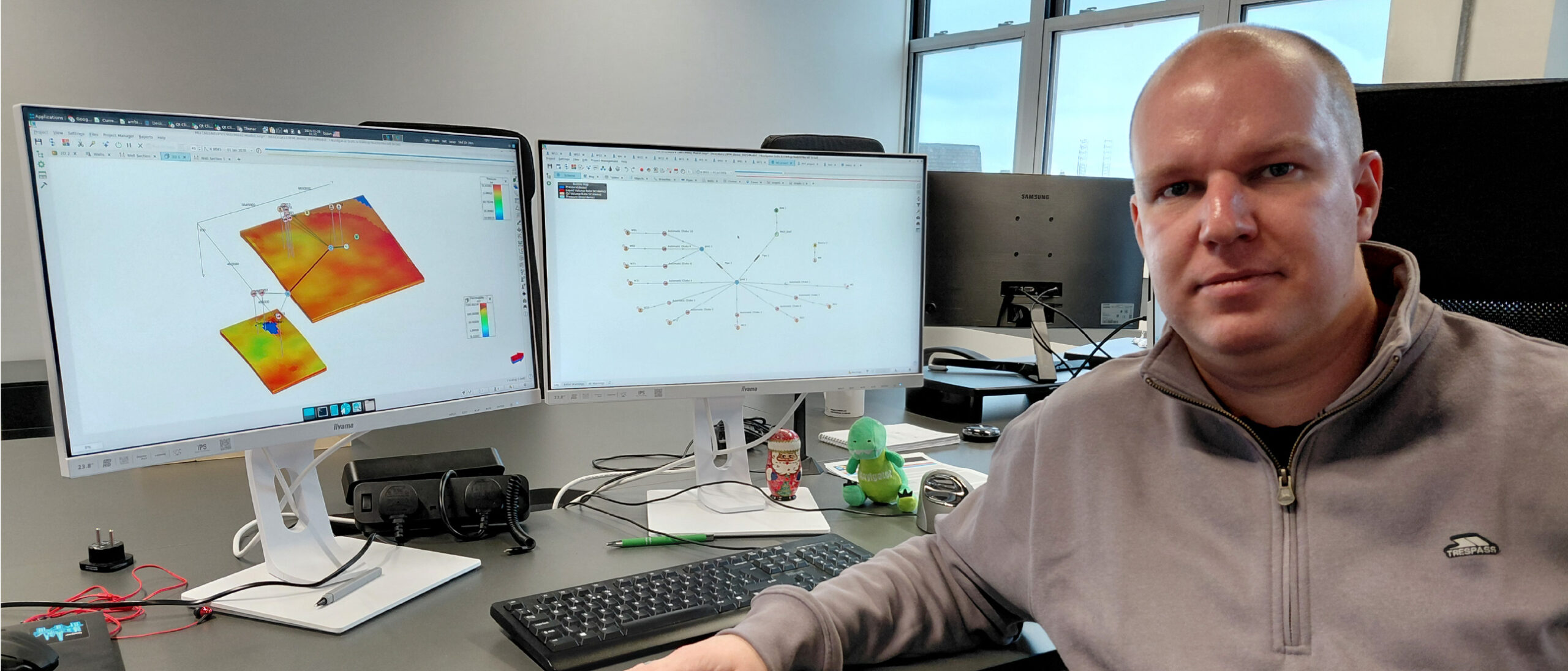
Mark Lakos. Photo: Private archive.
Diverting the flow: The hidden power of overburden barriers
And more insights from a conversation with Mark Lakos from Rock Flow Dynamics

Since Mark Lakos joined Rock Flow Dynamics (RFD) from Wintershall Dea a bit more than a year ago – a job that brought him to Russia and Egypt – he has been heavily involved with modelling of CO2 injection and migration in the subsurface, using RFD’s t-Nav software. As a reservoir engineer with a background in managing gas-condensate fields, he was up for that type of work.
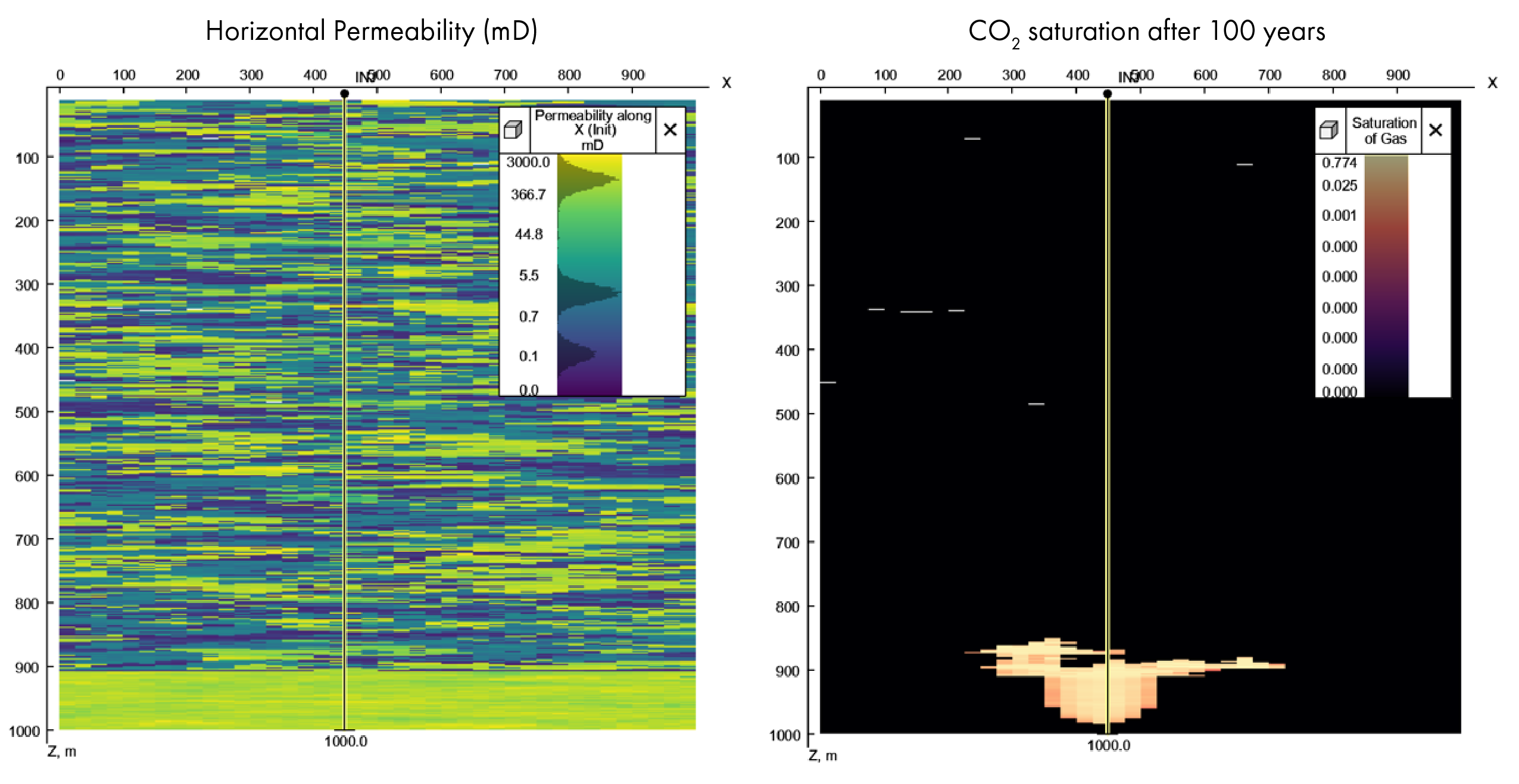
“One of my key learnings was that our modelling suggests that the risk of CO2 coming up all the way to surface is, in fact, negligible,” Mark says. “Look at this cross-section,” he continues, and he points to a model of just a single 100 m reservoir with a 900 m thick overburden consisting of a mix of lithologies that do not form a perfect seal. “Even in such an extreme case, where we don’t have a perfect seal,” he explains, “we don’t see CO2 migrating to surface in a matter of 100 years, as most of the CO2 would have dissolved in the formation water by that time.”
“Even better, the faster we inject the CO2, the less the plume will have migrated up over time,” Mark says. “This sounds counterintuitive, but there is an explanation for it. When we inject CO2 at a higher rate, it will penetrate deeper into the reservoir than if we injected at lower rates, due to kinetic forces dominating over buoyancy. At low rates, buoyancy is the key driver of the migration, leading to more rapid vertical CO2 movement.”
This observation would lend support to the model of injecting CO2 by offshore vessels, as the injection rates in that scenario are high.
“And then we haven’t even introduced lateral barriers,” Mark says. Following on from work published by Alexander Bump from the University of Texas at Austin, who has been saying that the subsurface is not the problem when it comes to CO2 injection, Mark also ran models in which he introduced these barriers. “In that case,” he says, “even when the barriers are discontinuous, we still see that they strongly inhibit vertical movement. To an extent that upward migration is even less of a concern.”
In other words, based on the modelling he has performed, Mark thinks that the often-heard concern about CO2 leakage has received too much negative press. “Some are usually sceptical about modelling work,” he concludes, “and its capability of forecasting reliably hundreds or thousands of years into the future. But even if we are slightly wrong and some CO2 does escape to the atmosphere, let us give it a thought: Is it better to store 99 % or nothing at all?”