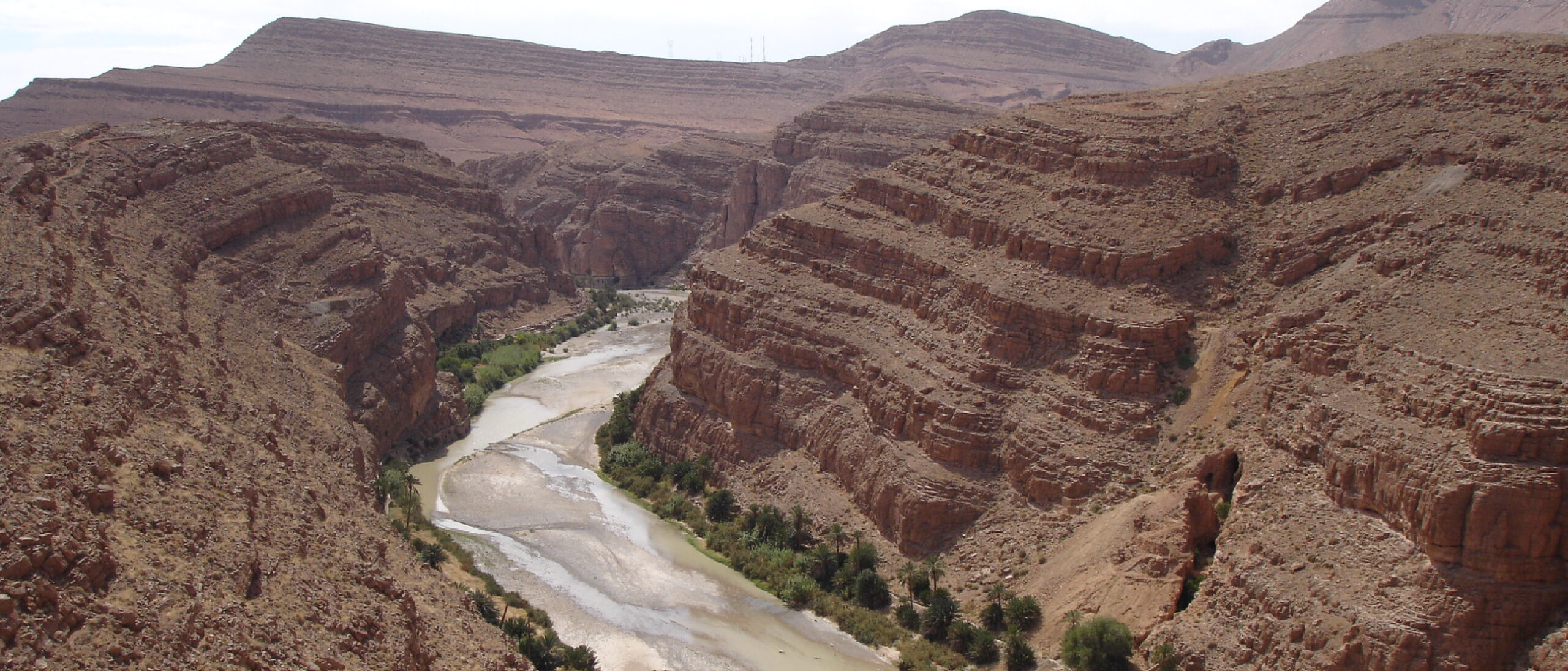
River incision through a thick, well-bedded Mesozoic red-bed succession in the Dadès - Errachidia region, High Atlas, southeastern Morocco. Differential erosion highlights resistant sandstone-rich beds and finer-grained recessive intervals. Photo: Salim Lahsini.
Matching global explorers with Morocco’s frontier potential
A conversation with Salim Lahsini, Head of Hydrocarbon Assets Promotion at the National Office of Hydrocarbons and Mines (ONHYM), and nominee for the Africa Oil Week 2026 Exploration Award

Morocco’s Atlantic margin offers a combination of proven petroleum systems and large areas that remain underexplored. The country wants to translate this diversity into clear, investable exploration opportunities. This requires more than technical datasets and conference presentations; it demands a careful alignment between what the subsurface offers and what individual companies are genuinely equipped and motivated to pursue. This is the skill Salim Lahsini, Head of Hydrocarbon Assets Promotion at ONHYM, has refined over nearly two decades in the industry.
Lahsini’s career spans exploration geology, basin evaluation, upstream strategy and international investment promotion. This breadth allows him to move easily between scientific detail and strategic dialogue, a talent essential to his current role. His work begins long before any meeting with an investor. He studies company portfolios, technical capabilities, regional strategies and appetite for exploration risk, building a clear picture of which opportunities in Morocco align with which explorers. “My role is to bring the right company to that stage, connect it with the appropriate ONHYM specialists, facilitate access to authorised information and maintain continuity between the initial contact and the next decision point,” Lahsini explains.
In Morocco’s northern offshore, for example, complex salt provinces and nappe-related structures create opportunities for companies skilled in salt tectonics and advanced seismic imaging. The region’s structural complexity, combined with discoveries such as Anchois, appeals to explorers who specialise in settings where subtle traps and mobile salt demand sophisticated interpretation.
Farther south, the margin evolves into a domain shaped by Jurassic carbonate platforms, Early Cretaceous uplift and deepwater turbidite systems. Extensive seismic coverage, both 2D and 3D, provides a strong foundation for evaluating these plays. Companies with experience in carbonate reservoirs or basin floor fans often find strong alignment here. The potential scale of stratigraphic traps and deepwater systems attracts explorers comfortable with frontier drilling and long-cycle exploration strategies.
Perhaps the true frontier opportunity lies even farther offshore, where long-offset seismic has provided indications of mature Jurassic source rocks extending over oceanic crust. This emerging play type, supported by analogues from Namibia, core data from the Deep Sea Drilling Project and thermal maturity modelling, suggests that Morocco may host a deepwater petroleum system capable of generating hydrocarbons. “ONHYM has started presenting the oceanic-crust concept selectively to technically relevant explorers while the play remains under evaluation. We may bring it up in discussions with companies that have ultra-deepwater and conjugate-margin expertise,” details Lahsini.
Investment decisions ultimately depend on whether technical teams believe in the subsurface story
Once a company’s interest deepens, Lahsini ensures that the technical dialogue is rigorous and transparent. He works closely with ONHYM’s exploration teams to present opportunities accurately, including the evidence, the uncertainties and the risks that still need to be assessed. He recalls a meeting where a promotional discussion quickly transformed into a technical debate. Maps were opened, seismic lines examined, and the conversation shifted from fiscal terms to source-rock maturity, migration pathways and alternative play concepts. “It became a genuine technical exchange between geoscientists trying to understand the same basin from different perspectives,” Lahsini recounts. “Moments like this capture the true nature of exploration promotion, investment decisions ultimately depend on whether technical teams believe in the subsurface story.”
Salim Lahsini’s work demonstrates that successful exploration promotion is not about broad messaging, but about precision: Understanding the subsurface, understanding the investor, and bringing the two together in such a way that a new petroleum province can emerge.