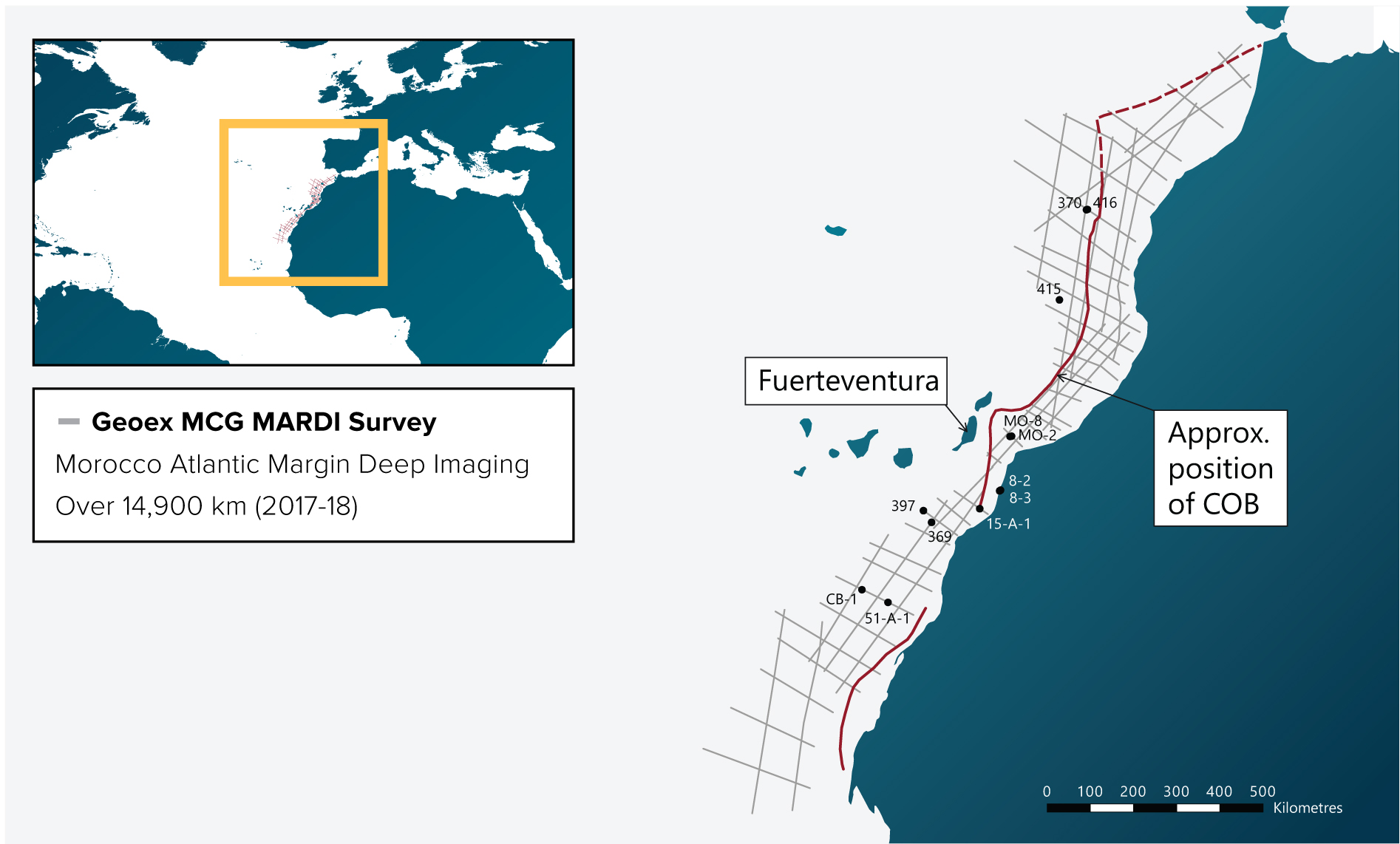
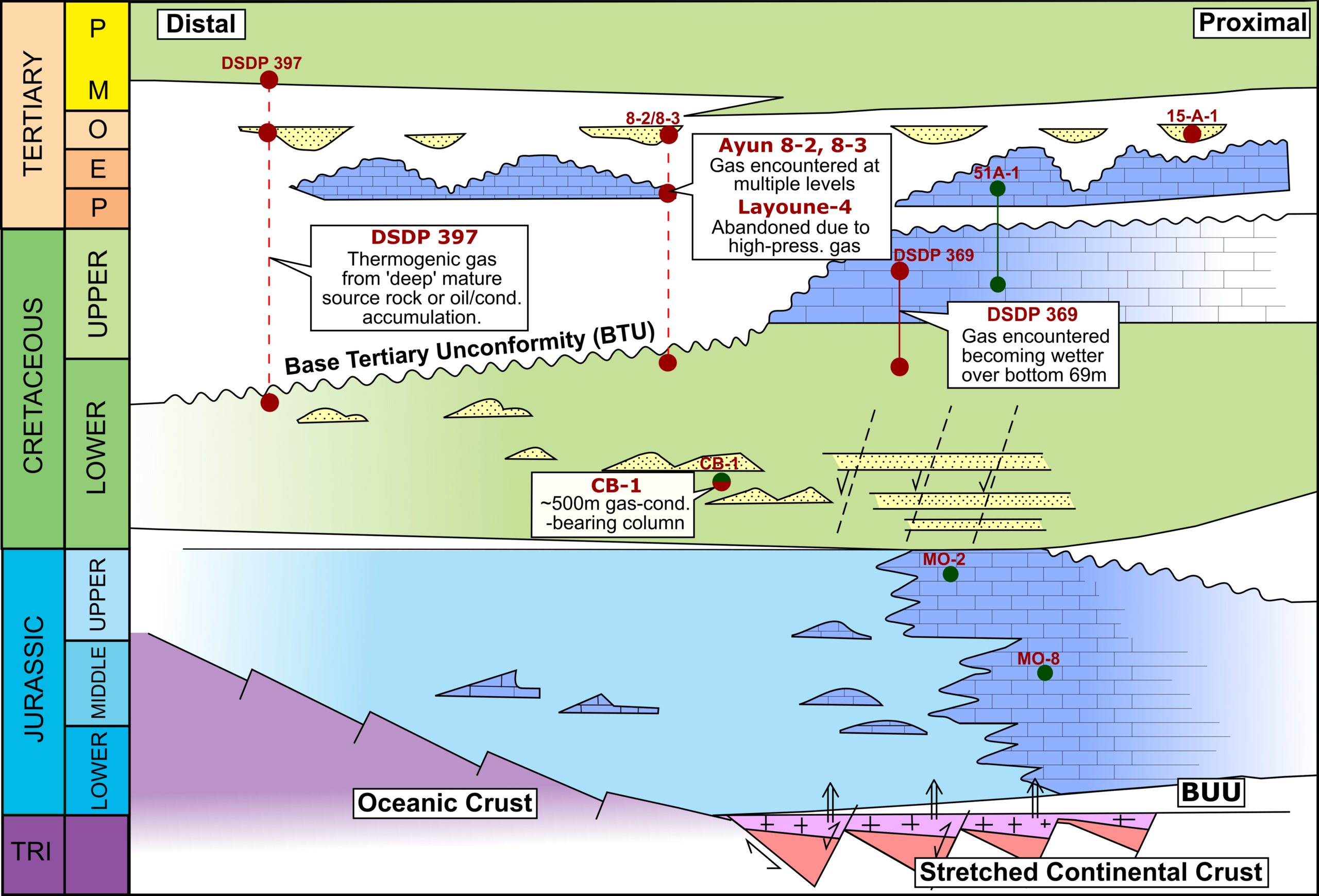
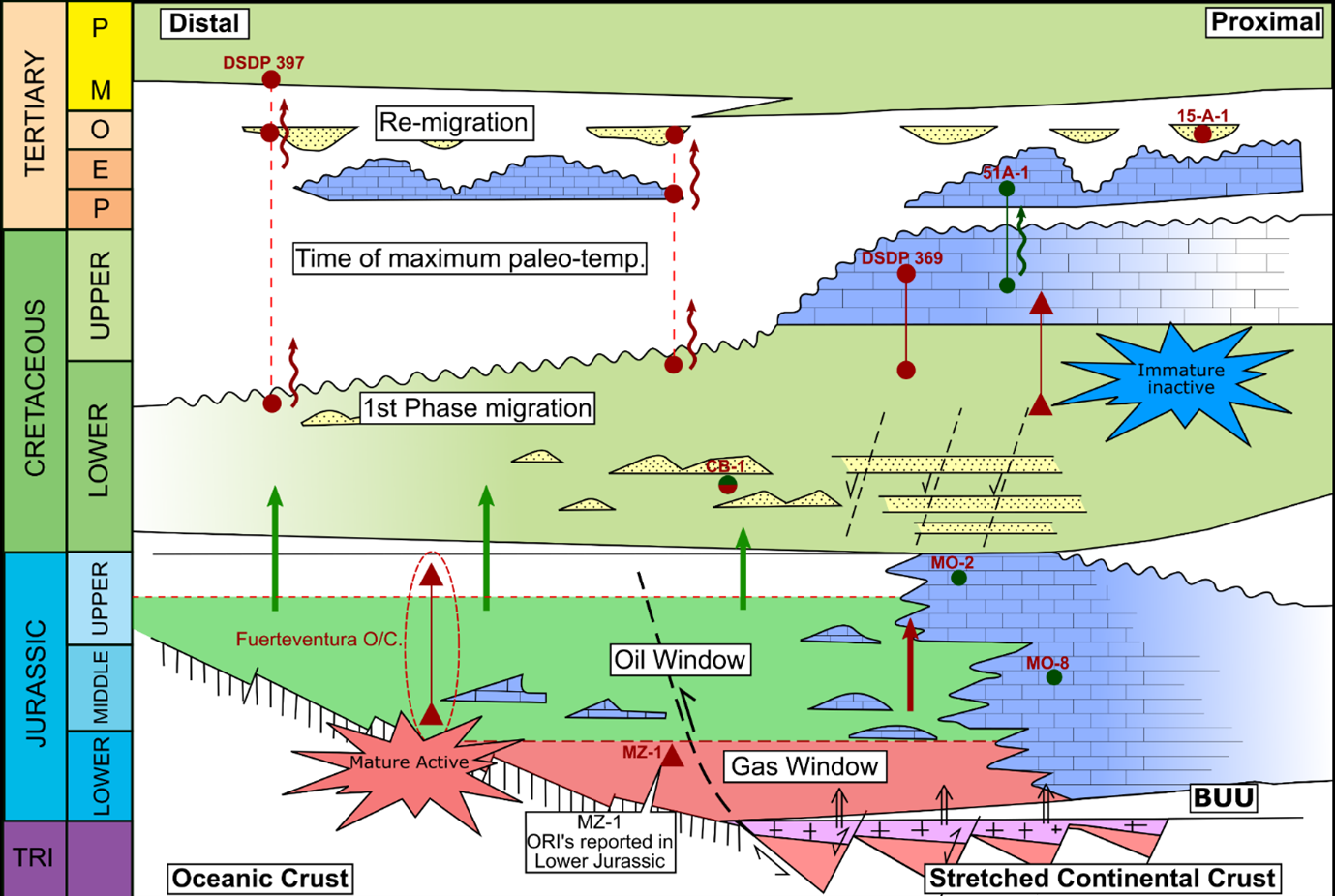
Modern Super-Regional profiles observing an entire margin are often difficult to procure as the emphasis in seismic acquisition is becoming increasingly focused on smaller-scale high-definition 3D volumes. In margins where the expected success has not yet been realised, these large regional profiles can be particularly insightful. They offer new perspectives on petroleum system–controlling features that have an impact at scales far larger than can be resolved when examining a more localized, prospect specific, 3D. Geoex MCG’s regional 2D seismic survey offshore Morocco provides an opportunity to conduct such an analysis (Figure 1). Despite numerous wells in the proximal domain of the margin, the distal portion of the Morocco offshore, more specifically on oceanic crust, remains significantly underexplored. This regional long offset 2D provides significant insights into key locations for further exploration invoking an untested petroleum system that has been demonstrably active. Unequivocally, source rocks can generate significant quantities of hydrocarbons atop oceanic crust and therefore conventional thinking of where to explore for oil and gas has been challenged in recent years with numerous global locations now viable candidates for exploration. Prior to the discoveries in Namibia, the concept of mature source rocks on oceanic crust was often met with a degree of scepticism. Since these discoveries, there has been a willingness to explore deeper offshore with upside being provided by larger potential discoveries. As such the next Namibia “self-similar” prospect is being chased across the West African margin with evidence of working petroleum systems on oceanic crust being evaluated. One such location that provides this evidence in deeper waters, whilst still being frontier, is Morocco. Using Geoex MCG’s Morocco Atlantic Regional Deep Imaging (MARDI) survey, a better understanding of the location of potential oceanic crust source rocks (OCSR) is afforded. This data can also be used to help determine potential thermal maturity from the plethora of wells tied by the data. Thermal maturity understanding is furthered by the seismic profiles geographical location. Traversing the Continental to Oceanic Crust Boundary (COB), analysis of the crustal types present in Morocco, given its long-offset nature, can subsequently lead to the identification, generation and evaluation of leads and prospects associated with the deeper offshore section of the margin. Exploration in Morocco has seen a series of wells drilled on continental / transitional crust with a Cretaceous source rock perceived as the most likely candidate to charge reservoirs sufficiently. Unfortunately, despite numerous promising results, namely Spansah 51-A-1, CB-1, Alisio 15-1 and MO-2/-8 etc., commercial quantities have yet to be discovered. Therefore, a new perception of the petroleum system is required to fulfil the evident potential. This article illustrates that this innovation takes the form of investigating deeper into the stratigraphy onto oceanic crust towards significantly underexplored territory. To prove that OCSR’s exist in the offshore demonstratable proof is required. In the offshore realm of Morocco, DSDP 397 provides unique insight into this potential. This corehole encountered thermogenic gas whilst drilling, providing a strong indication that source rocks in the offshore have a good level of maturity. As is well-established; to generate thermogenic gas, organic rich source rocks are required to be within a temperature window of ~120-200 degrees. This exists offshore Morocco providing significant evidence of a deeper source rock. Additionally, the MZ-1 well, drilled in 2015, is reported to have encountered Lower Jurassic organic rich mudstones in the lower sections. This further demonstrates the potential for a Jurassic petroleum system along the Moroccan margin. The understanding of encountered ORI’s are summarised in Figure 2. Evaluating how the required maturity was generated within the margin is a poignant ‘piece of the puzzle’ which requires a regional perspective. Geoex MCG’s MARDI dataset covers a total of approximately 15,000 km, tieing a total of 36 wells constituting both DSDP coreholes and industry wells. The regional nature of the survey is best demonstrated by large strike lines which, in some instances, are greater than 700 km along the north and south of Morocco. By interpreting this data, widescale regional tectonics can be evaluated providing insights of the tectonic setting. A poignant feature of the seismic is the unconformity marking the transition between the Cretaceous & Paleogene intervals, termed “the Base Tertiary Unconformity” (BTU). This interval can be mapped on a regional basis throughout the seismic data. The causation of this large unconformity is understood to mark the initial, and subsequent pulses of collision between Eurasia and Africa providing the necessary uplift on a regional scale to create a distinct feature on the regional data. Lack of recognition of a feature such as this could be possible when reviewing smaller, more localised 3D volumes which would subsequently result in a underestimation of maturity levels and the misinterpretation of the timings of optimum hydrocarbon expulsion, migration and charge in the deep basin. The proposed system is outlined in Figure 2. To fully understand the implications of this unconformity on the thermal maturity, AFTA (Apatite Fission Track Analysis) and VR (Vitrinite Reflectance) data was procured from DSDP coreholes above and below the unconformity. Following the results and re-working of the biostratigraphy, it became clear that the missing section was significant. In the DSDP coreholes, ~30Ma of missing section was observed and, in some locations, even greater time hiatuses were encountered measuring at ~100Ma. Furthermore, AFTA and VR results indicate that the intervals below the BTU were hotter in the past compared to present day when evaluated against a continuous geothermal gradient. This has positive implications for source rock maturity on oceanic crust offshore Morocco whereby the Jurassic system was active prior to the uplift and creation of the BTU. Geoex MCG then extrapolated the relevant temperature data to understand the locations whereby Jurassic source rock material may have developed on oceanic crust. One such area is shown in the respective foldout. Here type IV AVO responses, often considered to demonstrate the presence of source rocks, are present within the Jurassic. This is clearly on oceanic crust; highlighted by the presence of the COB, the cessation of the associated salt bodies and the rugose nature of the crust. With source rocks in the Jurassic somewhat established, further consideration regarding how these source rocks have positively contributed to the petroleum system is evaluated. Given the evidence presented in this article, particularly by DSDP 397, Tertiary reservoirs can only be charged by hydrocarbons re-migrating from deeper accumulations. This is evidenced in the form of DHI’s that indicate hydrocarbons are seeping across the BTU and charging Tertiary reservoirs where available (termed re-migration on Figure 3). Whilst the Cretaceous petroleum system in Morocco has been tested by several wells, there is yet to be a significant hydrocarbon discovery other than that of Chariot in the very north of Morocco. Most of the historical exploration has focused on the Cretaceous petroleum system following the provision of encouragement through technical success / shows in the basin. However, it is apparent that new innovative thinking is required to start exploring deeper into the basin, invoking a Jurassic source rock. To do this, large regional profiles provide excellent insight into the large-scale processes that are potentially missed when reviewing smaller 3D volumes. In Morocco, these regional profiles have provided excellent insight into the potential workings of the petroleum system over oceanic crust which remains significantly underexplored and requires further insights and drilling to evaluate the full potential. This reflects an excellent and unique opportunity for those operators wishing to delve deeper into the offshore with much of the southern acreage in Morocco currently open and more importantly, on oceanic crust.
Morocco’s oceanic crust – A new exploration paradigm
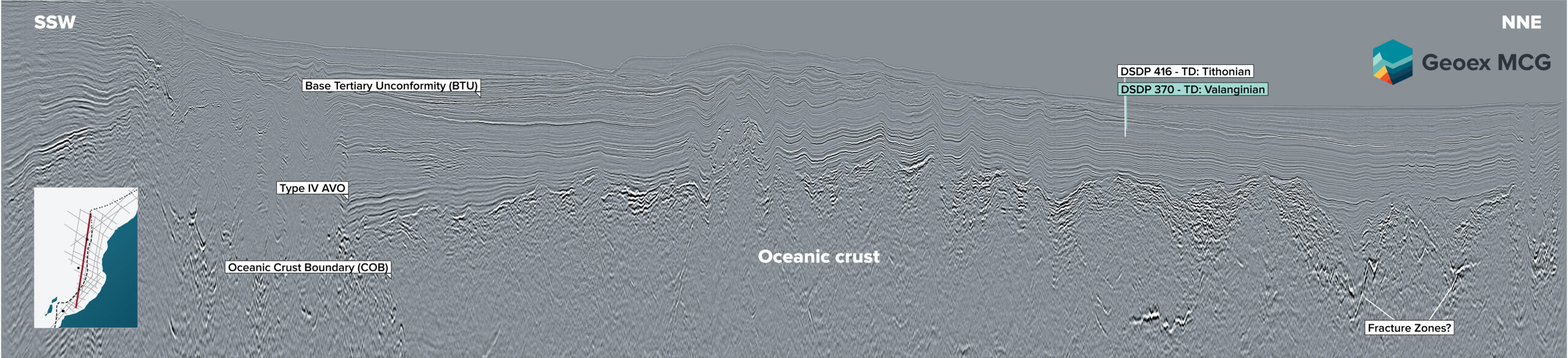 Figure 1: Regional profile in Morocco providing evidence of source rock maturity on oceanic crust.
Jurassic source rocks on oceanic crust – Establishing the new ‘hot’ topic offshore Morocco
Morocco providing an “in-vogue” frontier
The rocks rule the roost
Bigger picture exploration – implementing regional ideas for localised success
Pathway to the new frontier – he who dares, wins
Related Articles