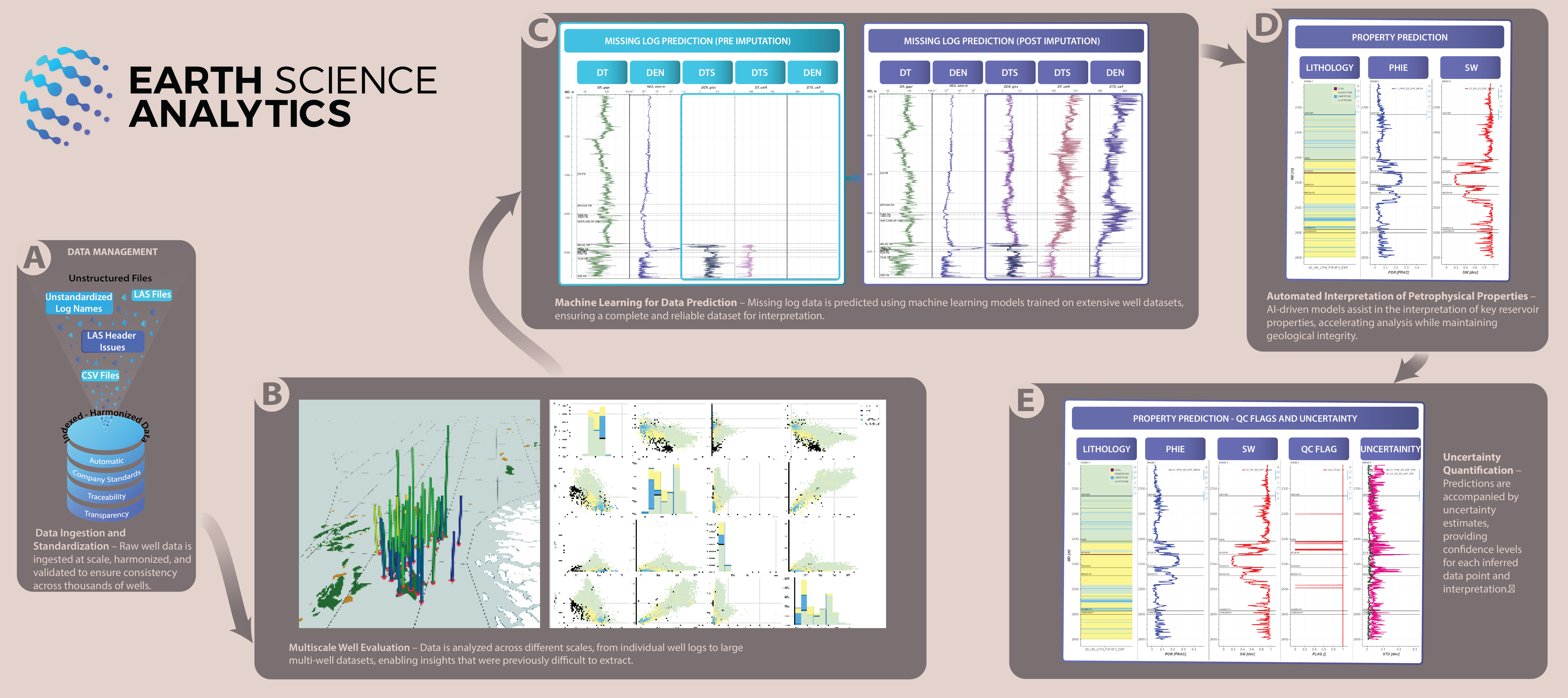
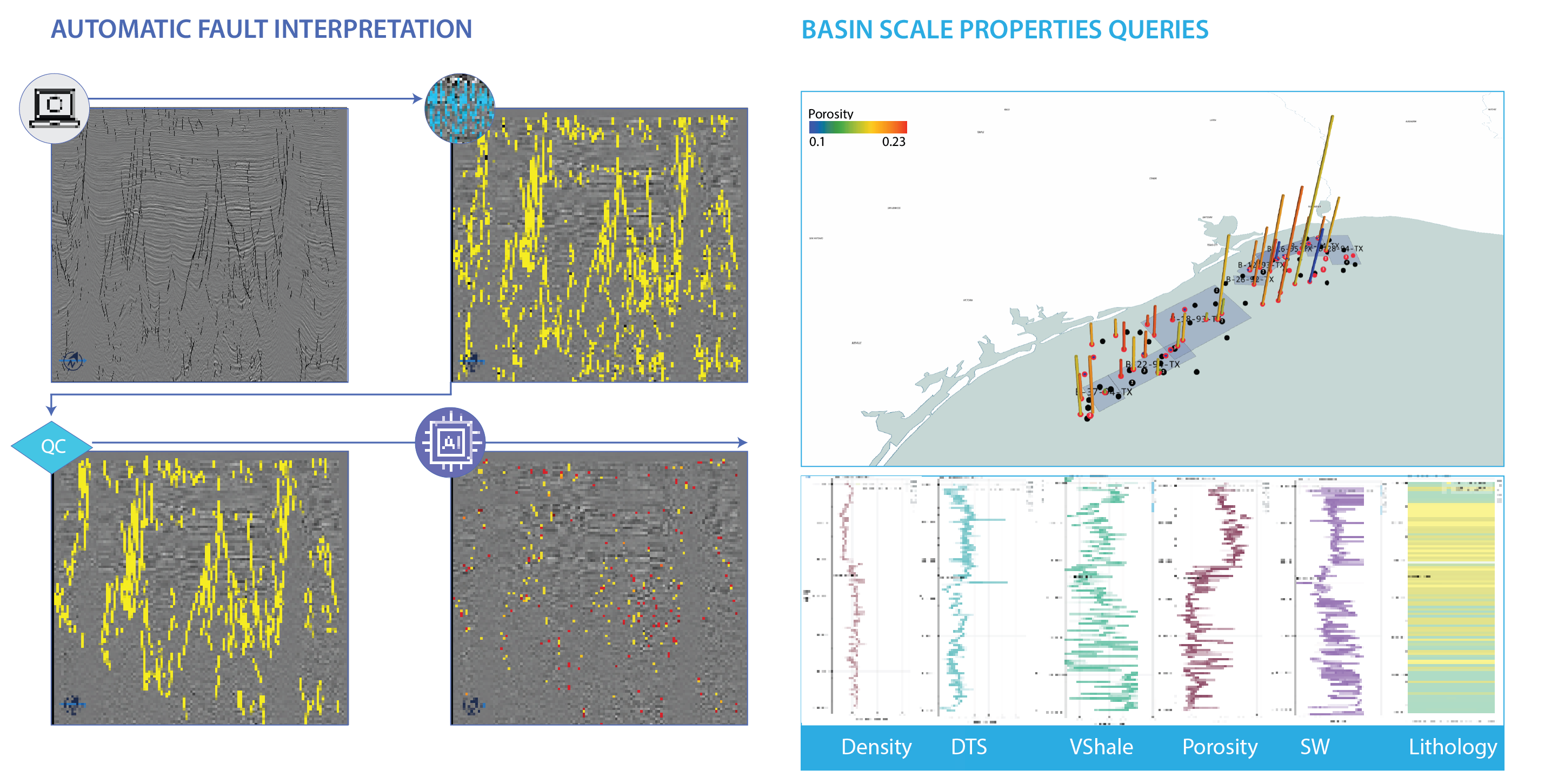
The Norwegian Continental Shelf (NCS) Big Data Well Conditioning project illustrates how AI-driven workflows transform subsurface analysis. As shown in Figures A through E, the process begins with large-scale data ingestion and harmonization (A), followed by ML- based enrichment using models trained across diverse geological settings (B and C). This enables prediction of missing logs and key properties like porosity and water saturation (D). Automated petrophysical analysis, including uncertainty quantification (E) ensures reliability for exploration and Carbon Capture and Storage (CCS) applications. Together, these workflows provide scalable, high-resolution insights that improve data quality, accelerate decision-making, and support strategic initiatives such as carbon storage and field development. The oil and gas industry is navigating a transformative era fueled by the convergence of geoscience, data science, and artificial intelligence. As the volume and complexity of subsurface data grow exponentially, traditional well data workflows – once rooted in manual QC and interpretation – are becoming insufficient. In response, new methodologies have emerged, leveraging modern data science to transform static, fragmented well datasets into dynamic digital resources. Two key efforts that exemplify this transformation are the “Go Digital for Wells” initiative, using EarthNET, and the Earth Science Analytics large-scale Big Data Well Conditioning project on the NCS. The NCS Big Data Well Conditioning project is a living example of this workflow in practice, incorporating over 2,000 wells and 30,000 km of log data, and has produced a unified and consistent dataset for the region. ML models were trained to impute missing logs, resulting in a 5-fold increase in log coverage and enabling downstream prediction of porosity, lithology, and water saturation across the dataset. Both workflows begin with a foundational data management phase. In the NCS study, logs, core data, lithology descriptions, and metadata were aggregated from diverse sources and merged into a centralized digital data lake. A harmonization process compared overlapping data from different channels, flagged inconsistencies, and resolved discrepancies to produce a high-quality baseline. The ML pipeline uses the curated, high-diversity datasets to train algorithms – including Random Forest, Light GBM, and XGBoost. In the NCS project, more than 350 models were trained across four geological provinces. These models predicted missing logs (e.g., density, sonic, shear sonic) and derived properties, such as lithology, porosity (PHIE), and water saturation (SW). Cross-validation and blind testing ensured model robustness, and output logs were ranked with priority flags to guide usage based on prediction quality. These workflows emphasize automation without compromising geological context. In “GoDigital for Wells,” petrophysical properties are interpreted with AI support, reducing manual workload while maintaining consistency. The NCS project extended this automation to include adaptable pay analytics: Users can apply custom porosity and water saturation cutoffs to evaluate reservoir quality, calculate net pay, and generate maps of prospectivity. Every prediction is accompanied by uncertainty estimates, enabling probabilistic analysis. This feature allows users to make informed decisions with transparency on data reliability – crucial for exploration, development, and CCS site evaluation. In the NCS caliper-based QC process flags ‘bad hole’ conditions, further enhancing prediction confidence. The outcomes of these workflows are both quantitative and strategic: In the NCS project, the coverage of shear sonic logs increased 5-fold, and interpreted reservoir properties expanded significantly (Figures 3 and 4). Exploration teams can now identify previously overlooked pay zones using ML-enriched data (Figures 4 and 5). Field development geoscientists and engineers leverage high-resolution petrophysical models for depth conversion and uncertainty assessment. This process also adds significant value to CCS screening by leveraging the consistent, high-quality datasets to assess rock properties and injectivity. Earth Science Analytics exemplifies this approach with a comprehensive evaluation of CCUS capacity and risk in Gulf of Mexico. Integrating seismic data from Geoex MCG, 4,000 wells, and ML-predicted reservoir properties enables data-driven site assessments and informed decisions for offshore carbon storage (Figure 6). Although these workflows were originally designed for oil and gas development, they are proving crucial in the evolving energy landscape. In CCS applications, consistent and enriched well data support site characterization, reservoir modelling, and injectivity prediction. The same tools are adaptable to geothermal energy, unconventional resources, and basin-scale modelling. The NCS data set, now enriched through ML, provides a robust foundation for subsurface analysis across multiple use cases. CCS project offers a real-world example of how digital transformation can directly contribute to climate solutions by enabling data-driven carbon storage evaluation. The digital revolution in well data is not a future possibility—it is a current reality. By embracing AI-driven workflows such as “Go Digital for Wells”, the industry is unlocking new efficiencies, insights, and opportunities. These approaches demonstrate that when traditional geoscience expertise is combined with advanced data science, the result is a smarter, faster, and more confident path to understanding the subsurface. In an era where decisions must be made quickly, confidently, and with long-term sustainability in mind, intelligent, well-designed data workflows are no longer optional—they are essential.
Liberating well data with modern data science and AI
AI-driven well data revolution: Unifying traditional expertise with modern data science
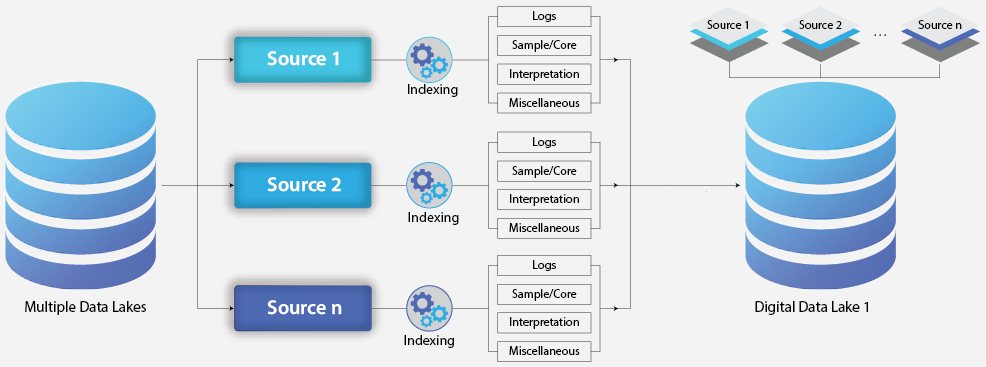
Integrated workflow: From data to insight (Figure A)
Multiscale well evaluation and machine learning for data enrichment (Figure B and C)
Automated interpretation of petrophysical properties (Figure D)
Uncertainty quantification and quality assurance (Figure E)
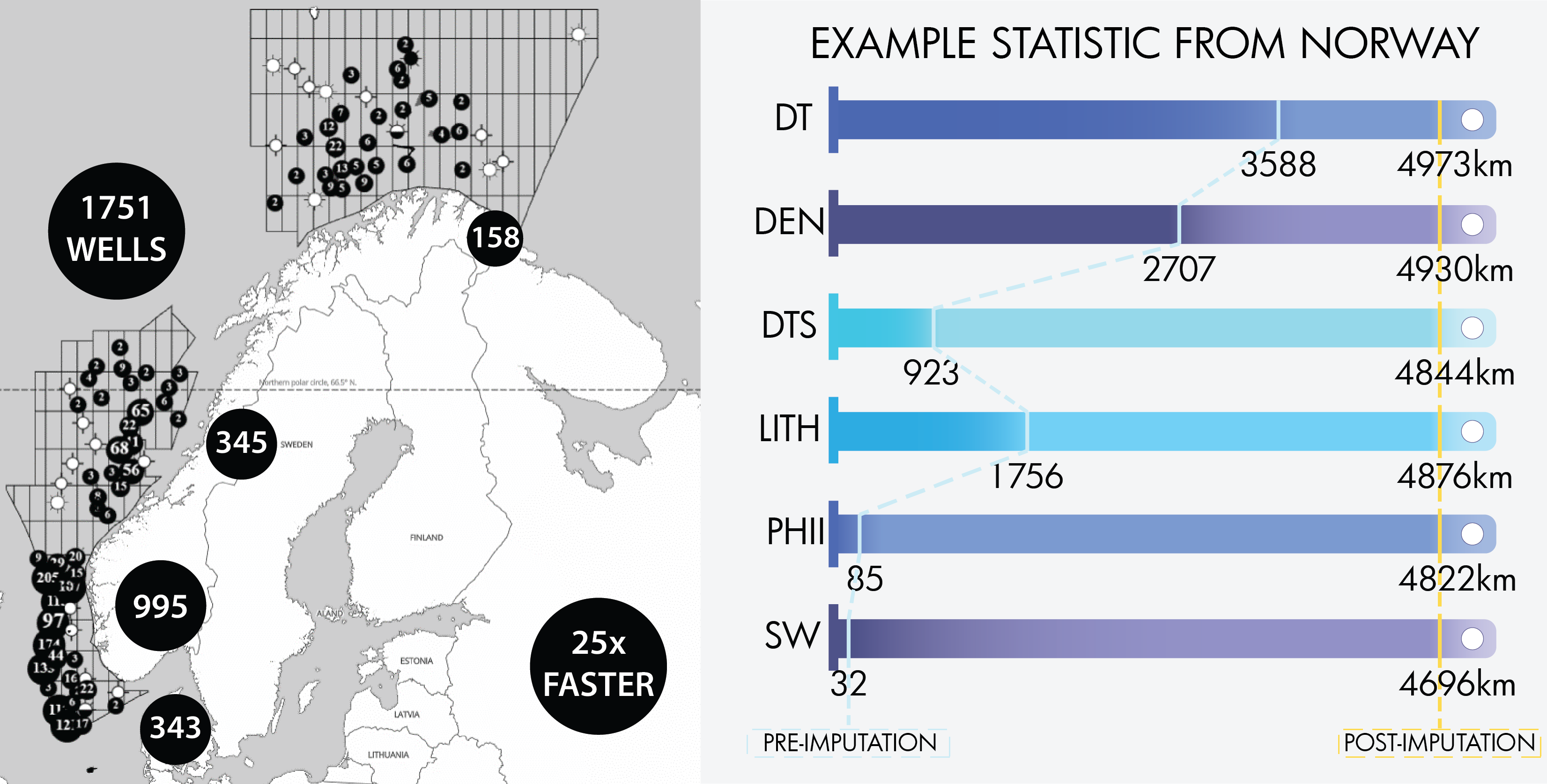
Real-world applications and results
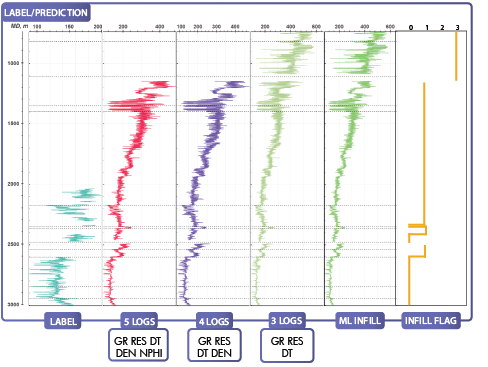
Transformational benefits across the energy sector
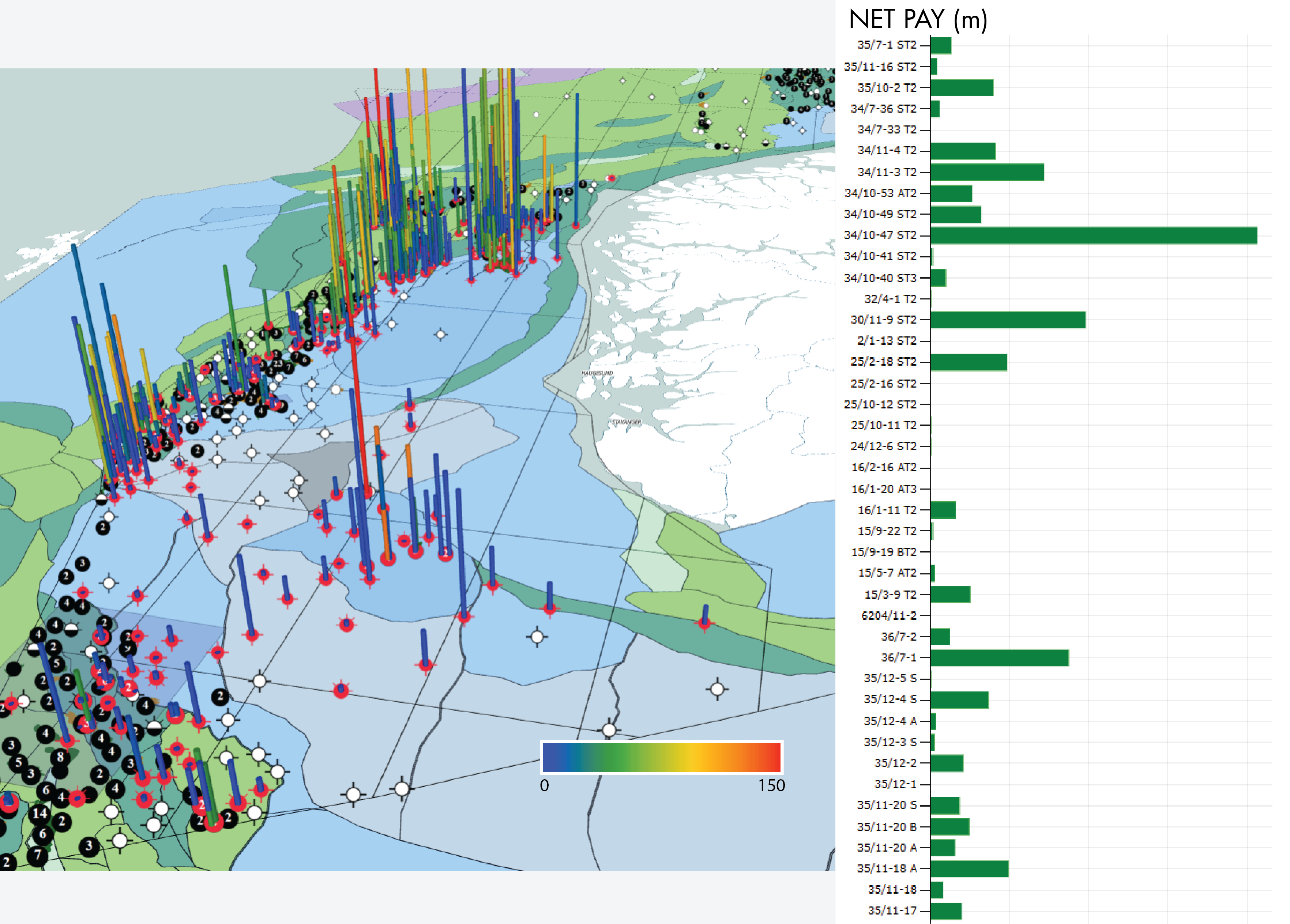
Paving the way for the energy transition
Conclusion
Related Articles