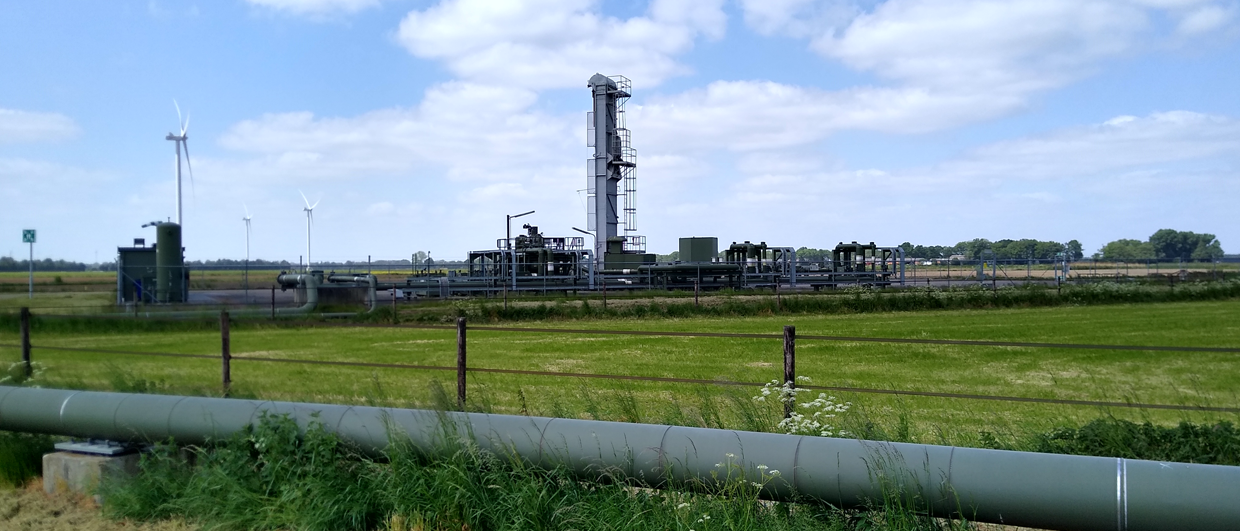
A Schoonebeek production facility and pipeline. Photo: Henk Kombrink
One of Europe’s largest onshore oil fields has restarted production
The Schoonebeek oilfield in the Netherlands was shut in for more than four years due to produced water injection issues. This has now been resolved

Many people will know the Groningen gas field, the discovery of which triggered offshore exploration in the wider North Sea in the 1960’s. It is also well-known that the Groningen gas field was permanently shut in a few years ago, following decades of induced seismic events. But a little further south from Groningen is the Schoonebeek oil field, which ranks amongst the largest oil fields onshore Europe. As is the case with Groningen, Schoonebeek did not produce hydrocarbons for the last few years too, but last month, oil production was restarted from the Lower Cretaceous Bentheim sandstone reservoir.
Operator NAM had to suspend operations in 2021 due to production water issues. As the heavy oil from Schoonebeek comes with a high water-cut of around 90% or higher, the separated water was re-injected in three abandoned gas fields in the Twente area south of Schoonebeek, using an existing 70 km long pipeline to transport the fluids. However, this led to microbially-induced corrosion and the risk of leakage. This was subsequently remediated through the fitting of flexible pipes into the existing pipelines, ensuring minimal disruption and allowing quick resumption of operations.
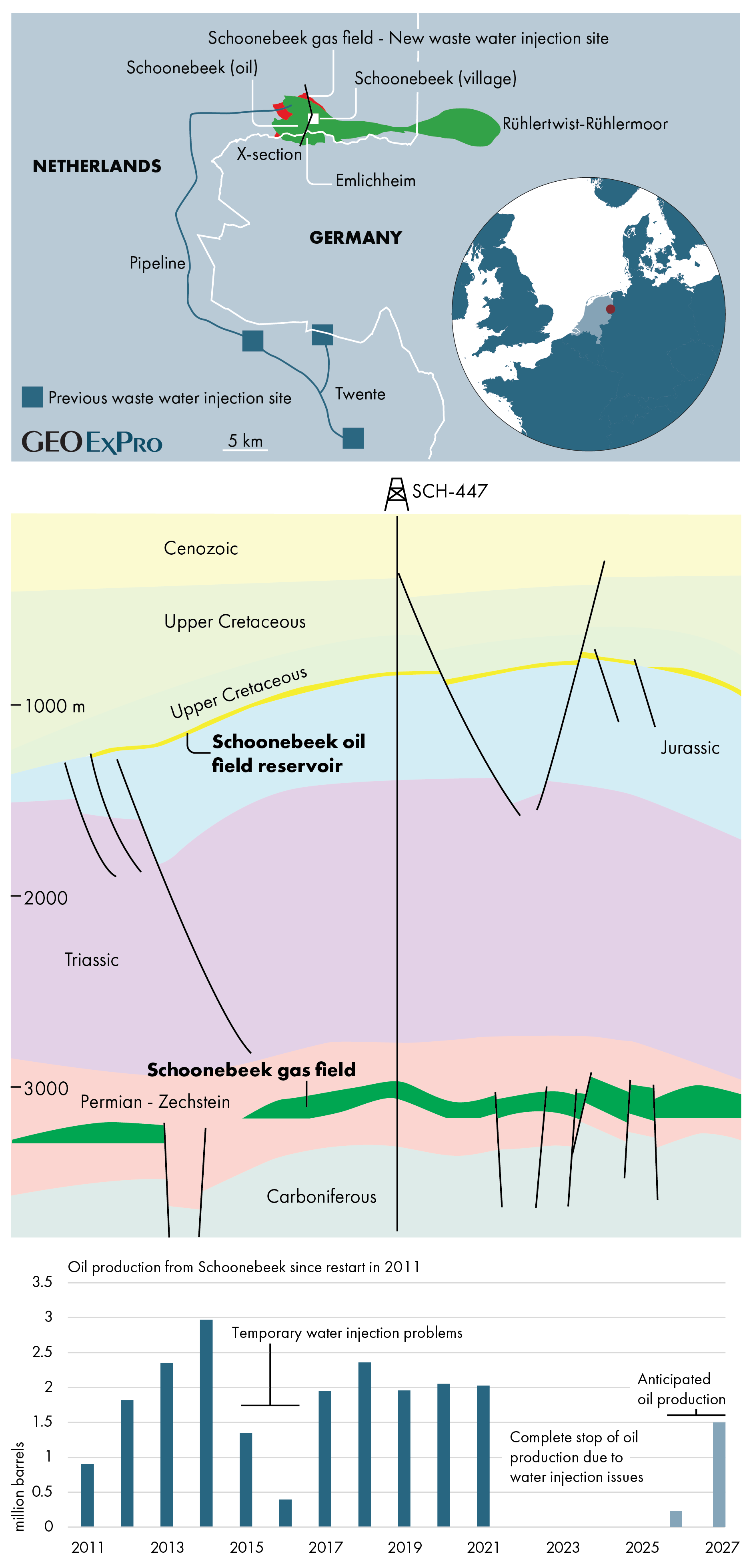
However, a downhole rupture in the outer casing wall of one of the Twente injection wells was subsequently found. Even though it did not lead to fluid leakage, NAM was accused of not picking this up in a timely manner. This triggered an outcry of public anger in the Twente area, which ultimately led NAM to stop water injection in August 2021. This also meant that the production of oil from the Dutch part of this major oil field came to a stop. In the German part of the field (Emlichheim), where a more conventional way of production using nodding donkeys take place, production has continued all the while.
But a solution has now been found, and this solution does not require a long route of water transport anymore. The produced water is injected into the Permian Zechstein gas reservoir beneath the Cretaceous reservoir from which the oil is being produced. It makes you wonder why that solution wasn’t selected straight away. And while water injection into the gas field is taking place, a limited amount of gas production will continue (0.9 Bcf/year), possibly aided by the increased water injection from the oil field above.
The Schoonebeek field is one of the largest European onshore fields, with an initial in-place oil volume exceeding 1 billion barrels. The largest part of the field is situated in the Netherlands, but it extends into Germany where the field is known as Emlichheim. As often happens when a prospective basin starts to be explored, the biggest fields are found first. That also applies to Schoonebeek, which was discovered during the Second World War in 1944 with the help of a gravity survey.
Conventional oil production from the relatively shallow reservoir (700-800 m) ceased in the Dutch part of the field in 1996. NAM restarted Schoonebeek in 2011, following an extensive drilling campaign that also saw the arrival of steam-assisted drainage.