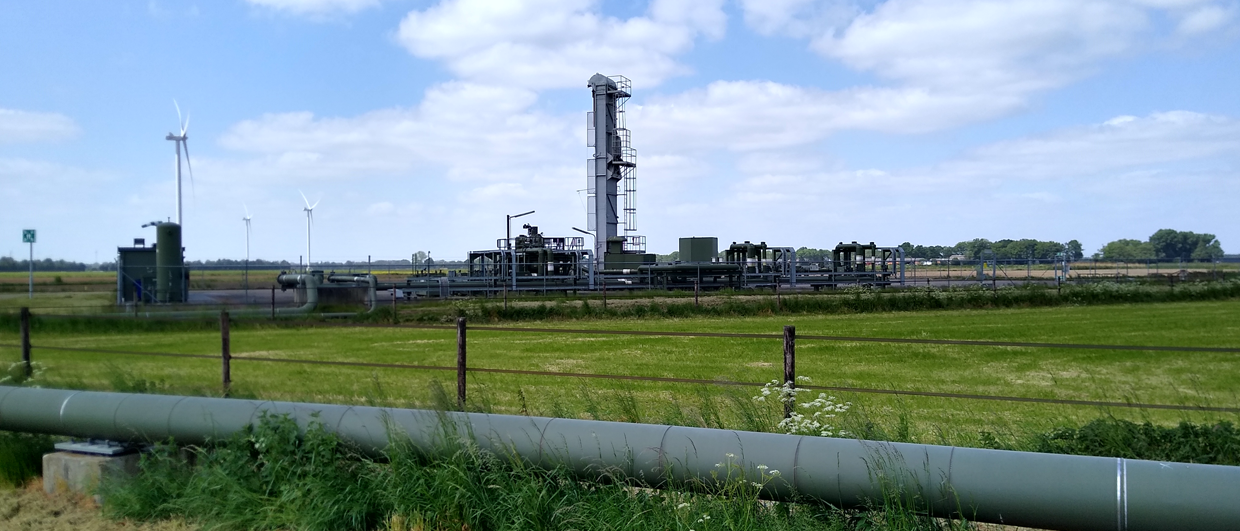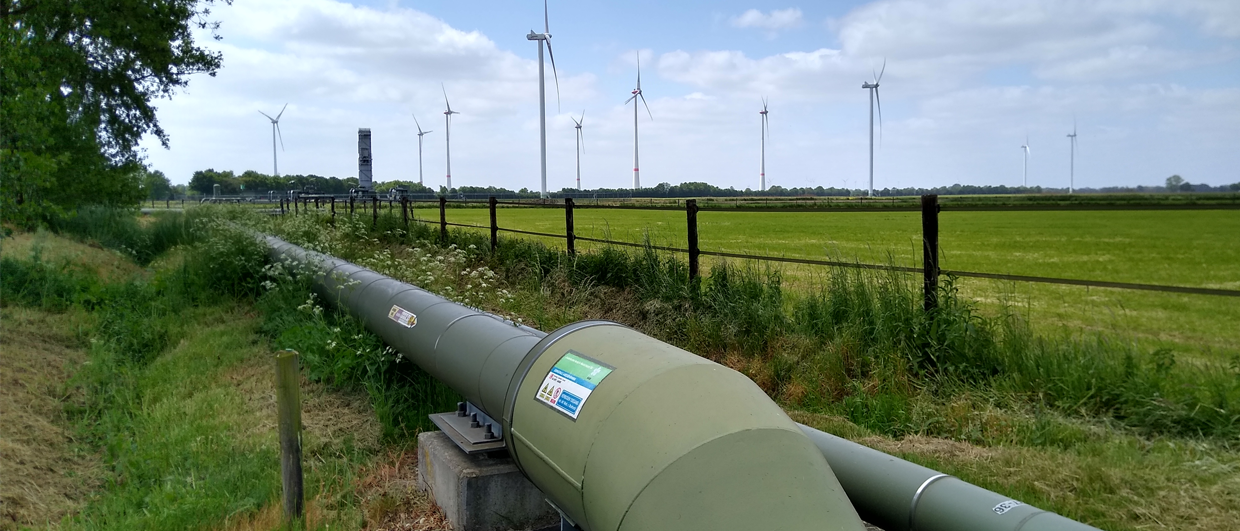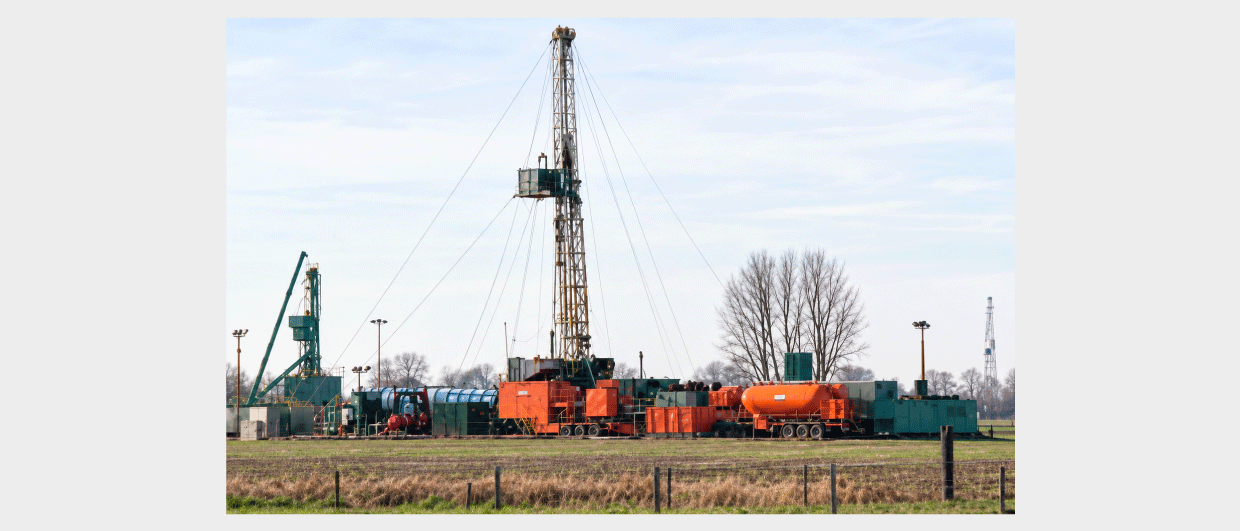
The Schoonebeek Field during abandonment in 1996. The drilling rigs from the German part of the field, which continued in operation, can be seen in the background. Photo: Shell, (improved quality by Chat GPT).
Time to redevelop an abandoned European oilfield?
Souring oil prices have inspired NAM to consider redeveloping one of Europe’s largest oil fields. A 3D high resolution seismic survey will lower the structural uncertainties and horizontal drilling, in combination with new recovery procedures,means that the abandoned Schoonebeek Field could yield a further 100 million barrels of oil.

“High costs and low oil prices resulted in the closure of the Schoonebeek Field in 1996″, says Michiel van Dongen, senior seismologist for the project. “NAM has been evaluating the opportunity to redevelop the field for the past three years, and we now feel that with the new recovery techniques available to us, plus a totally different oil price scenario, this field still has plenty of potential.”
The Schoonebeek Field was discovered in 1943, and more than 250 million barrels of oil had been produced before the field was shut in ten years ago. Enhanced seismic techniques can help to clearly picture the structure of the field. Nederlandse Aardolie Maatschappij (NAM) is therefore keen to restart production. Using advanced recovery procedures they are hoping that Schoonebeek could yield a further 100 million barrels of oil.
50 years of operation
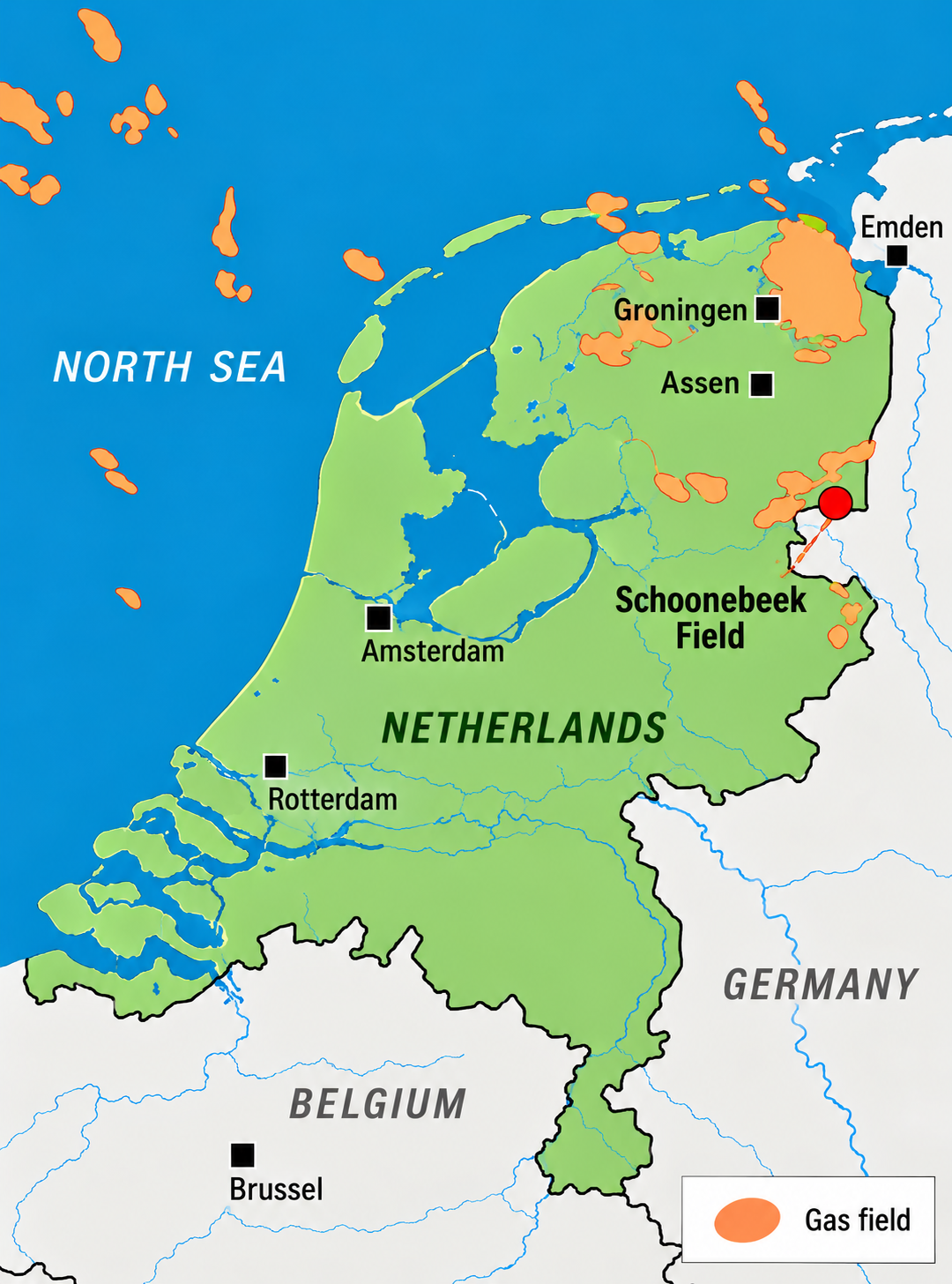
The Schoonebeek oil field lies in the eastern Netherlands, close to the border with Germany, about 12 km south of the city of Emmen. The field extends across the border into Germany where it is known as the Ruhlertwist and Emlichheim fields. The amount of oil initially in place (STOIIP) was estimated to be in excess of 1 billion barrels, making it one of Europe’s largest oilfields.
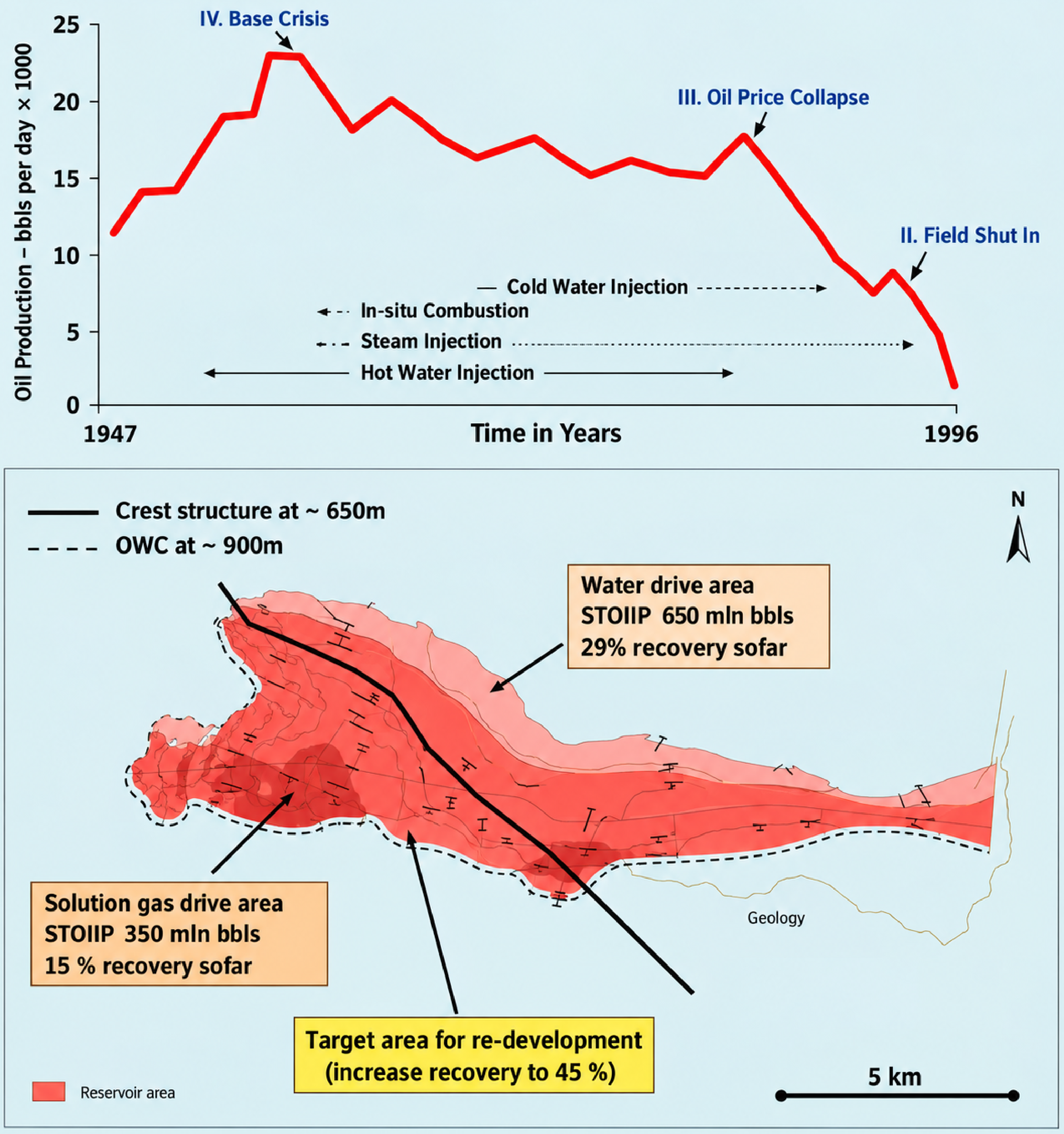
Production started in 1947, and eventually nearly 600 wells were drilled from 300 locations. The oil is heavy, with an API in the region of 25°, and over the years many different oil recovery techniques were used and tested in the field, including cold and hot water injection, wellbore heating, steam injection and in-situ combustion.
Production peaked at 24,000 bopd in 1954 and slowly declined over the years, until the field was finally shut-in in 1996. By then, about 250 million barrels of oil had been produced from the Schoonebeek Field, only about 25% of the estimated oil in place.
Why was Schoonebeek abandoned …?
As Michiel van Dongen says, “Abandonment was not an easy decision, especially since operations continued, and still continue, across the border in Germany. The abandonment of the field in 1996 was justified on economic grounds, based on the techniques and infrastructure available at the time. Essentially, the field was abandoned because operating costs were high and, as you will remember, oil prices in the early 1990s were very low, between $11 and $18 a barrel.”
“In addition, there were some significant economic factors relevant to the field itself. Recycling water was adding between $1 and $3 per barrel to the operating costs, a factor which we have removed in our present plans for the field, as we intend injecting 100% of the produced water into depleted gas fields.”
… and why redevelop now?
“Although it is only ten years since the field was shut-in, both technological and economical factors have changed and advanced a great deal,” says Michiel. “The idea of reopening the field has always been attractive due to the large volumes of remaining resources, at least 750 million barrels. This, coupled with the high oil price and the present lower taxation levels, has made us seriously reanalyse the potential of Schoonebeek.”
New technologies which would be important for enhanced recovery include the combination of horizontal drilling and innovative high oil recovery techniques such as Gravity Assisted Steam Flooding (GASF). This is a new method of particular use in the production of heavy oils, such as those found in Schoonebeek. In a typical GASF scenario, a pair of horizontal wells is used, with steam being injected into a horizontal well located in between two horizontal producers. As steam enters the reservoir, it heats the reservoir fluids and surrounding rock. Hot oil and condensed water drain through the force of gravity to a production well at the bottom of the formation. A steam chamber grows around the injection well and helps displace heated oil toward the production well. Similar techniques are used when producing oil from the Canadian oil sands.
The Solution Gas Drive Area (SGDA) of the Schoonebeek Field has been targeted by NAM as the favoured area for initial redevelopment. This is due to a combination of factors, as Michiel explains.
“The lower recovery levels to date in the SGDA mean that we can aim for higher enhanced oil recovery (EOR) targets in our future plans. In addition, the weak aquifer support in the SGDA will result in less water influx and associated water handling problems. This will allow us to operate at lower reservoir pressures, a key requirement for the chosen recovery process of Gravity Assisted Steam Flooding (GASF). We estimate that in the Solution Gas Drive Area the estimated oil in place is 350 million barrels. Using these enhanced techniques we can increase recovery in the SGDA from 15% to 45%.”
Justifying new HiReS seismic
A number of 3D surveys had been undertaken to delineate the Schoonebeek area between 1984 and 1991,but these focussed on the deeper targets, down to 3,000m. Further reprocessing and merging of data was undertaken in the 1990s and some new 2D hi-res data was shot. Part of the discussion analysing the potential for reopening the field centred on the requirement and expense of acquiring further seismic, particularly 3D.
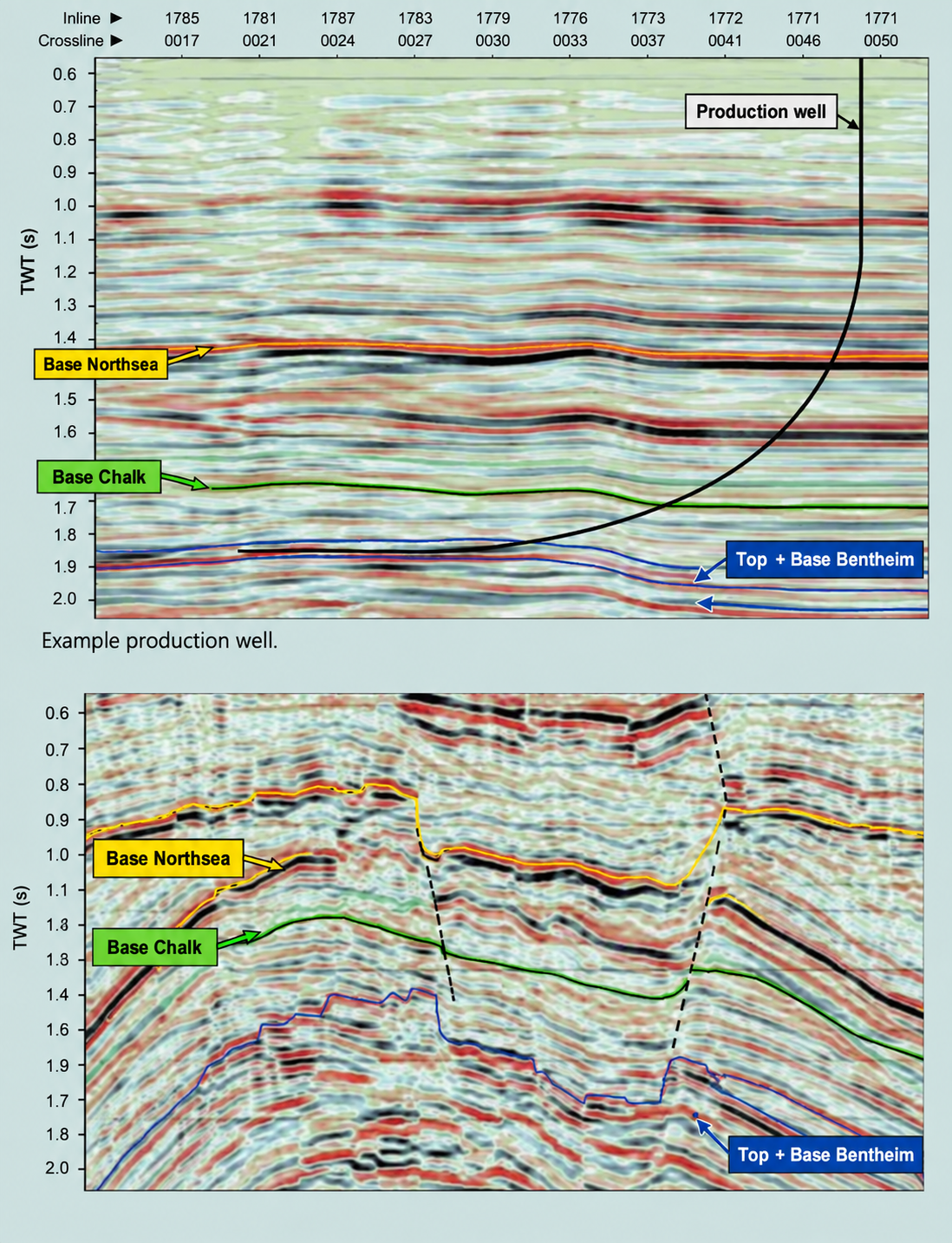
“1992 PosSTM data formed the basis for the Schoonebeek project,” explains Michiel. “As can be seen from the example here we felt that this seismic was not yielding the best results, with weak responses from the base of the Bentheim reflector and poor fault resolution. It was important, however, to be able to prove that the acquisition of further seismic could be economically viable”
“We therefore decided to undertake a VOI-exercise (Value of Information) to look at the impact of new 3D HiReS on the project economics, assuming that the fresh seismic will significantly reduce the structural uncertainties. VOI is a method to quantify the value of new seismic information that enables better decision-making and lowers investment risk. We would acquire more seismic if the added value of new 3D HiReS seismic could be shown to be greater than its acquisition and processing costs.”
“To quantify the value of 3D HiReS we need to determine the value of proper well placement. Proper well placement is key to the project, as the wells need to be positioned in the strike direction and preferably in the bottom third of the thin reservoir (15-30m in the redevelopment area). In addition, the wells should avoid any faults. We have to take into account structural uncertainties, which may result in the well being drilled off target, and we make the assumption that the improved resolution of the new seismic will halve the vertical uncertainties.”
“To determine the value of proper well placement we compared the project value for two cases, the first with the current seis mic, which we refer to as full uncertainty, and the second in which we assume that the new seismic will reduce the structural uncertainties by 50%. We then undertook uncertainty modelling in Petrel, by running 500 realisations. In each of these realisations, the planned wells are in a fixed position and the structures (top and base reservoir) vary in the vertical sense. The range of variation for the full case was twice that of the half uncertainty case. The realisations in fact comprised wells which were positioned off target, missing part of the reservoir section or positioned off-strike.”
Project values were then calculated on the basis of the total cumulative oil which could be expected to be produced in the respective cases (using 5 realisations). Further value was attached to additional development areas. With new seismic, areas with thinner reservoir and a more complex structure could potentially be included in the redevelopment.”
The result of the VOI studies suggested that it would be cost-effective to undertake further 3D HiReS seismic. “The value of the new seismic to the project was estimated to be more than US$12 million, split between improvement in well placement and the delineation of additional development are as,” explains Michiel. “The cost of the acquisition and processing of new seismic would only be US$7.2 million, proving the case for new seismic. The decision to acquire the new seismic was taken in the summer of 2005, with the acquisition taking place in the autumn. Currently processing of the data is underway, with the first data expected to be available for evaluation in the summer of this year.
Redevelopment to cost US$500 million
If the Schoonebeek redevelopment project goes ahead, it is expected that the total project duration will be more than 25 years and it will cost in excess of US$500 million. The aim is to recover approximately 100 million barrels of oil from the western part of the field, drilling as many as 70 injector and producer wells from about 20 different locations. These are planned to be about 150m apart and grouped in fault blocks and it is anticipated that they will have 200 500m horizontal sections.
“Using horizontal wells and GASF technologies should allow us a very good recovery level. We will enhance the project efficiency through the generation of steam and electricity on site and our plans for 100% water disposal in depleted gas fields will effectively lower costs.”
“NAM has been evaluating the opportunity to redevelop the Schoonebeek Field for the past 4 years. We expect to make a final investment decision in the course of 2007,” Michiel adds.
If NAM decide in favour of the redevelopment, then by 2009 oil should once again be flowing from one of Europe’s largest fields.
The Schoonebeek Field
The Schoonebeek field is extensive, measuring about 16 km from east to west and 4 to 5 km north to south, including the German part. It is one of Europe’s lar gest oilfields, with over 1 billion barrels of oil in place. The reservoir is found in the Lower Cretaceous Bentheim Sand at a depth of between 700 and 800m. In the proposed redevelopment area, the thick ness of the reservoir is between 15 and 30m, increasing towards the east, and it has a net to gross ratio of 0.98 and a porosity of 30%. It is sealed by the over lying Cretaceous Vlieland Shale and Upper Holland marl.
The trap is formed by a heavily faulted anticline with a crestal collapse graben. Michiel von Dongen explains the structure of this giant field. “As can be seen from the field outline map, the Schoonebeek Field is split into two non-communicating reservoirs by a major fault which runs northwest to southeast. To the east of this fault, the Main Water Drive Area (MWDA) is connected to a large high pressure aquifer which has contributed to early water breakthrough and water handling issues, but which has also increased oil recovery. In this area, in fact, we have achieved recovery of about 30% reserves in place.”
“To the west of this fault, however, the Solution Gas Drive Area (SGDA) has experienced very little aquifer influx and this part of the field has much lower recovery levels, at about 15% of STOIIP.”
The extension of the Main Water Drive Area into Germany is the Ruhlertwist Field, which is operated by Preussag Energy, while the southern extension of the Solution Gas Drive Area into Germany is called the Emlichheim Field and is operated by Wintershall.