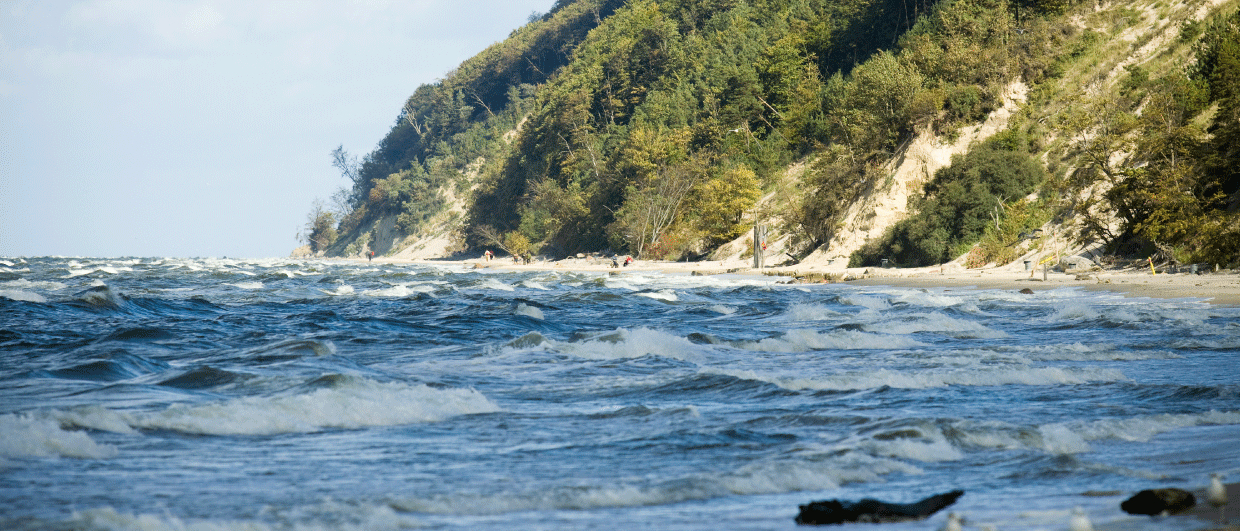
Baltic Sea, Poland, Wolin - coast. Photo bzyxx via Adobe Stock.
Finding oil when everyone expects gas
When CEP drilled the Wolin East 1 exploration well in Polish shallow waters last year, the company was certain it would hit gas. Until the data were analysed

“It took us a while before we could accept that we found oil,” says chairman Peter Putnam when we get to talk about the discovery his company Central European Petroleum (CEP) made in 2025. And there is a reason why the company, which only consisted of three full-time staff members at the time the well was drilled, thought it would be a gas discovery.
Just to the west, across the border in Germany, a few wells were drilled in the 1980s. These wells targeted the same Upper Permian Zechstein trend as the Wolin East 1 well did, and all of those found gas. “So it made a lot of sense to think that we would find gas too,” says Peter.
It took us a while before we could accept that we found oil
But the mud logs, fluid and pressure data were surely conclusive. “We are dealing with oil, and potentially quite a lot of it,” Peter explains. Estimates of recoverable hydrocarbons range between 200 and 400 MMboe. The gas field in the German part must therefore represent a separate compartment relative to the oil field,” says Peter, “the pressures have shown that’s the case.” So how does this work?
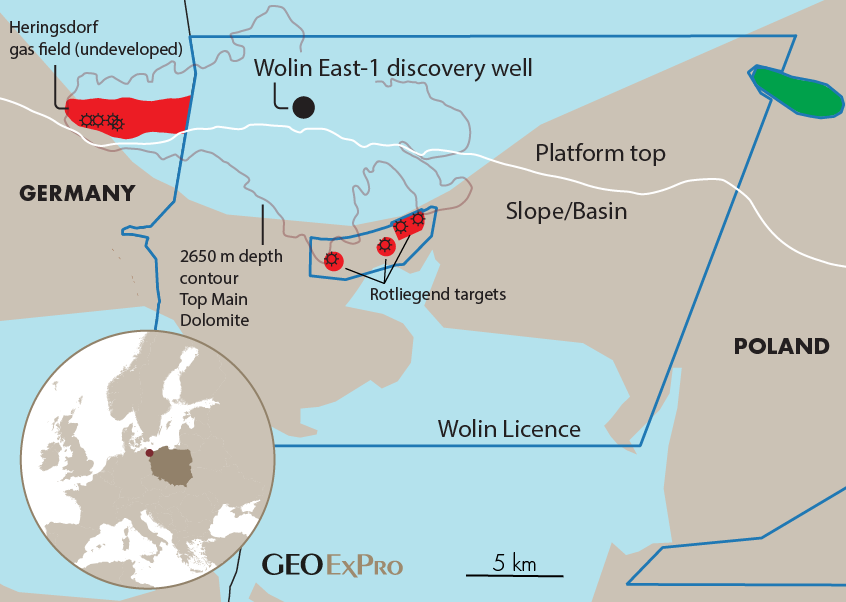
A geological explanation
“Older geological maps already show this,” he says. “There is a set of north-south running faults that dissect the area. On seismic data, it is not very obvious if these faults make it into the Permian reservoir succession, so we did not have clarity on that predrill. But now, post-drill, we can conclude that the faults are likely to have compartmentalised the field into at least the gas-bearing German part – which is known as the Heringsdorf field – and an oil compartment that we drilled.”
Preparing for appraisal
The company is now preparing for an appraisal campaign to further test the discovery, with spudding of the well taking place very soon. The well is located fairly close to where the 2025 hole was drilled. “The main aim is to perform a production test in the Zechstein oil column, investigating if there are more oil resources by drilling slightly more down into the structure, and assessing the potential of the underlying Rotliegend succession,” says Peter. The discovery well proved an oil column of 62 m without seeing any contacts. Rotliegend sandstones have already proven to be prospective in the area just south of the licence, including elevated helium readings.
We are dealing with oil, and potentially quite a lot of it
All in all, the discovery of Wolin is a remarkable story in many ways. Remember that CEP drilled the well at 100%, which is very uncommon for a company of that size. Also, CEP is one of the very few small operators still active in Poland, where state-owned Orlen is by far the dominant player. We hope to report more extensively on this story later.