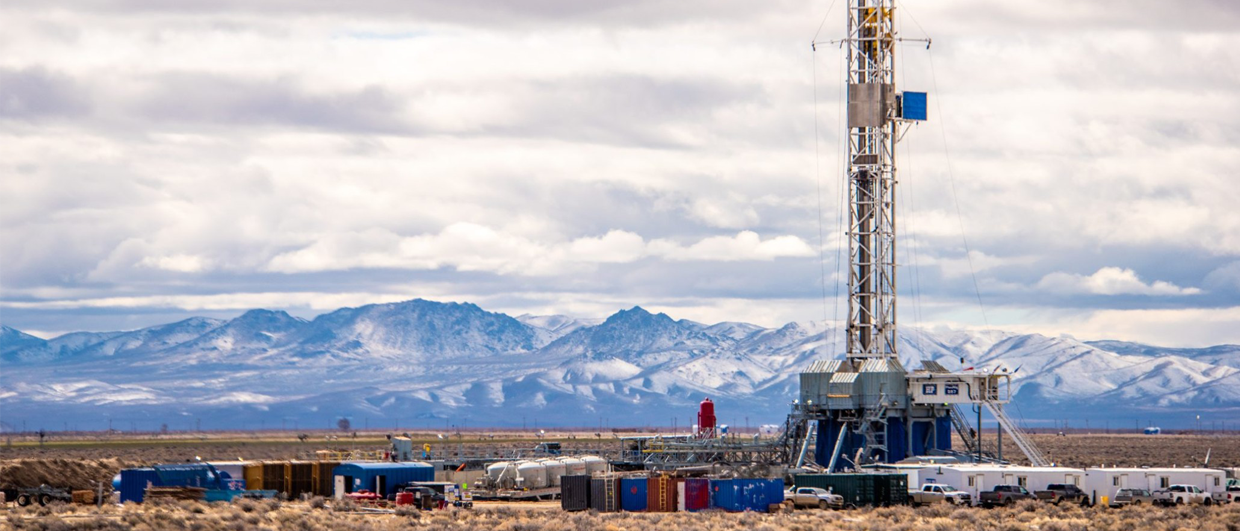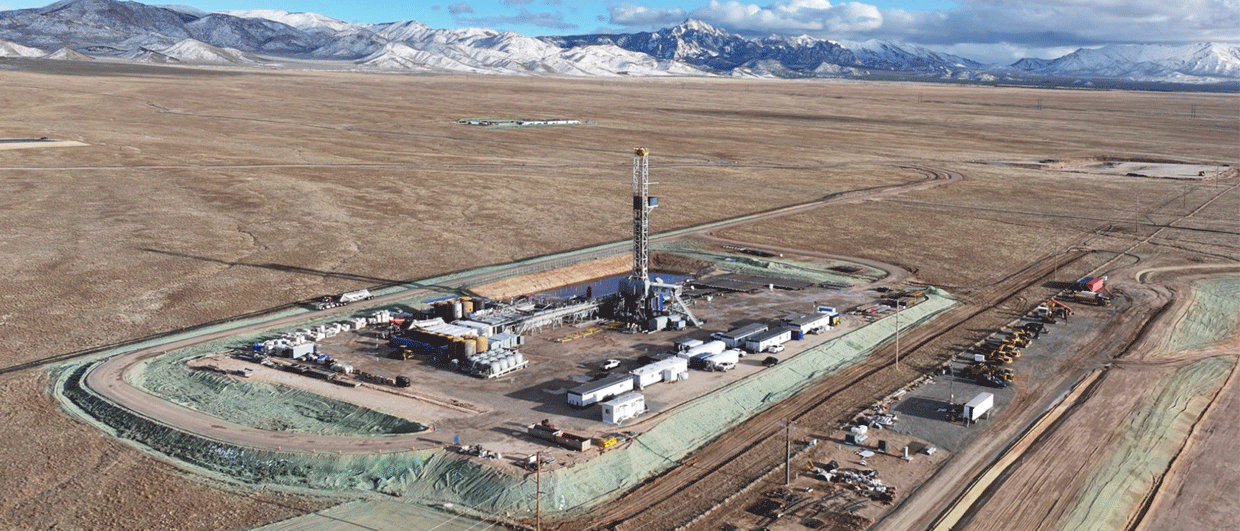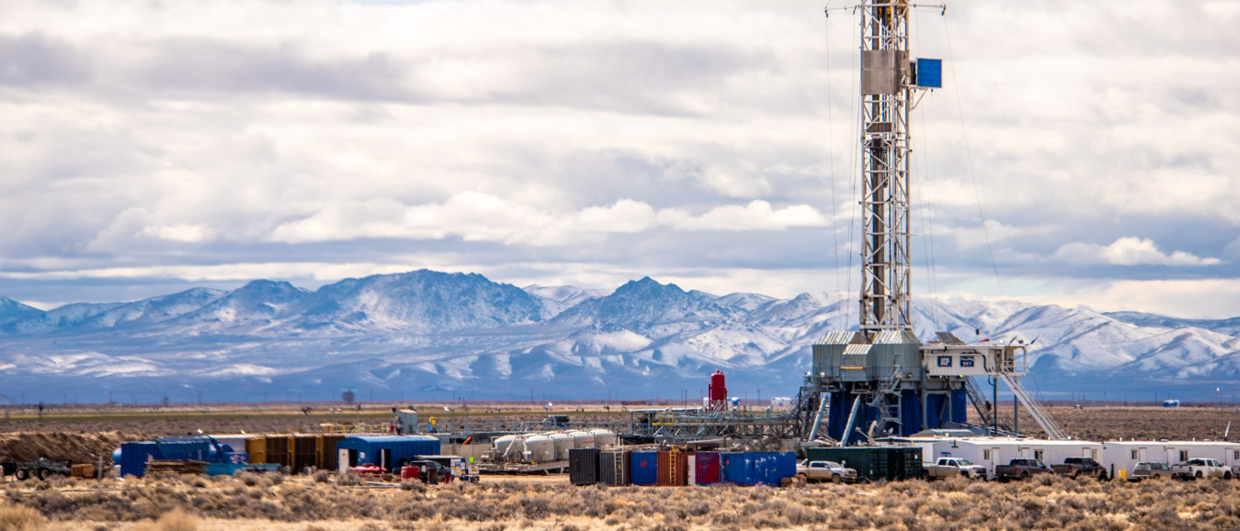
Project Red drilling site in Nevada. Photo: Fervo
Response to feedback from Mark McClure

Last week, we published the latest contribution from Elliot Yearsley, in which he discusses the lack of published well test data to support the claims made by Fervo about their flagship Cape Station geothermal project. We received feedback on the article from Mark McClure, CEO of ResFrac Corporation, in the form of a comment on our LinkedIn post about the article. Here, the points raised by Mark McClure are provided in bold, followed by our response.
(a) In the flow test at Cape Station, it’s not unfair to use to an injection well on each side of the producer; at scale, there will alternating injector/producers (though yes, a stronger point is that the peak rates from the test are often cited rather than the sustained flow rates; regardless, both are reported in their paper about the test).
The only data currently available in the public domain is based on one producer supported by two injectors, so that is the configuration used for the assessment of the limited published results. Ideally, that is the configuration that should be matched by a modelling exercise, which, to date, has not been done. If the final well configuration will be one of alternating producers and injectors, meaning that the producer-to-injector ratio increases, the energy output is likely to drop further.
(b) The cited Horne paper does not “endorse” Fervo; it doesn’t even mention them; it’s a generic technoeconomic analysis that uses flow rates that are “the target flow rate set by NREL and DOE in the recent Enhanced Geothermal Shot study.” Their paper is merely presenting the results for what would be possible for EGS if the target was reached.
It is true that Professor Horne does not openly endorse Fervo in his Nature paper, but at the same time, it is also true that he is currently on Fervo’s website as a member of the Technical Advisory Board. And he is the former PhD advisor to Fervo’s CEO Tim Latimer as well as Jack Norbeck. In other words, even when this is not explicitly stated, it is not unreasonable to conclude that ties between Fervo and Stanford are strong. That is not an accusation, but it is a good thing to be aware of. That is also the reason to include the word endorsement, which is primarily visible to the public through the LinkedIn posting from Professor Roland Horne. As an example, in a post that coincides with Fervo’s IPO, he wrote: “Fervo Energy’s team, founded and ably led by Tim Latimer and Jack Norbeck, have opened a new page on geothermal energy – in fact they’ve written a whole new book! Enhanced Geothermal Energy is an idea that has remained ‘promising’ for nearly 50 years. Some projects have succeeded, but only at modest scale – Fervo threw away the playbook and started over with a whole new approach, finally turning the promise into a reality. By innovating on technology, without ignoring the economics, Fervo is poised to deliver EGS at gigawatt scale. Geothermal almost everywhere!” This is quite the endorsement.
(c) The article refers to the circulation rate from the FORGE project as if it is analogous to Fervo’s wells; but FORGE has only 1000 ft of stimulated lateral, smaller-scale than a commercial EGS project or any of Fervo’s wells; actually, per ft of lateral, the FORGE circulation rate is higher than the Fervo wells.
The point of mentioning FORGE was to emphasise the observation that the only peer-reviewed article that discusses EGS well test results is from a project that is much more moderate in size than Fervo. That means there is no peer-reviewed content available that discusses something at the scale of what Fervo is currently undertaking. The mentioned 23 kg/s from FORGE is not a comparison, but just a fact.
(d) The article is critical of the Singh paper (of which I am coauthor) for not providing an analysis of the Project Cape flow results; that paper is a writeup of a consulting project that we as a third party performed for Fervo prior to the drilling of the wells; an analysis of the subsequent results is not in the project writeup because the project concluded before the circulation test had occurred.
Indeed, the Singh paper says: “This paper focuses on the Project Cape modelling that was done prior to drilling the first wells.”
At the same time, it is clear that whilst the write-up was done, some data must have been available to the authors, because the abstract reads: “In an initial circulation test, the first production well drilled for the project flowed at more than 100 kg/s (54,000 bbl/day), a record for an EGS project.” Also, near the end of the abstract, we can read: “..in the initial flow test, the observed circulation rate was within the range of predicted values. The operator is now drilling and fracturing additional wells, building power plants, and advancing the project.”
In that light, whilst the modelling work was concluded before the wells were drilled, during the write-up of the paper the authors had the opportunity to compare their results to the data that had become available, and as such an opportunity to build on those initial results beyond stating that the observed circulation results were within the range of predicted values.
(e) The drilling cost reductions reported by Fervo (which have also been pioneered by FORGE) are huge improvements on published results; it is problematic to undercut them by saying “although these reductions are benchmarked against their own wells,” as if to imply they are not actually improvements.
Absolutely, there has been very clear progress in terms of drilling. However, the point of the critique is that the benchmarking is against their own drilling history. Also, in every press release on drilling progress, Fervo only compares progress to their previous wells. It would be more complete when this is also benchmarked against costs and time required for drilling conventional geothermal wells, as well as the total drilling cost (including fracking) per net MW of sustainable production.
(f) To put things in context, they (along with engineers from FORGE and elsewhere) have achieved great improvements in both drilling and EGS well performance. They’re continuing to improve rapidly. They’ve been more transparent about sharing data than perhaps any other private geothermal company.
Elliot Yearsley: Fervo have not been transparent at all. In fact their project is shrouded in secrecy and misdirection. They have completely bypassed the normal geothermal industry review and professional discussion. Hence my articles.
Henk Kombrink: Fervo have indeed released more data than other similar companies, and that is positive. However, that doesn’t mean that there is no room for questions. Questions that have been asked through the publication of a number of articles, without having resulted in a response from Fervo themselves. That is all ok, but especially in the light of the company listing on the stock market and the hype that exists around EGS, it is important to keep on scrutinizing what is happening. That’s why I appreciate the articles Elliot writes.