
Photo: A Different Perspective, Pixabay
Why dual-phase systems demand a new assessment approach
In mixed oil and gas traps, the hydrocarbon phase and recoverable volumes are controlled by a dynamic interplay between charge phase and volume, PVT conditions, trap geometry and size and seal capacity. Standard tools often overlook these factors, leading to unrealistic or misleading outcomes

Various work-arounds attempt to compensate for these limitations, but each introduce their own artefacts. A common approach is to treat gas as a failure by assigning a “gas risk” and evaluating only oil scenarios. Another merges the risked and success case volumes from separate oil and gas cases, but eliminates the possibility of a dual-phase outcome. A third work-around subdivides the hydrocarbon column into a gas column and an oil column, often considered the most acceptable option, but it is rarely supported by justifiable parameter choices, and it fails to capture the controls on phase behaviour and column height.
To overcome these limitations and to properly estimate prospect risk and volumes in systems where oil and gas phases compete for pore volume and seal capacity, the best workflow is a petroleum systems-based approach. This integrates charge volume and composition, PVT conditions and seal properties to derive the hydrocarbon phase risk associated with the expected range of oil and gas volumes.
This difference becomes clear when applied to a prospect assessment case study from the gas-dominated Vulcan Sub-basin, which illustrates how strongly resource estimates depend on the underlying fluid assumptions, even when pore volume is held constant.
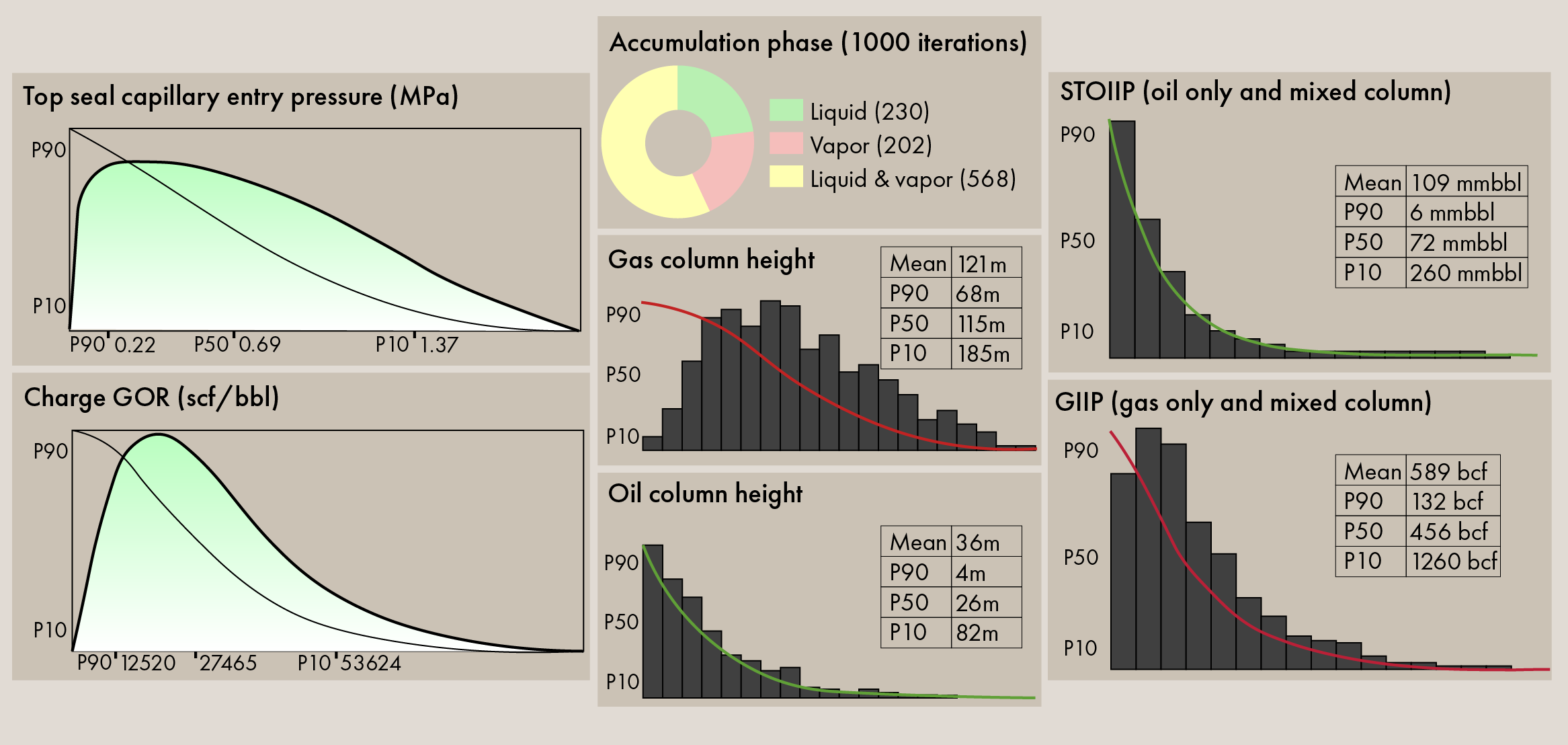
An oil-only, filled-to-spill scenario yields an estimated mean STOIIP in excess of 1,000 MMbbl; however, as discussed in our previous article (GEO EXPRO Vol. 23, Issue 2, 2026), filled-to-spill oil-only accumulations cannot be physically explained in dual-phase charge systems. Constraining the oil column height based on nearby analogue field data reduces the mean STOIIP estimate to 477 MMbbl, but this approach is flawed because the analogue distribution is dominated by gas columns. Limiting the analysis to oil-only analogue columns lowers the mean STOIIP to 75 MMbbl, moving closer to a plausible range but still failing to account for mixed columns.
In contrast, the petroleum systems-based prospect assessment yields a mean STOIIP of 109 MMbbl and a mean GIIP of 589 Bcf, within a single probabilistic assessment where oil and gas are inherently associated. The results of this approach capture the natural continuity from gas-only (class 1), mixed (class 2) and oil-only (class 3) accumulations with a dual-phase scenario representing the most probable outcome (~60 %), and also the most prolific for oil. The increase in estimated STOIIP relative to the oil-only column case reflects the potential presence of a gas cap, which effectively displaces oil into structurally higher gross rock volume portions of the trap.
The case study demonstrates why petroleum system understanding and integration are essential to realistic prospect assessment. Standard methods often rely on assumptions that lead to unrealistic resource estimates, especially when evaluating an oil accumulation in a gas-dominated petroleum system. A petroleum systems-based approach inherently captures the inverse relationship between column height and oil phase in such settings, embedding phase behaviour within the methodology itself and eliminating the need for separate “oil versus gas” risking.