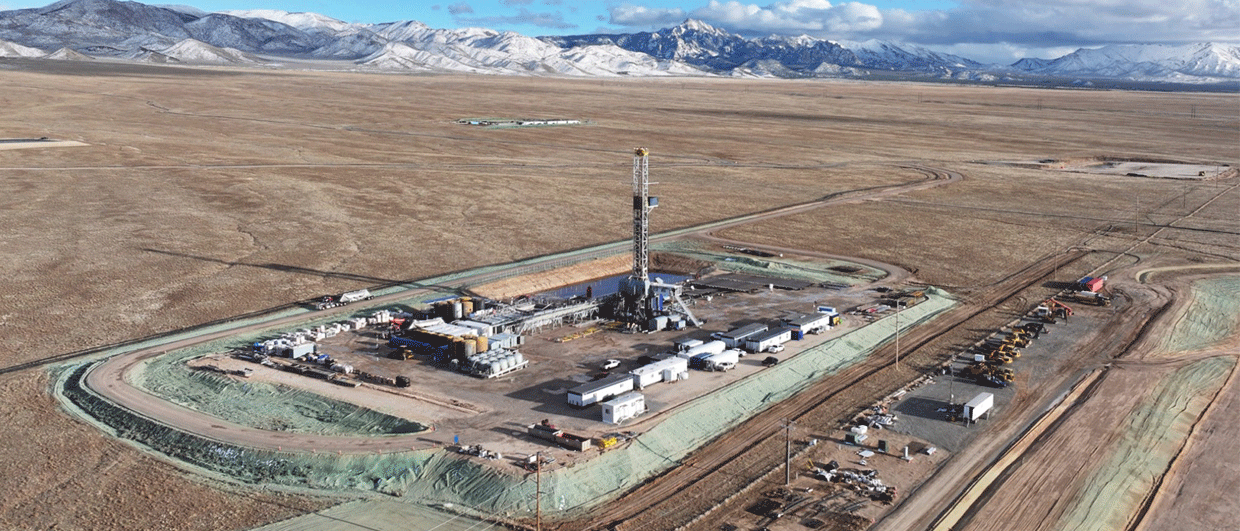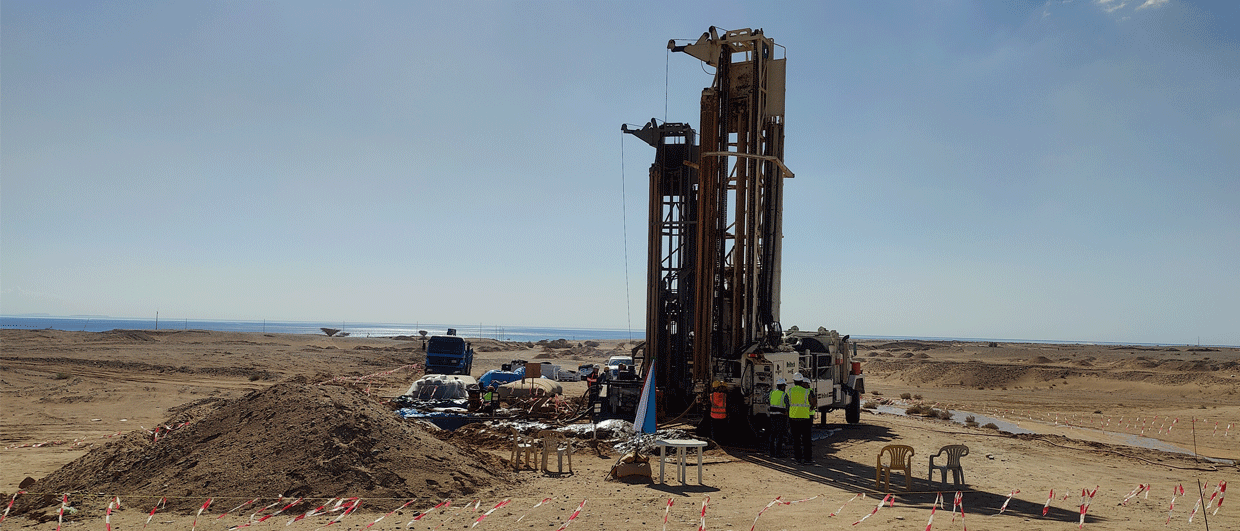
Rig in the desert at Gayal, Saudi Arabia, along The Line excavation, where closed- and open-loop shallow geothermal tests were conducted to assess the ground’s capacity for energy storage. Photo: Nicolas de Varreux private archive.
From the shores of Lake Geneva to NEOM in Saudi
Nicolas de Varreux stumbled into the shallow geothermal business in Switzerland, but it has taken him on a mission to the Arabian desert


“What are you doing?” Nicolas de Varreux asked his neighbour in Switzerland when a drilling rig rolled into his garden back in the summer of 2005. He had never seen such a machine before and became even more intrigued when his neighbour explained this was to drill a shallow geothermal borehole for a heat pump…
Nick says it was at that point that he got hooked and began a 20-year-long deep dive into the shallow geothermal and geo-energy world.
In 2007, he and 2 other associates bought a drilling rig, and from one thing to another, he ended up head of regional operations for the once-largest European geothermal probe installer, which, at one point, was running 22 geothermal rigs.
“We were installing over 10’000m per month, and with such a fleet, fine-tuning drilling techniques was paramount. Because in the end, it all boils down to how quickly you can install the ground heat exchanger.”
“Early on, I remember that some rigs were only installing 50 m per day. Now, it is more like 300 m, with peaks close to 1,000 m per day in ideal conditions. What a difference that makes when you realise that drilling time is the most important variable influencing CAPEX in a shallow geothermal loop installation.”
Shallow vs. deep geothermal: Efficiency, risk, and potential
“Compared to other renewables, shallow geothermal is hidden,” Nick continues, “once the rig has gone and the system is connected, you don’t see anything. In a way, that’s wonderful, but this also means that this fantastic technology gets very little public exposure. So, promoting shallow geothermal is that much harder. The shallow subsurface is akin to one big battery, and our job is to tap into this enormous and practically unlimited resource that actually exists and can be exploited practically everywhere. An important contrast to deep geothermal, which is completely dependent on local geological conditions.”
In the deep geothermal world, it is a fact that the real profitable projects are still in the sweet spots where thermal gradients are at their highest, or like in the Paris Basin, where a prolific reservoir is at the right depth and easily reachable. “But every single deep geothermal project starts with a very expensive exploration phase,” Nick explains. “And if that fails, which is unfortunately often the case, millions are wasted.”
He continues: “In shallow geothermal, however, we don’t have that issue. The resource is always available, and the ‘exploration phase’ required to precisely measure it is cheap and, in general, valid for very wide zones. Once the local geology and thermal conductivity have been defined with the first borehole of a multi-probe field and a thermal response test, sizing the field and optimizing the drilling process is simple. The remaining probes of the programme can then be drilled with very little risk. This is a very different and much more cost-efficient approach compared to deep geothermal exploration.”
“That being said, drilling methods and rig setups need to be adapted to the specifics of each region’s geological reality. I have seen drillers from Brittany in France bite the dust while trying to drill in the Alps,” Nick smiles. “Being used to and equipped for drilling into granite with very little overburden doesn’t prepare you for the thick conglomerates of boulders, gravel, sand and schists of the Alps! In our world, we all bow to geology, which completely determines your drilling approach and cost base.”
“But the shallow geothermal world isn’t all about making holes. Ultimately, it’s about efficiency and optimization. The key is devising the most cost-effective system to use the ground, surface water, the sea or an aquifer to your advantage in order to reduce the cost of supplying heating or cooling to the end user. In essence, where heat pumps or chillers are concerned, providing the warmest source in winter, the coolest one in summer and maintaining those source conditions for the longest time possible during the season.”
“Shallow geothermal is also about being opportunistic and ingenious. Using existing or envisaged construction elements as interfaces with the ground and mediums for energy exchange is an opportunity that is not sufficiently explored at the moment. Piles, foundation rafts, underground parkings, tunnels… basically any man-made structure installed under the surface offer numerous possibilities and should be studied for their geo-exchange potential,” explains Nick.
Scaling Innovation: From Europe to NEOM
Now, with all the experience he has accumulated over the years, Nick finds himself in Saudi Arabia, where he is helping to design a sustainable energy system for the NEOM project that is underway in the northwest of the country. It is a project of a scale that has rarely been seen before, with multiple different geological settings and challenges. Energy from the ground could sound incompatible with the hot and dry Middle East climate, but Nick was asked to use his Shallow Geothermal knowledge and experience to investigate and develop new and more efficient ways of producing cooling and storing chilled water. Techniques such as hybridization, seasonal Borehole Thermal Energy Storage (BTES) and Aquifer Thermal Energy Storage (ATES) to name a few are looking very promising not only for NEOM but also for the entire region where cooling is usually produced either through evaporative methods like cooling towers, thereby consuming precious fresh water, or simply by using basic (and highly inefficient) air-based heat exchangers.
Nick hopes that his current R&D in the region will help diversify the way cooling is produced and assist in modernizing the way comfortable living conditions are created in modern buildings in the Middle East.
“In the end, it’s all about thinking out of the box, being a little ingenious and having smart economic sense”, concludes Nick, “Nature and the earth give us multiple energy sources year-round. We just need to gather the possibilities and assemble them the right way for each specific situation”