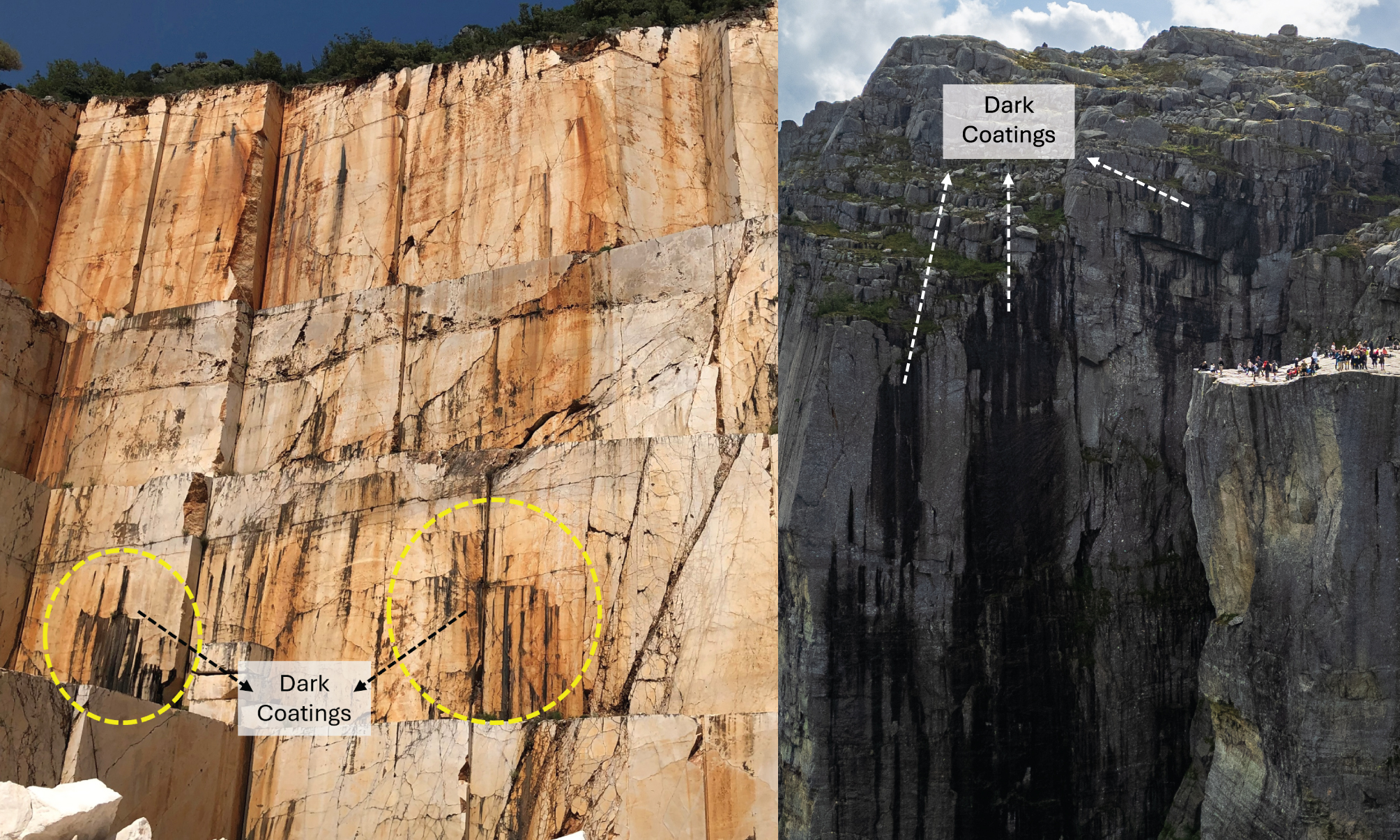
Granites of Pulpit rock from Norway. Photo: Andrea Tabaro via Adobe Stock.
“Oh, look! Oil everywhere…”
Field studies are crucial initial steps in hydrocarbon exploration, because the discovery of oil and gas seepages forms an important sign of a working petroleum system. However, whilst being optimistic about seepages is positive, caution needs to be exercised because not all seeps are the same

What seems like an oil seep on a rock face, especially from a distance, can equally be the result of chemical weathering. When these types of rock coatings, which can be found across a wide range of settings, are misinterpreted as oil seeps, the implications can be serious. In exploration settings, such misinterpretations may influence geological assessments and investment decisions, particularly when observations are not supported by thorough geochemical or geological verification. This can ultimately result in significant financial losses and reputational consequences. To prevent these situations, understanding the existence and mechanisms of rock coatings becomes essential not only for field geologists but also for decision-makers.
Mechanisms of rock coatings
The most significant property of rock coatings is their colour on outcrops. The vast majority of rock coatings are dark-coloured, usually black or brown, whilst forming flowing/cascading structures (Figure 1). They are also sometimes referred to as dark coatings in the literature.
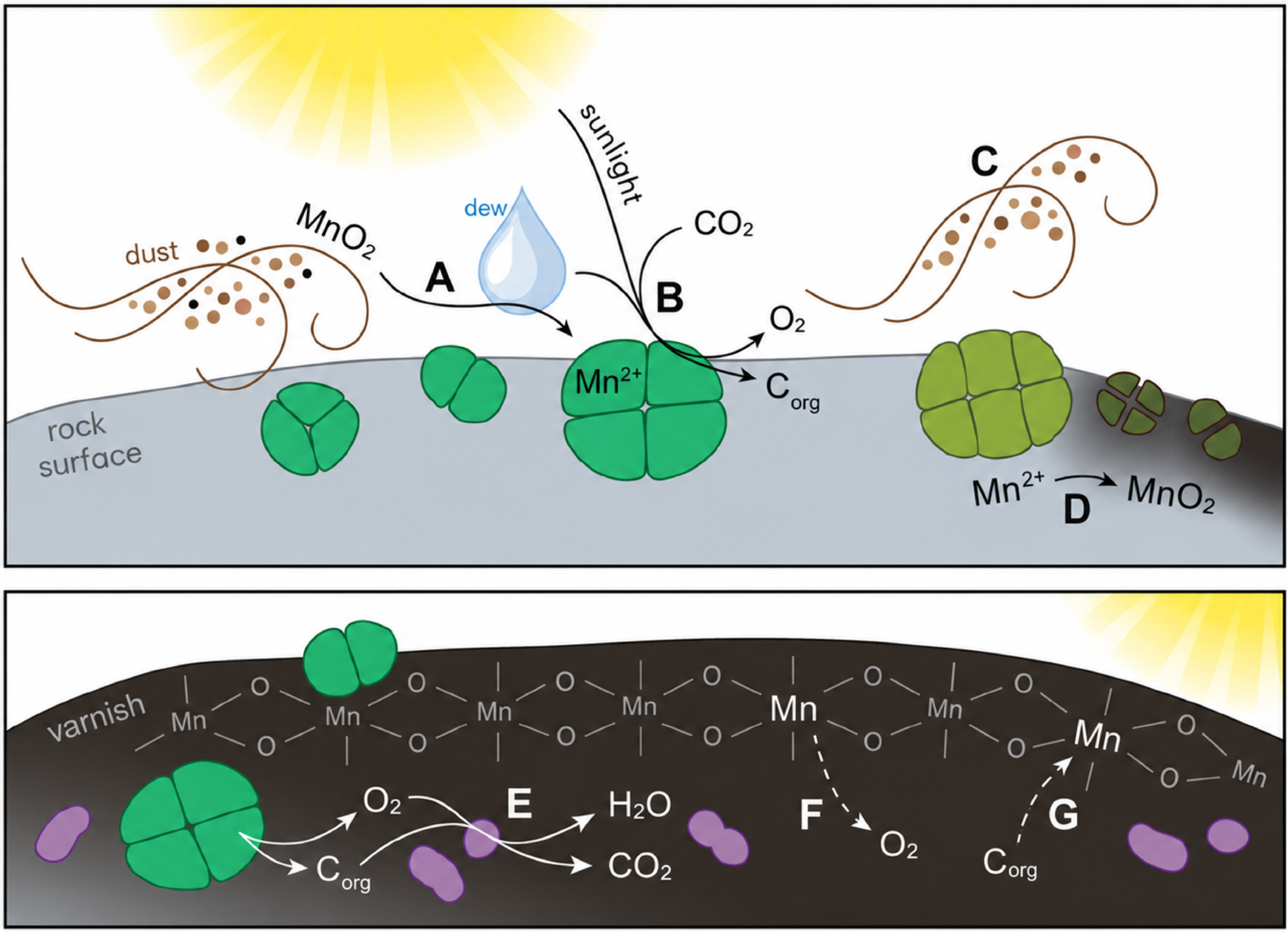
Although the debate about the occurrence of rock coatings still continues, there are a couple of mechanisms proposed to explain the process. The most well-known ones are rock/manganese (Mn) varnish and iron film. Researchers such as Dorn (1998) and Lingappa et al. (2021) describe the Mn varnishing process whereby clay minerals and trace metals transported by wind, especially in arid climates such as deserts, adhere to the rock surfaces. With the help of dew, rainwater and bacterial activity, Mn is subsequently dissolved and oxidised, followed by the precipitation of oxidised Mn as birnessite. These minerals form a dark-coloured, shiny coating on the surface of the rock. The simplified chemical formula for this process is:
2Mn²⁺ + O₂ + 2H₂O → 2MnO₂ + 4H⁺
Another widely accepted mechanism is the effect of groundwater. Mn/Fe-enriched groundwater seeps to the rock surface, and after evaporation and oxidation, precipitation occurs (Dorn, 1998). Seepage usually develops along fractures and creates a dark coating which directly resembles an oil seep (Figure 1). The Mn/Fe ratio determines the colour of the coating, with a high ratio indicating a black colour, while increasing Fe content causes a brown-orange colour, also named as iron film.
Case studies
I have come across significant misidentification by geologists during my field studies. The features shown in Figure 1 present a good example in which a suspected oil seep turned out to be rock coatings developed as a result of rain and groundwater seepage.
There are also some important studies in the literature. For instance, Price (1932) notes that iron films were mistaken for oil seeps in the Corpus Christi area of Texas, USA. Likewise, Arnold (1959) highlights the presence of iron films and manganese varnish and classifies them as pseudo-evidence of oil and gas based on his decades-long experience in the field. Arnold also proposes a methodology that entails scratching the surface of the iron film with a pencil. If the film breaks into angular blocks, it is a direct indication of rock coating.
More recent studies demonstrate similar approaches as well. Blodgett and Clautice (2005) describe existing water pools with iron films that can be mistaken as oil seeps in the prospective Puale Bay-Becharof Lake-Wide Bay region on the northern Alaskan Peninsula. The study emphasises that resemblance can be developed not only on the outcrops but also on the water surfaces too. In a similar way, Tedesco (2012) warns that Mn/Fe oxides on outcrops can mimic hydrocarbon seepage signatures and might lead to false interpretations during surface geochemistry prospecting for oil.
Distinguishing rock coatings from oil seeps
So, the question emerges: If rock coatings are so common on outcrops, how can they be differentiated from oil seeps? One of the most obvious indicators is the smell along the seeps. Oil seeps emit an odour of petroleum/bitumen, especially when they are scratched. Rock coatings have no odour. Physical properties such as hardness and texture differ as well. Rock coatings are hard to scratch with a fingernail due to their hardness level on Mohs (5–6). By contrast, oil seeps are much softer and may smear. In terms of texture, rock coatings are characterised as vitreous/matte edifices, while oil seeps are represented by a waxy texture.
One of the other most significant differences is how these two features react to UV light. Swanson (1981) has shown that hydrocarbons fluoresce under longwave UV light with a colour of either yellow, blue-white or green. Rock coatings have no ability to fluoresce as they remain dark under longwave UV. Therefore, with a simple portable UV torch, fluorescence behaviour can be tested in the field easily. Apart from that, a flame test might also indicate whether the edifice is an oil seep or a rock coating. When a lighter flame is applied to a rock coating, no reaction occurs, while oil seeps either melt, bubble, or produce black-coloured smoke.
Another in-situ test includes a portable XRF analyser, which can identify the elements on a rock surface. It is usually recommended to have measurements both on the rock coating/suspected oil seep and bare rock surface to make a robust comparison. Detailed geochemical analysis in the lab would be the last step to reveal the nature of the rock samples coming from the outcrop.
Key takeaways
Rock coatings on outcrops might resemble oil seeps, occasionally looking almost identical. Therefore, to better understand the hydrocarbon potential of any sedimentary basin and to prevent poorly informed investment decisions, geoscientists working in the field should not forget that they are applying scientific principles and methods while examining outcrops. Thus, they should be cautious and sceptical until measurements clearly demonstrate the nature of the observed feature. Based on that understanding, they should follow field testing procedures, take samples, preserve them accordingly and conduct necessary geochemical analyses to verify the composition of the potential seepage. Finally, field geologists should communicate their findings objectively and transparently to managers and decision-makers, particularly those without a geoscience background, ensuring that their interpretations are supported by appropriate evidence and acknowledging any uncertainties that may remain.
References
Arnold, R. (1959). Pseudo Evidences of Oil and Gas. AAPG Bulletin, 43(5), 1058–1064.
Blodgett, R.B. & Clautice, K.H. (2005). Oil and Gas Seeps of the Puale Bay–Becharof Lake–Wide Bay Region, Northern Alaska Peninsula. Alaska Division of Geological & Geophysical Surveys, Report.
Dorn, R.I. (1998). Rock Coatings. Elsevier, Amsterdam.
Lingappa, U.F., Yeager, C.M., Sharma, A., Lanza, N.L., Morales, D.P., Xie, G., Atencio, A.D., Chadwick, G.L., Monteverde, D.R., Magyar, J.S., Webb, S.M., Valentine, J.S., Hoffman, B.M. & Fischer, W.W. (2021). An ecophysiological explanation for manganese enrichment in rock varnish. PNAS, 118(25), e2025188118.
Price, W.A. (1932). Disseminated Oil in Pleistocene Water Sands of Corpus Christi Area, Texas. AAPG Bulletin, 16(4), 385.
Swanson, R.G. (1981). Sample Examination Manual. AAPG Methods in Exploration Series.
Tedesco, S.A. (2012). Surface Geochemistry in Petroleum Exploration. Springer Science & Business Media.