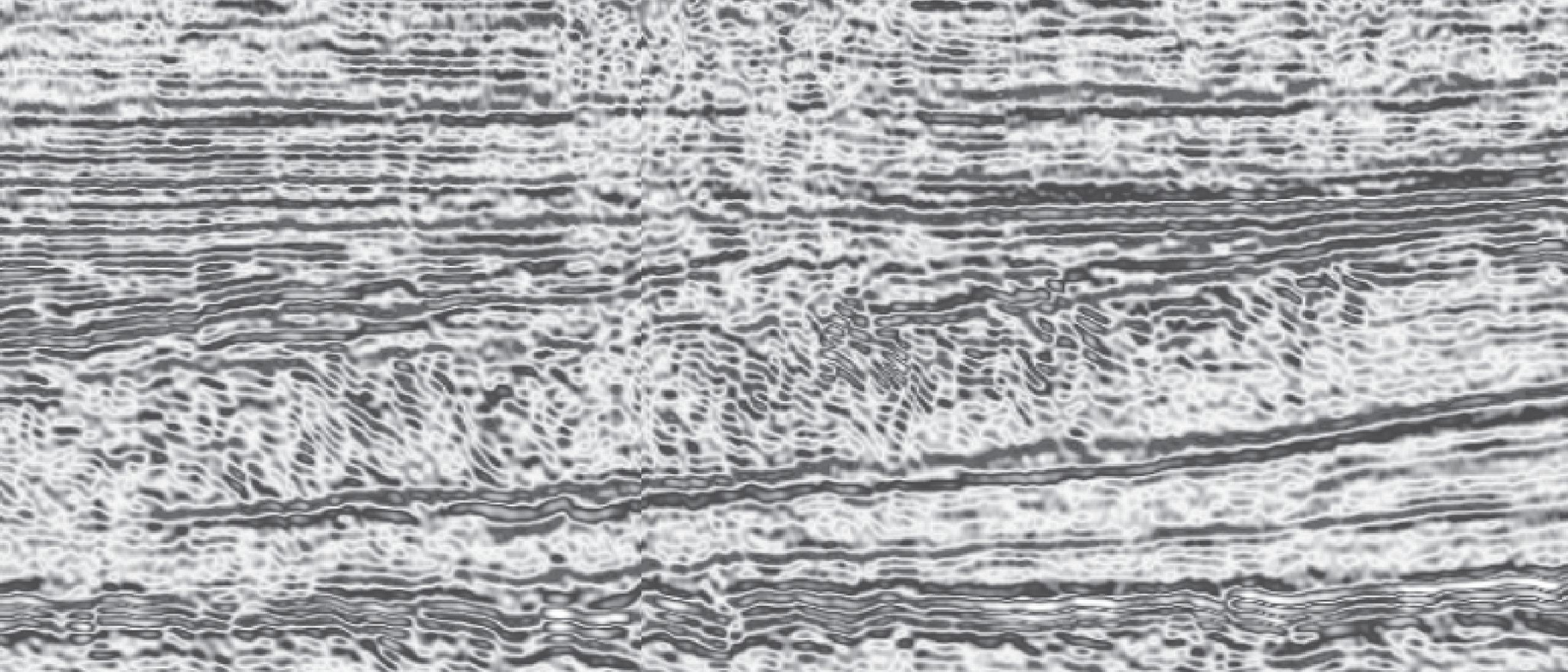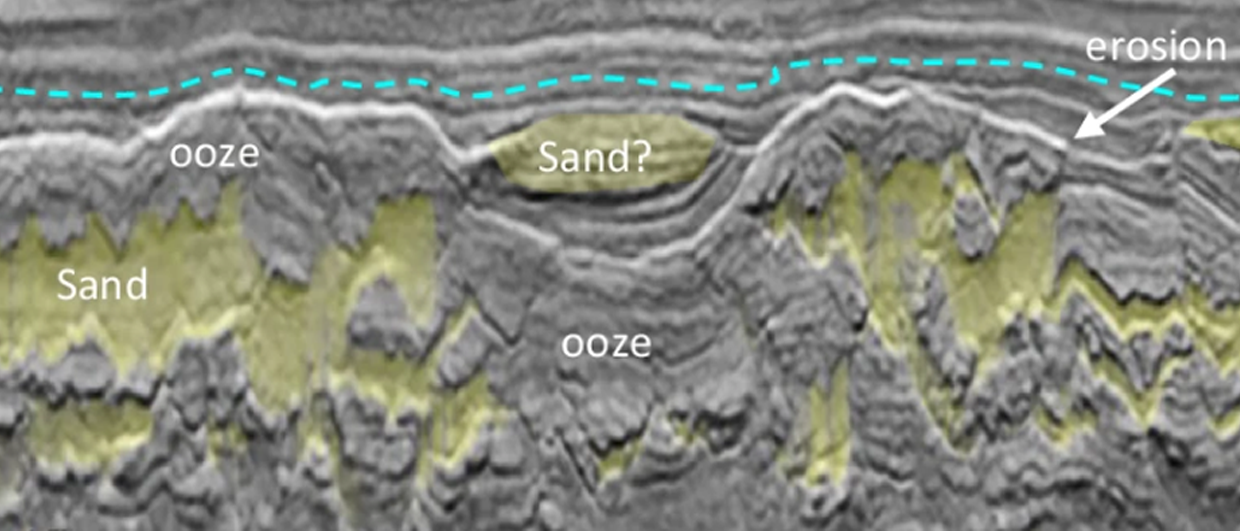
Interpreted sand intrusions (sinkites) and adjacent overburden sand, both shaded in yellow. Source: Rudjord & Huuse (2025) - Nature
Up or down – in which direction did the sand go?
Jan Erik Rudjord and co-workers propose that freshly deposited sand can also sink, going against the more accepted idea of sand injection that implies upward movement

At the recent EAGE Annual in Aberdeen, I briefly met geologist Jan Erik Rudjord. He convinced me to see his talk on what he calls sinkites: Sands that have apparently sunk into the underlying strata. It was a new topic for me, and I was intrigued. The reason is that it goes against the more commonly held idea that sand mobilisation takes place in an upward direction.
In several published papers, Jan Erik and co-authors describe what they call jack-up sand structures along the mid-Miocene unconformity in the Norwegian Northern North Sea that are hundreds of kilometres wide and up to 200 m in thickness. These structures are now found below the mudstones they were once deposited on. At least, that’s what Jan Erik thinks.
“We don’t have the silver bullet kind of evidence for Miocene sinkites yet,” he admits in a message. But amongst the many examples in the seismic 3D data he sees as supportive of his ideas, there is one that stands out: The Zulu East jack-up structure that was drilled by well 26/10-1. Here, as shown in the illustration below, we see a jagged sand body overlain by an interval of oozes, bounded on either side by an interval that shows the same succession in the opposite order.
But can the sand drilled by 26/10-1 be correlated to the undisturbed sand higher up? Jan Erik looked at strontium isotope dates obtained from samples in the well, and saw that there are some that indicate a younger age than the host rock. That could indeed be a sign that there is an age reversal that would be expected in the case of sinkites. At the same time, he points out that previous research rejected the isotope ages because of caving, so there is an alternative hypothesis too.
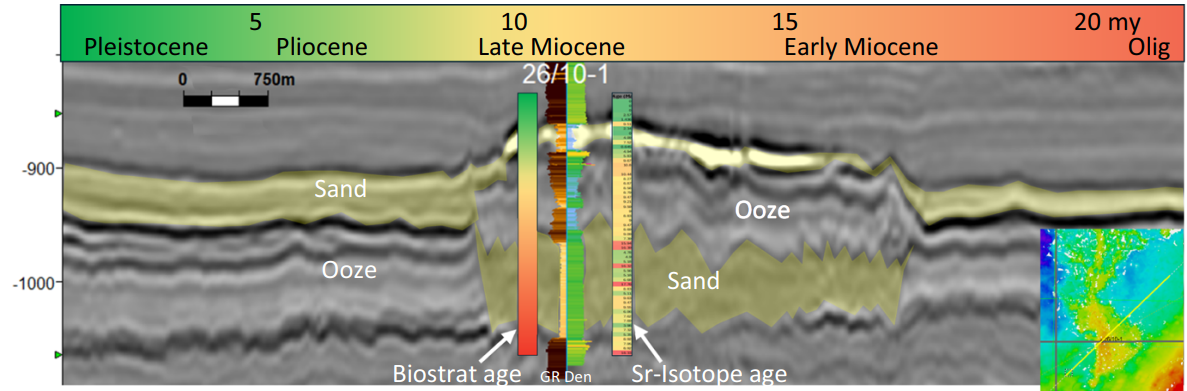
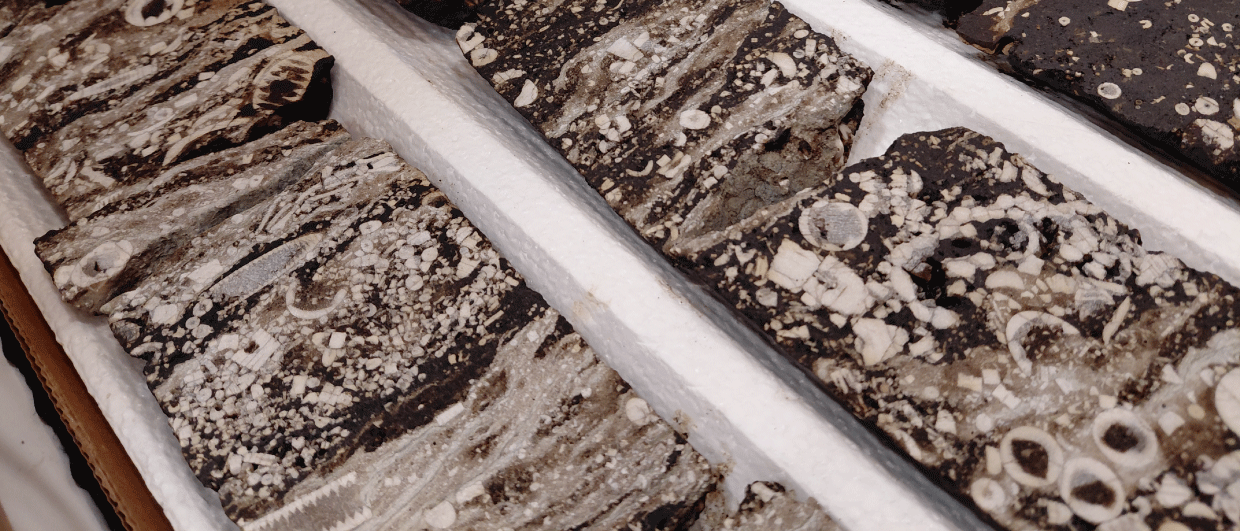
Another line of support for sands moving downwards are density contrasts. All the mapped Miocene sinkites are constrained within one 200–500 m thick interval of fractured, early consolidated and low-density (1.7–1.8 g/cm3) biosilicious ooze – consisting of fragments of diatoms and radiolaria mixed with 50–70 % clay. Assuming that the process took place at seabed, which is supported by the observation that seismic horizons above and below the sinkites are undisturbed, a density of >2 g/cm3 can be assumed for the sands. This creates a density imbalance, which may have caused liquified sands to move down during earthquakes or due to upwards water expulsion, sinking via polygonal fractures and displacing rigid blocks of ooze upwards.
“The challenge extending this model to deeper Paleocene-Eocene structures is that the seismic imaging is of poorer quality and that the evidence of low-density ooze is masked by depth-dependent silica-diagenesis and compaction,” Jan Erik writes. However, he hopes that the availability of more well data may ultimately compensate for this. He is keen to further study Paleocene and Eocene sinkites, also because of the potential economic implications. At the end of the day, that’s where many fields, especially in the Norwegian North Sea, produce their oil from. That also makes the whole topic more controversial, of course. But that only peaks our interest.