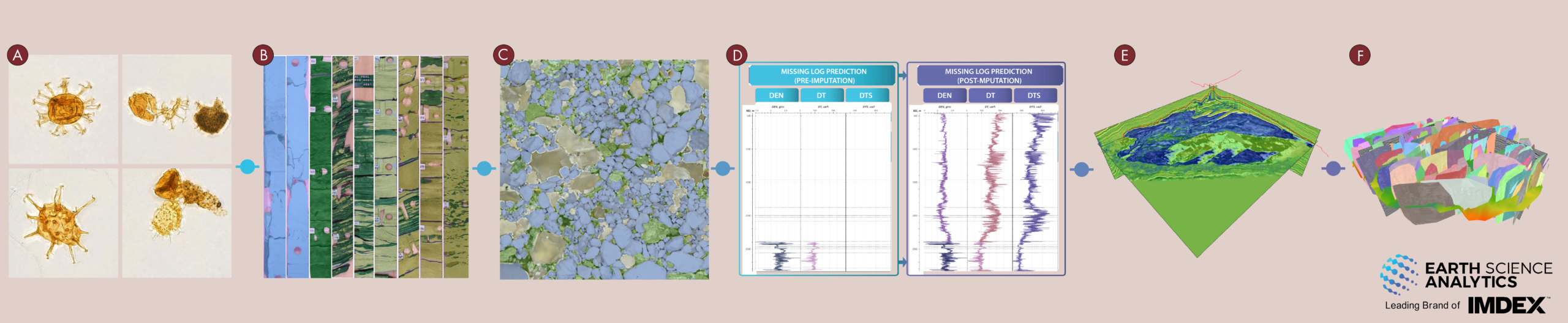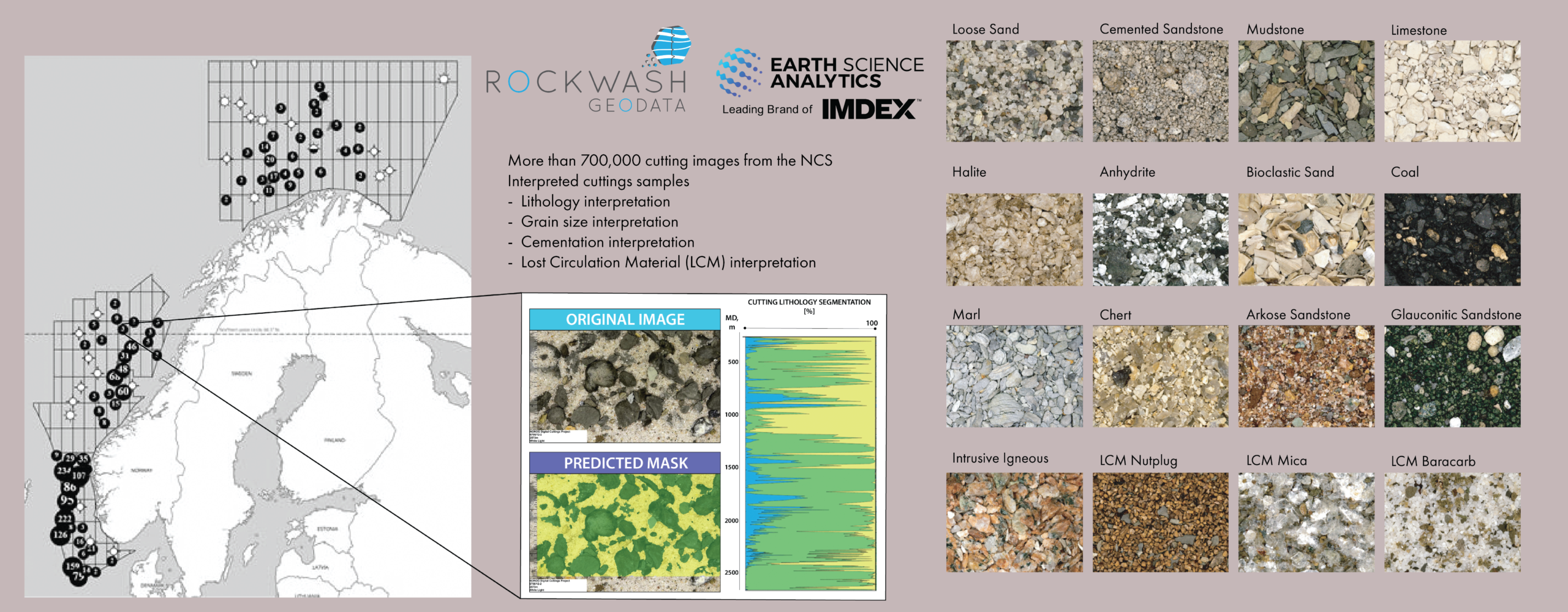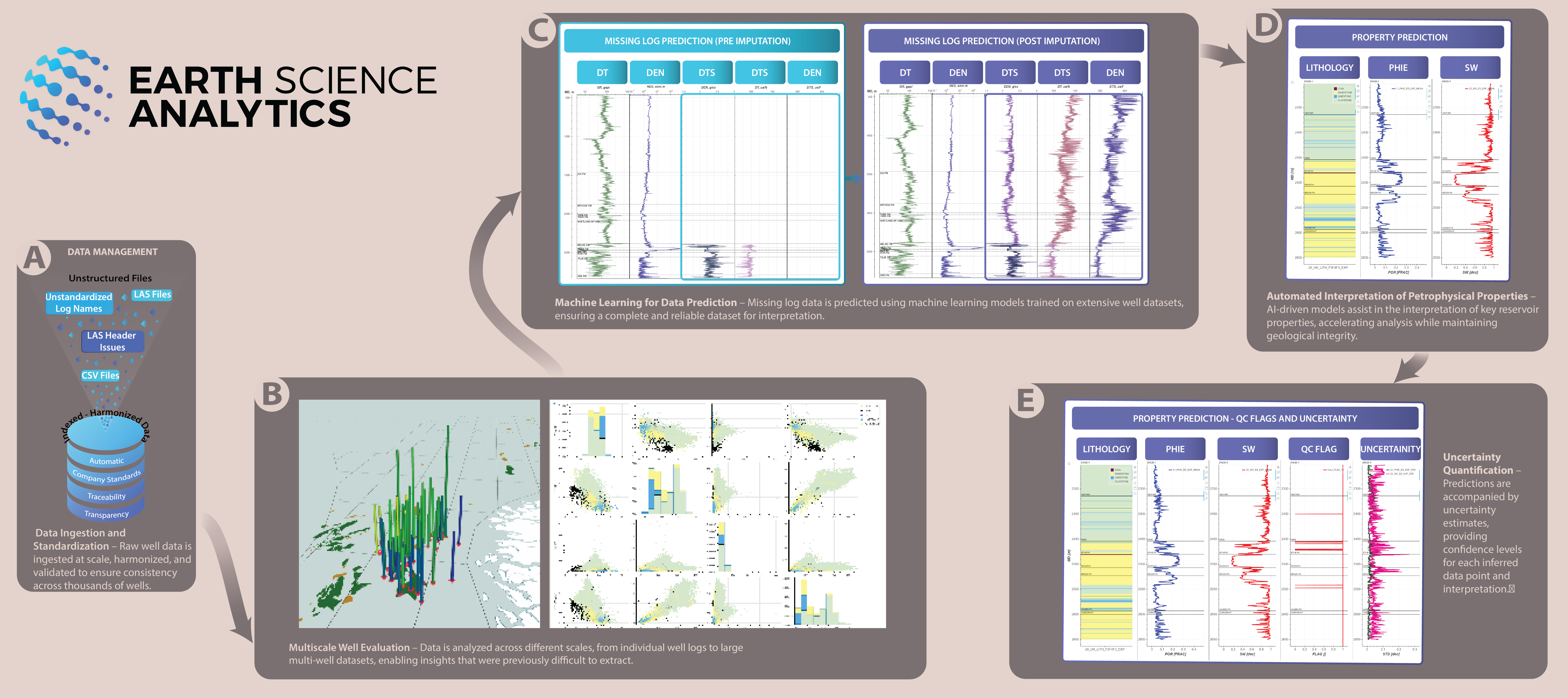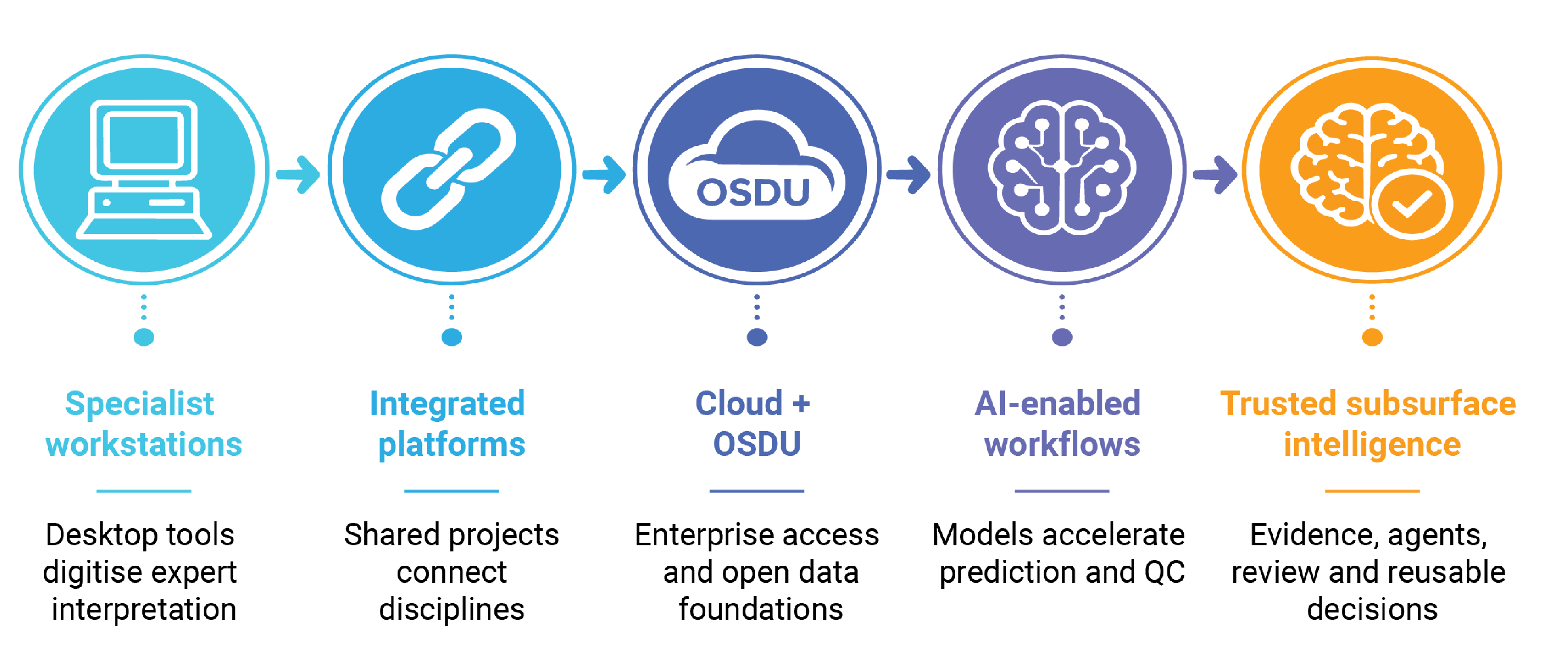
Figure 1: Specialist workstations, integrated platforms, cloud and open data foundations, AI-enabled workflows and trusted subsurface intelligence coexist rather than replace one another cleanly.
Beyond AI: Why the future of geoscience software is trusted subsurface intelligence
Geoscience software is changing again, but the shift is larger than cloud migration or the addition of artificial intelligence to established interpretation tools. Operators increasingly face a challenge beyond generating more interpretations or AI predictions: How to transform heterogeneous data, models and knowledge into trusted subsurface intelligence that can be reviewed, reused and applied with confidence.
The next generation of G&G software will combine scientific applications, open data foundations, AI-assisted analysis and human expertise within governed decision workflows. EarthNET provides a practical example of how exploration, reservoir characterisation, unconventionals and CCS teams can connect data, interpretations and decisions in transparent, evidence-based workflows. The future is not autonomous geology. It is trusted subsurface intelligence with provenance, uncertainty and expert accountability built into the workflow.

Start with the geoscientist, not the software stack
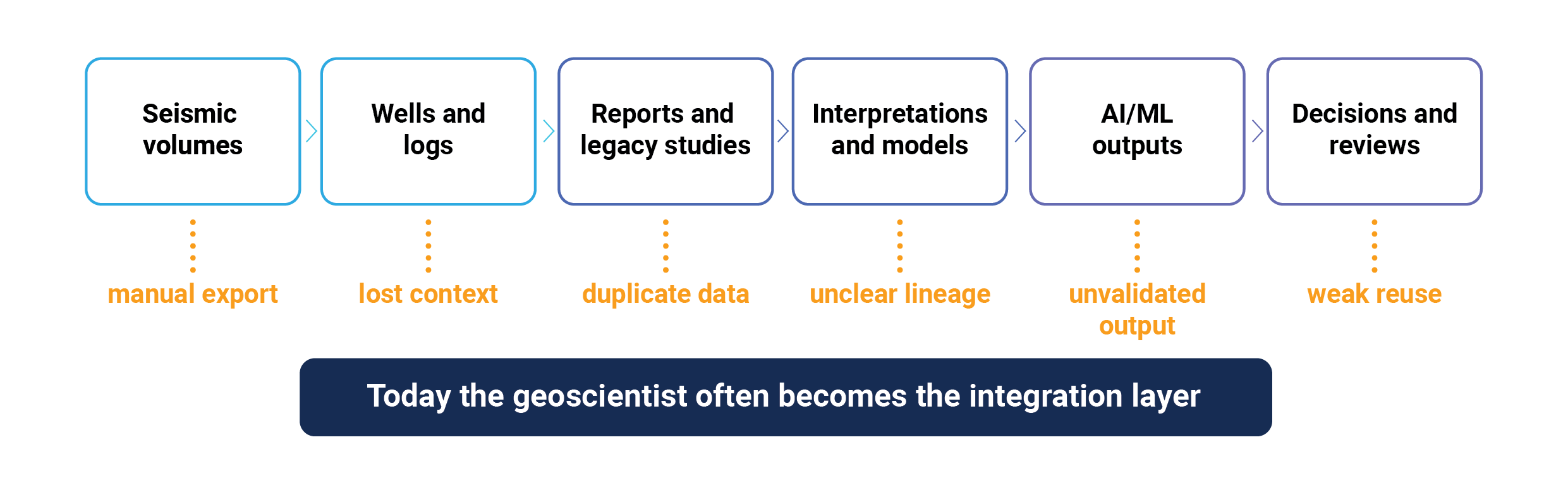
A modern geoscientist rarely works in one clean software environment. A regional screening task may require seismic volumes, well logs, core data, well reports, pressure information, stratigraphic charts, public-domain material, basin studies, analogue fields, interpretation projects, spreadsheets and a growing set of AI-assisted outputs. In unconventional settings, the same task may also require consistent curve families across hundreds or thousands of wells, completion and production data, and rapid comparison of changing interpretations.
The problem is not a shortage of applications. The challenge is that evidence, assumptions and decisions are distributed across too many places.
The geoscientist therefore has to ask practical questions: Which data can I trust? Which interpretation is current? Which model generated this prediction? Which assumption is critical? What uncertainty matters for the decision? Has the output been reviewed before it is used in an investment discussion? These are not simply data-management questions. They are technical questions because they determine whether a result is fit for a subsurface decision.
This is why the software conversation is moving beyond AI. AI can accelerate interpretation, prediction, conditioning, retrieval and reporting, but acceleration creates value only when outputs can be understood, challenged, reused and governed. In consequential workflows, human review is not a slow exception to automation. It is part of technical validity.
EarthNET illustrates the emerging response to this challenge. Rather than asking geoscientists to abandon established tools, EarthNET is positioned to connect governed data, geological context, domain AI and expert review so that teams can move from fragmented information to harmonised evidence, trusted intelligence and better decisions.
From interpretation workstations to intelligence systems
The history of G&G software can be viewed as an additive evolution. Specialist workstations embedded expert workflows in digital tools. Integrated platforms connected seismic interpretation, wells, mapping, geomodelling and reservoir studies within shared projects.
Cloud and open data foundations expanded enterprise access, scale and interoperability, while AI-enabled workflows now accelerate classification, prediction, quality control and interpretation. The emerging next generation seeks to connect these capabilities into trusted subsurface intelligence systems.
This evolution is important because most operators work in multi-vendor environments where scientific applications, enterprise data services, specialist tools, in-house methods and historical project archives all continue to create value. These technologies are not being replaced. Their scientific maturity, user familiarity and extensive project histories remain important strengths. The challenge is that modern decisions increasingly span their boundaries.
A workflow may depend on enterprise data, interpretation software, AI-assisted analysis, historical reports and review by multiple specialists. The strategic question is therefore not which single platform wins, but how data, science, models, evidence and decisions remain connected across the workflow (Figure 1). The purpose of the next generation is to preserve scientific depth while reducing friction between data access, interpretation, AI assistance, technical review and decision making. Trusted subsurface intelligence emerges when governed data, domain science, AI and expert judgement operate together in traceable, reusable and defensible workflows.
What is driving the next generation?
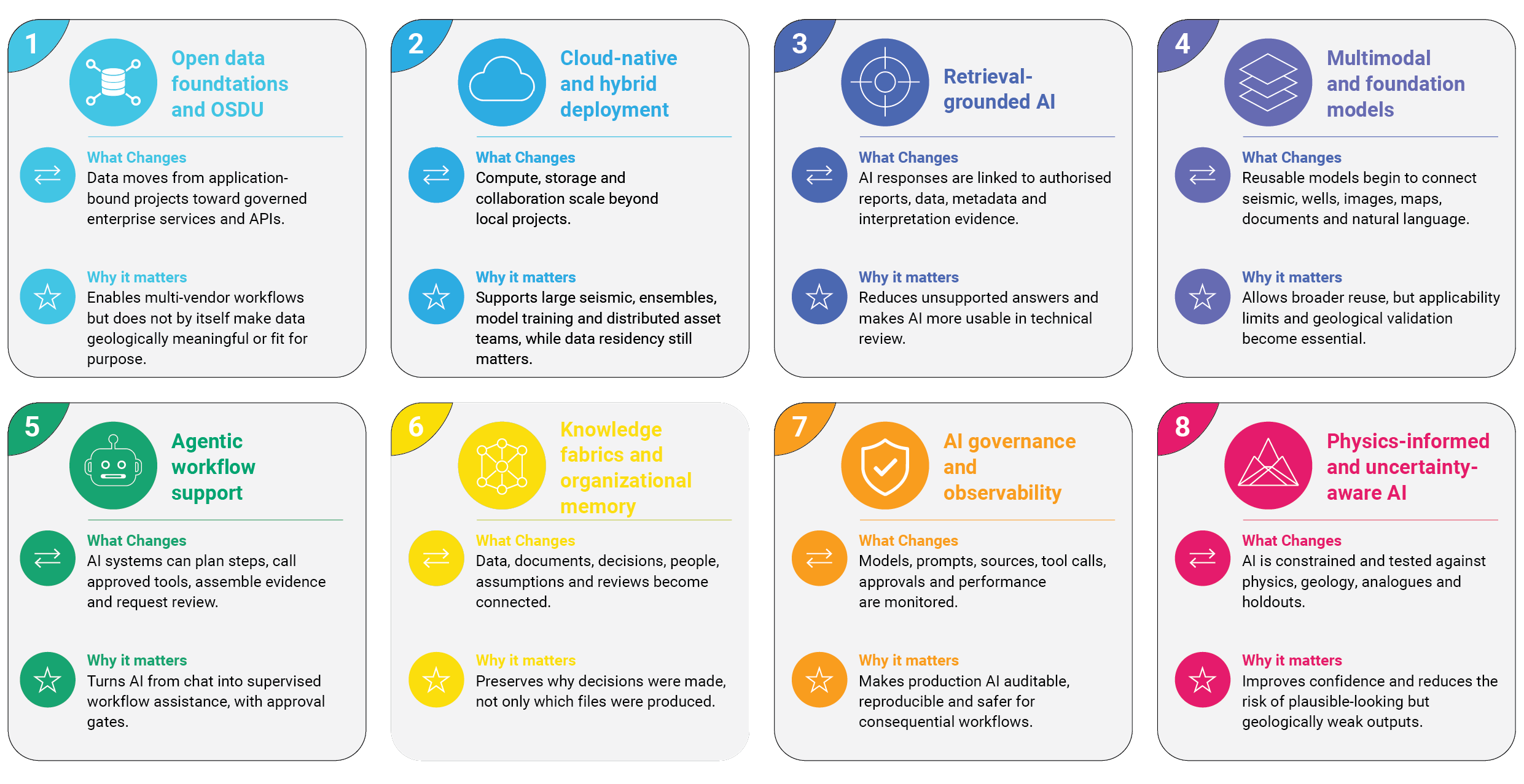
Several technology trends are converging. Their importance lies less in the individual buzzwords than in how they combine around workflow adoption, trust and decision quality. Figure 2 highlights eight of the most important forces driving this transition.
From harmonised data to trusted intelligence
The phrase ‘AI-enabled geoscience’ can hide a critical distinction. A prediction, classification or generated summary is an output. Subsurface intelligence is an output that has retained enough evidence, geological context, uncertainty and review history to be used responsibly in a decision. The pathway is therefore not simply data to AI. It is fragmented data to harmonised context, harmonised context to trusted intelligence, and trusted intelligence to better decisions.
Harmonisation is more than moving files into one location. Data must be aligned sufficiently for the intended workflow: wells and curves need consistent identities and units; seismic and interpretations need usable spatial and version context; documents and prior decisions need discoverable relationships; and AI outputs need links to their source data, model versions, assumptions and limits. Trusted intelligence depends on end-to-end traceability from evidence to decision. Fitness for purpose remains a technical judgement.
EarthNET is positioned at this intersection. Its role is not to replace established interpretation applications or enterprise data foundations. It is to help connect governed data, domain applications, AI-assisted outputs and expert review within a traceable workflow. In that model, value does not come simply from generating more answers. It comes from preserving the context that allows answers to be challenged, improved and reused. Figure 3 summarises how fragmented subsurface information can be transformed into trusted subsurface intelligence through harmonisation, AI and expert review.
How trusted subsurface intelligence creates value
The value of trusted subsurface intelligence is not limited to a single workflow or technology domain.
Across exploration, reservoir development, unconventional resources and emerging CCS applications, geoscientists increasingly need to integrate diverse datasets, interpretations, models and prior knowledge while maintaining context, traceability and technical oversight. When fragmented information is harmonised into a shared geological and operational context, domain science, AI-assisted analysis and expert review can work together to reduce uncertainty, improve efficiency and support more defensible subsurface decisions. The following examples illustrate how these principles can create value across different subsurface workflows.
Exploration: Faster screening without losing judgement
Consider a frontier or near-field exploration team reviewing a large acreage position. Screening requires regional studies, well results, seismic coverage, structural elements, play concepts, source-rock information, analogue fields and previous internal interpretations. AI can help retrieve, summarise and correlate this material, but the workflow becomes trusted only when the geoscientist can inspect the sources, understand confidence and record why a lead was accepted, rejected or deferred.
A connected workflow can reduce time spent searching and reconciling evidence while preserving the geological reasoning behind opportunity ranking. The asset-value connection is direct: More opportunities can be screened, critical uncertainties can be exposed earlier, and future teams can understand why a prospect was matured, parked or dropped. The result is not simply a faster presentation. It is a more durable exploration memory.
Development: Reservoir characterisation in a connected workflow
In development settings, value often depends on connecting well control, seismic attributes, rock physics, inversion results, static models, production evidence and uncertainty. AI-assisted property prediction or seismic interpretation can be useful, but results must be checked against wells, geological plausibility and known limitations. A model that performs adequately across a broad dataset may still be unreliable in a particular facies, acquisition vintage or structural setting.
Trusted subsurface intelligence therefore requires bidirectional quality control: Testing the model at known control points and challenging predictions away from control. It also requires the capture of human review. If an interpreter modifies a predicted horizon or rejects an AI fault segment, the correction is valuable technical learning. Subject to permissions and governance, that learning should remain available to improve subsequent work rather than disappear inside a local project.
Unconventional resources: Consistency at scale, judgement at the decision point
Unconventional resource workflows amplify the harmonisation challenge.
Teams may need to compare large well populations assembled from multiple vintages and sources, with inconsistent curve names, units, sampling, quality and completeness. Geological interpretations must then be connected with seismic properties, petrophysical indicators, completion information and production response. Scaling the workflow depends on consistency, but commercial decisions still depend on geological and engineering judgement.
AI can assist with log conditioning, missing-curve prediction, interval characterisation, seismic property prediction and opportunity ranking. These outputs become trusted only when users can trace the underlying data, inspect quality-control results, understand applicability and review uncertainty. A connected intelligence layer can help teams compare like with like, preserve the reasons behind ranking decisions and carry learning from one area or campaign into the next.
CCS and new energy: Uncertainty matters more when data are sparse
The same principles apply in CCS and other emerging subsurface workflows. Storage screening often depends on sparse well control, legacy seismic, regional interpretations, seal assessment, containment risk, pressure behaviour and analogue reasoning. AI can help locate evidence and generate candidate interpretations, but confidence must be bounded. A technically attractive storage concept is not decision-ready until its evidence, uncertainty and assumptions are visible.
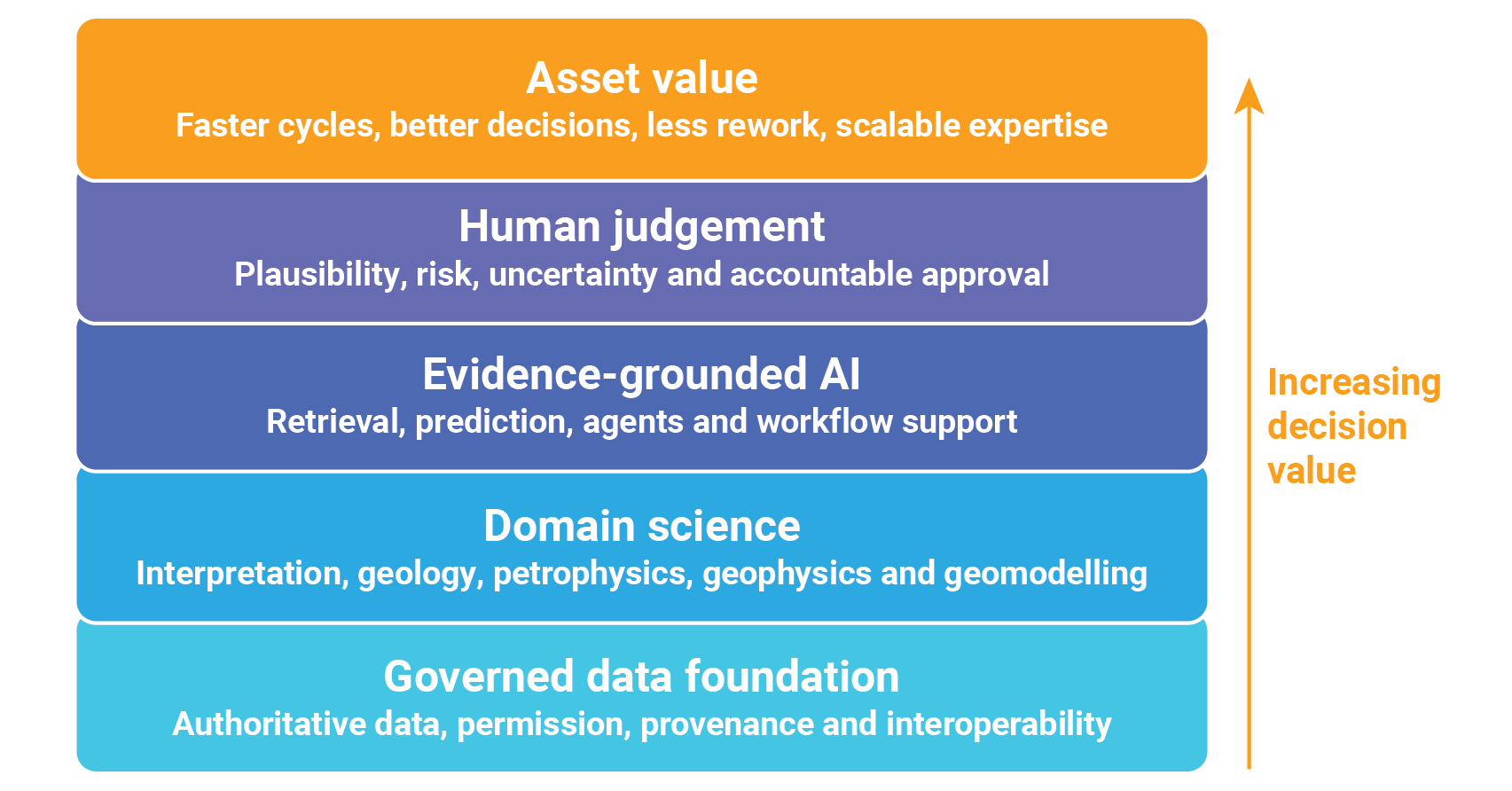
In low-data settings, the most valuable output may be a clear account of what is not yet known: Missing logs, weak seal evidence, unresolved fault behaviour, outdated velocity models or untested assumptions. Decision-makers need a transparent view of confidence and data gaps, not only a polished AI-assisted answer. Figure 4 illustrates how these capabilities combine to create value across subsurface workflows.
Trusted subsurface intelligence as a value stack
The value stack starts with governed data, but it cannot stop there. Harmonisation makes evidence usable across workflows. Domain science provides geological meaning. AI and retrieval add speed and reach. Human judgement provides accountable review. Asset value emerges when these layers operate together with provenance, uncertainty and reusable learning.
Faster technical cycles: Less time is spent searching, conditioning and reconnecting fragmented evidence.
Better use of available evidence: Legacy reports, wells, seismic, interpretations and expert reviews become more findable and reusable.
Reduced rework: Assumptions, model outputs, decisions and corrections remain connected across project handoffs.
More defensible decisions: Reviewers can inspect sources, uncertainty, model context and approval history.
Scalable expertise: Specialist judgement becomes more traceable and reusable across teams, assets and time.
What this means for operators, vendors and geoscientists
For operators, the challenge is to avoid rebuilding a monolithic silo in a new cloud form. A flexible architecture creates value only when responsibilities are clear: Authoritative sources, data stewardship, model ownership, approval gates, evaluation data and review workflows all require operating discipline. Interoperability is a means, not the end. The end is better, faster and more defensible decisions.
For software providers, the opportunity is to preserve mature domain science while opening workflows to enterprise data services, cloud execution, AI and better evidence handling. Specialist providers can contribute focused technical capability, but their output must remain connected to the broader decision workflow. The competitive distinction increasingly lies in workflow trust rather than isolated feature lists.
For geoscientists, the opportunity is professional leverage: Less time moving and reconciling information, and more time testing interpretations, framing uncertainty and challenging models. This does not diminish expertise. It increases the value of expertise by making technical judgement more visible, reusable and influential at the decision point.
Where EarthNET fits in this evolution
EarthNET is positioned in the subsurface intelligence and workflow layer. It complements established interpretation, petrophysics, modelling and data-platform investments by connecting governed enterprise data, specialist geoscience applications, domain AI and expert technical review. Its strategic role can be summarised in three linked functions: Harmonise, govern and enable decisions.
Harmonise. EarthNET can provide a connected context across disparate subsurface inputs and outputs, including wells, seismic information, interpretations, documents and AI-assisted results. The objective is not uniformity for its own sake. It is sufficient consistency, identity, context and quality information to support a defined technical workflow. Harmonisation reduces the burden on the geoscientist as the manual integration layer.
Govern. Trusted intelligence requires more than accessibility. Data lineage, model context, assumptions, uncertainty, reviewer input and intended use need to remain associated with the output. EarthNET’s positioning therefore emphasises evidence and technical review, so that AI-assisted results can be inspected, challenged and improved rather than treated as opaque answers.
Enable decisions. The commercial value appears when harmonised and governed intelligence improves a real decision: Which opportunity to mature, which interval to test, which prediction to accept, which uncertainty to reduce, or which evidence gap requires new work. EarthNET is therefore best understood not as another isolated application, but as an enabling layer that helps existing data, software, AI and expertise work together more effectively.
Beyond AI
The next evolution of geoscience software will not be defined by a single application, a single data platform or a single AI model. It will be defined by the ability to connect evidence, science, models, workflows and human judgement into technically defensible decisions.
That is why trusted subsurface intelligence is a useful framing. It shifts attention from outputs to decisions, from pilots to adoption, from data access to fitness for purpose, and from automation to accountable human-AI collaboration. The future of G&G software is not autonomous geology. It is better-supported geoscientists working in systems that preserve context, provenance, uncertainty and learning.
EarthNET provides a practical expression of that future: A layer for harmonising disparate subsurface evidence, connecting domain applications and AI, retaining technical context, and supporting expert review. For operators, this can mean more value from existing data, software and expertise. For geoscientists, it means the opportunity to spend less time reconnecting information and more time improving the quality of subsurface decisions.