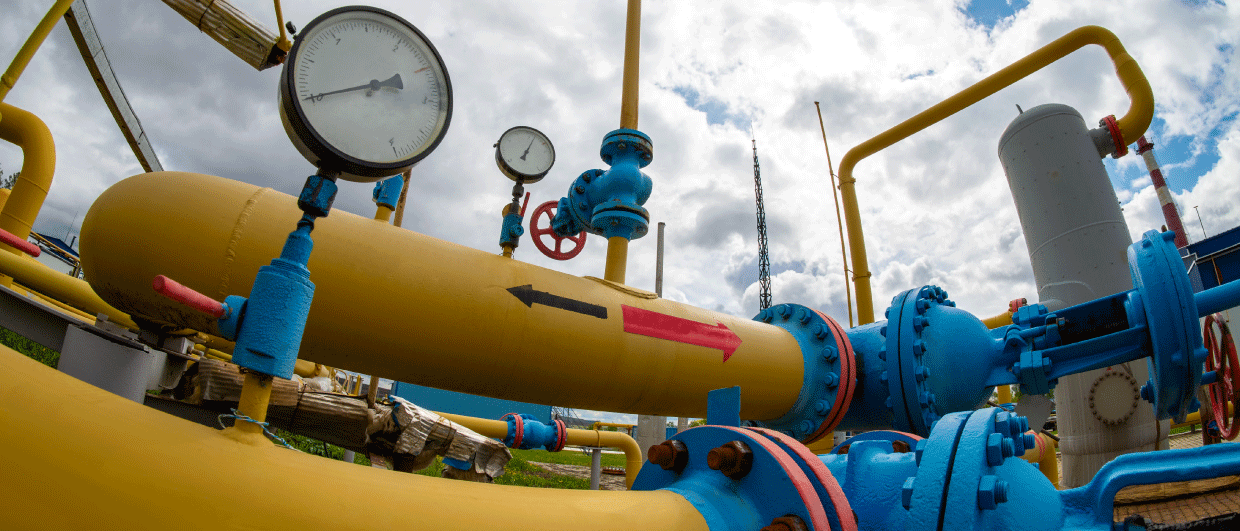
Gas processing station. Photo: 63ru78 via Adobe Stock.
Global gas storage projects on the rise
Both countries that already have a gas storage industry, as well as new ones, are working on and looking into expanding storage capacity

There is a lot of discussion in Europe at the moment around low levels of its gas storage reserves as winter is now approaching. Will there be enough? According to some analysts, it will be tricky. Where is Europe gas storage has traditionally been used to provide additional gas for heating in the winter months, there are multiple reasons to invest in this form of energy storage, with gas as a swing producer at times of low renewable energy output being one example. Security of supply and increased data centre energy demand are other obvious ones. It may therefore not be too much of a surprise to see that globally, the number of countries that are investing in gas storage projects seems to be on the rise, as a contact with knowledge on the matter recently told me.
In the US, the country with the largest gas storage capacity in the world (138 Bcm), Oil and Gas Watch Magazine reported that companies are planning up to 16 new gas storage projects in salt caverns, all in Texas, Louisiana and Mississippi. Being a combination of new as well as the expansion of existing gas storage projects, the added storage space (10 Bcm) will increase the currently available storage space in caverns by 50%. The drivers of this are multiple, with increased gas output from the Permian, more LNG terminal construction along the Gulf Coast, data centre demand and the energy transition – more flexible gas output – all mentioned.
Most gas in the US, and in the world, is stored in depleted gas fields. But in contrast to what one might think, the state of Michigan has the highest storage capacity (20 Bcm), followed and probably soon overtaken by Texas (19 Bcm).
China is also very actively expanding its gas storage capacity, with Reuters reporting that it added 6 Bcm in 2025 alone. With a total capacity still lagging behind the US significantly (around 30 Bcm compared to 140 Bcm), the policy to shift away from coal in favour of gas means that further growth is expected in China during the years to come, with one source writing that a working capacity between 80 and 100 Bcm is the aim in the years to come. And China wouldn’t be China if it were not involved in projects abroad as well. An example is a large gas storage project in the Aksaray Province in Türkiye, where 40 new salt caverns are under construction to store up to 5.2 Bcm of gas.
But there are also some countries that are new to the subsurface gas storage game. For instance, Brazil is currently working on its first subsurface gas storage project to support the power grid during times when renewable output will be low. The depleted Pilar gas field will be converted to a store of 0.1 Bcm, potentially to be upgraded to 0.5 Bcm in due course. India is also planning on constructing its first strategic subsurface gas storage projects, with state-run ONGC taking the lead on this. Like in Brazil, depleted hydrocarbon reservoirs seem to be the main candidates for this.
On reflection, there are multiple reasons for the expansion of subsurface gas storage capacity. But there is no doubt that the role of gas as a swing producer in a more renewable-dominated grid is one of them. A clear sign that the energy transition is slowly progressing.