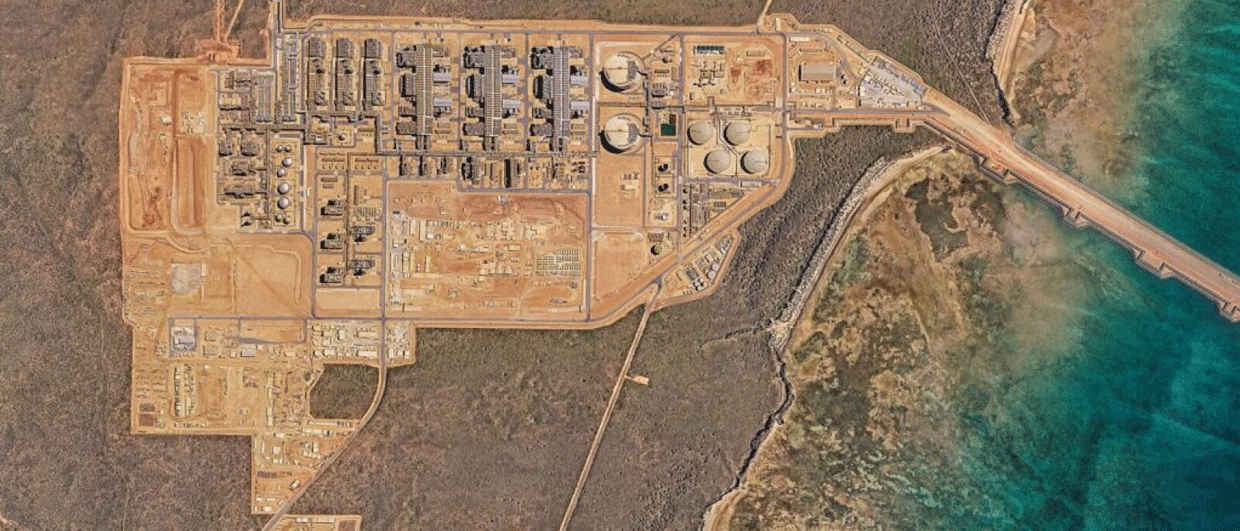
The Gorgon processing facility in Western Australia. Source: Chevron
Many CCS projects may falter quietly without the promised benefits
That’s the conclusion of a study recently published in First Break

In a recent special issue of EAGE’s journal First Break, dedicated to underground storage, one finds the usual articles that one would expect for such a publication. But there happened to be one little outlier. Or maybe a slightly larger outlier. A paper published by Ruud Weijermars and Simone Pilia, both affiliated with the King Fahd University of Petroleum & Minerals in Saudi Arabia.
In the introduction, the authors already warn that their message will not resonate well with the current “research lobbies and bandwagon supporters” of both green hydrogen production (GHP) and geological carbon sequestration (GCS).
They argue that whilst these parties claim that the technologies to support these activities are mature, in fact they are not, despite the “ballooning” number of literature claiming the contrary.
This dynamic of high levels of literature output has created a system in which political decision makers have gained a level of confidence in these technologies that is, in fact, misplaced. And with politicians ultimately being responsible for handing out subsidies, against a backdrop of well-researched climate change acceleration and a sense of urgency, it is no surprise that we see what we see: A large number of pilot projects depending on large amounts of subsidies without there being proof of the technology at scale.
A hype
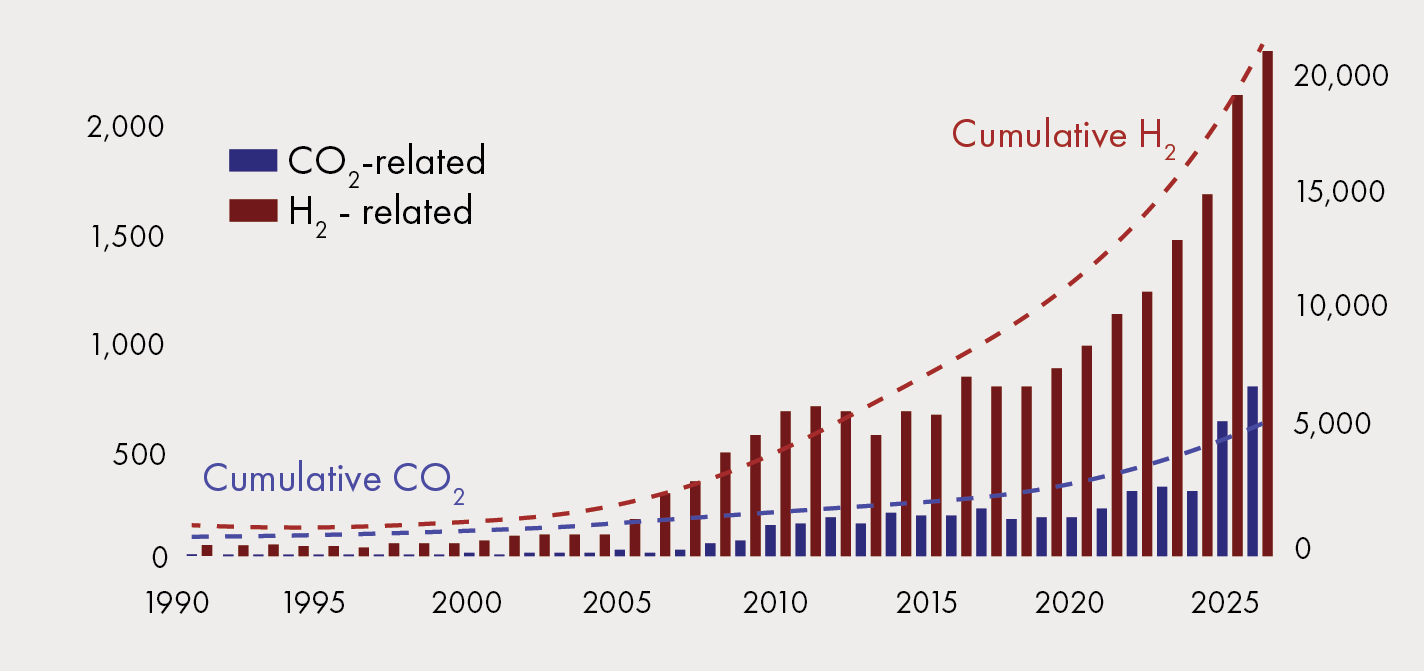
To back this up, the authors identify what they describe as a typical example of the Gartner-style hype: an initial trigger leading to a peak, followed by disillusionment and, subsequently, a “landing” in a phase of more modest, workable solutions.
Looking at the number of publications in the GHP and GCS spaces from European institutions, the authors observe a clear acceleration of publications during the last few years, which they now predict to decelerate or even start to fall in the next few years, as projects will progress at a slower rate than expected, or even just out-right disappoint.
No doubt
So, are we now in a phase where we see an increasing number of project failures? The authors leave little doubt. Looking at Gorgon in Australia, which keeps on being the only carbon storage project at scale, they observe continued injection challenges. They also argue that it is no surprise to see the Dutch CCS project Porthos experiencing cost overruns and project delays; the project was assigned to a government entity without operational experience that also lacks the contractor-handling leverage that large oil companies have.
Without denying that there is a climate problem that needs to be addressed, on the basis of their assessment, the authors cast doubt on whether CCS in the current form will ever be the way to achieve carbon neutrality.
This is an interesting conclusion, even when it is disconcerting at the same time. With all that public funding that has been and continues to be directed towards technologies that are lagging and costly, what are the alternatives? But still, maybe it is more important to have that very discussion more publicly than burying our heads in the sand.