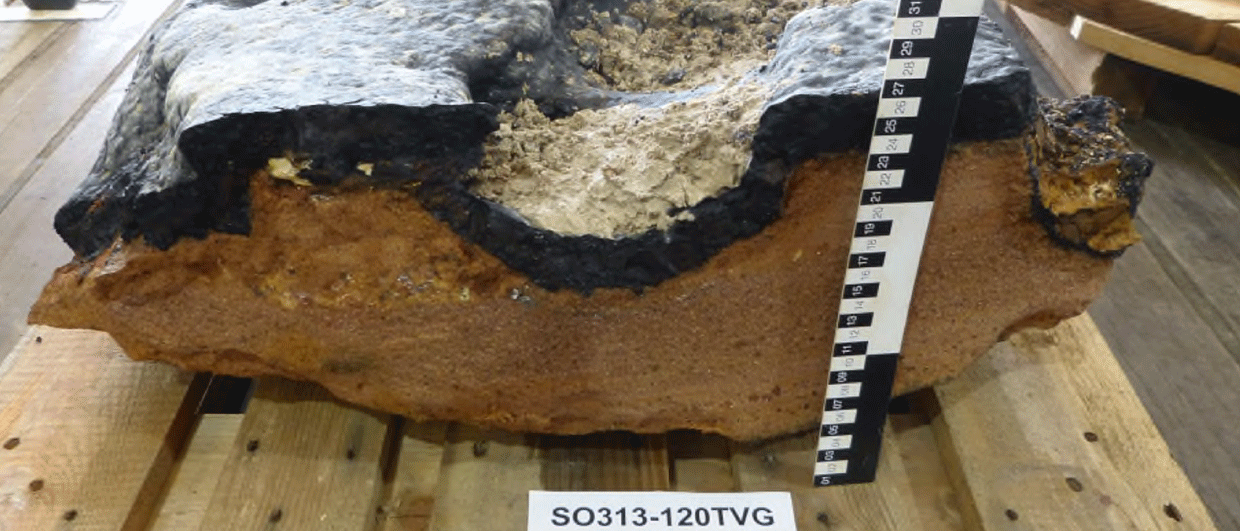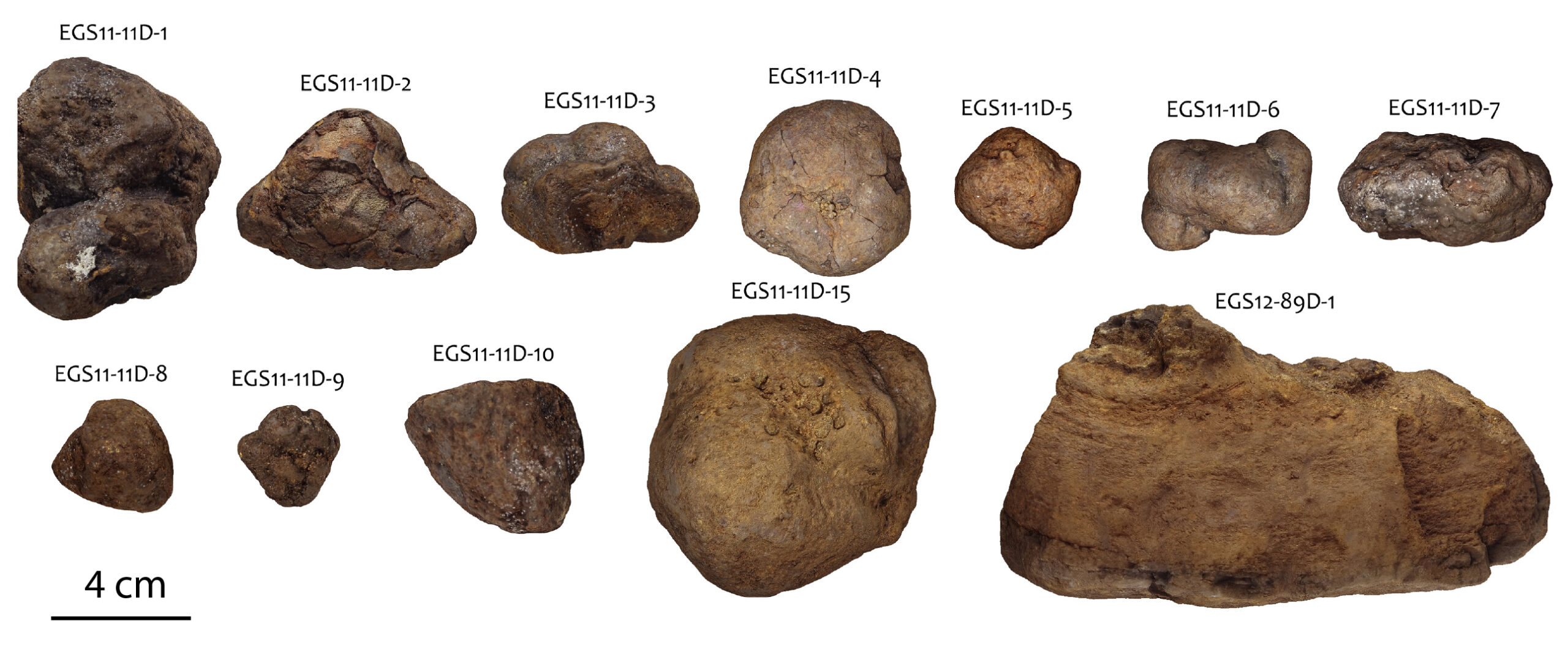
Hydrogenetic polymetallic nodules found during the survey expeditions in the Greenland Sea. Source: Zastrozhnov et al., 2026
Mic drop: Dropstones are, in fact, polymetallic nodules
Two expeditions looking for hydrocarbons in the Greenland Sea didn’t realise their find at hand and threw polymetallic nodules overboard. Scientific analysis on these nodules not only confirms their metal content, but also tells the story of the tectonic opening of the North Atlantic – Arctic gateway during the Miocene

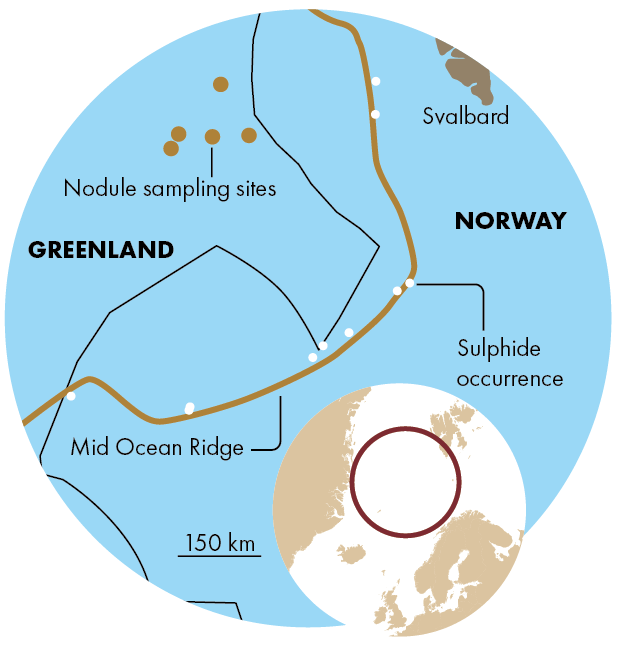 In search of oil seeps and to understand regional stratigraphy, VBER and TGS conducted two seafloor sampling surveys on Greenland’s north-eastern continental shelf over a decade ago. They retrieved samples through dredging and coring along the continental slope. Among the sample material were a multitude of ‘dropstones’, rocks carried out to sea by icebergs, or so was the interpretation at the time.
Dropstones were not the focus of the expedition, so about half of them were thrown back overboard, and the other half were filed away. Years later, Ebbe Hartz, a geologist at Aker BP, had a light bulb moment. Based on his understanding of the region’s oceanography and mineral-forming processes, he believed that the dropstones might in fact be polymetallic nodules. When the archive was checked, there indeed turned out to be nodules present and a project was launched to study them in detail. Twenty-four nodules from three different locations were selected for analysis.
The research revealed two separate groups of nodules, each with its own distinct appearance, chemistry, origin and age. Both nodule types were found at each sample location. The first, and most prevalent group, displays well-developed, thin concentric banding around a nucleus. These nodules are interpreted to be of hydrogenetic origin: they formed over millions of years by precipitation of metals directly from seawater. Age dating indicates that growth began around 13 – 14 M yrs ago. This coincides with the opening and deepening of the Fram Strait between Greenland and Svalbard and the establishment of deepwater exchange between the Arctic and Atlantic Ocean.
The nodules thus point to a direct link between ocean circulation and metal supply to the Greenland shelf. Arctic water rich in dissolved metals began flowing south while oxygen-rich water from the North Atlantic flowed in the opposite direction. This favoured the necessary oxidising conditions and precipitation of dissolved iron and manganese on the seabed. Meltwater from the Greenland Ice Sheet may have provided additional metal input and influenced growth.
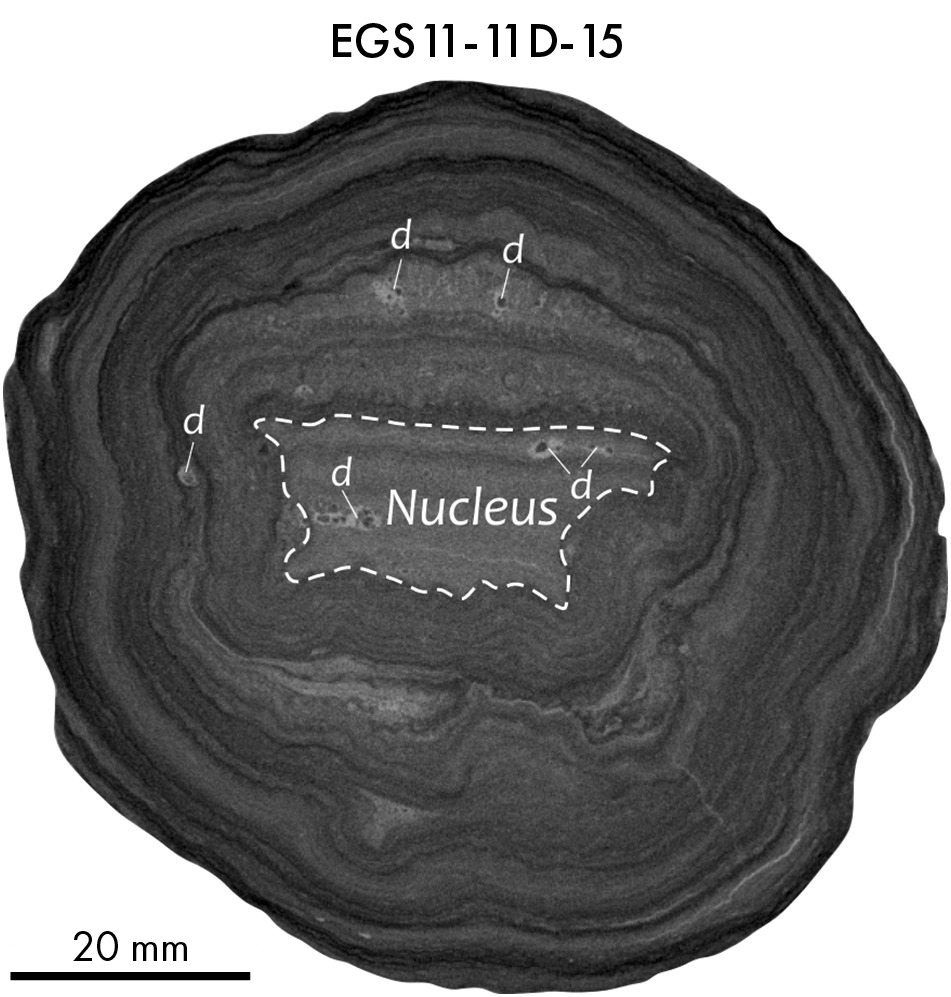
Nodules from the second group are fragments of larger, tabular nodules. They have an extremely high iron content, around 60 wt%, suggesting a hydrothermal origin. Age dating shows that they are much younger than the hydrogenetic nodules, around 0.3 – 0.4 M yrs, and have grown much faster. Although the origin of this nodule type is a bit of a mystery, mineralisation is thought to be the result of weak and diffuse hydrothermal circulation near the seabed.
There it is, the discovery of the first polymetallic nodules in the North Atlantic! An accidental find that almost went unnoticed.