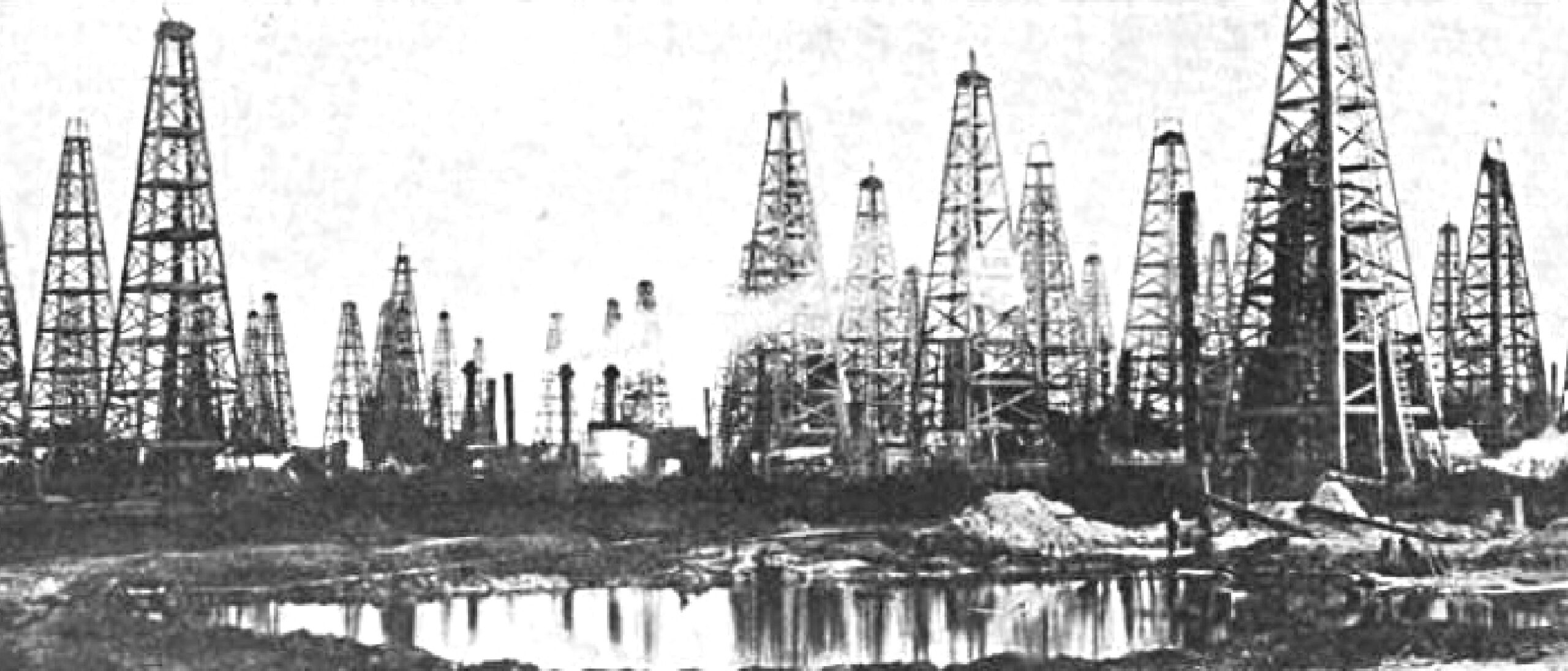
A view of the Spindletop oil field, Texas, March 1903. Source: Wikimedia Commons.
Spindletop spin-off: Helium storage
Due to the ongoing issues in the Persian Gulf, many countries and companies realise they should have built up helium reserves to counter the shortfall and price hikes

Qatar, generally responsible for a third of global helium supply, has had to halt production because the Iran war prohibits export. Storing liquified helium gas at surface is not cost-effective; highly specialised, insulated tanks are needed, and even then, the gas will still slowly evaporate. Hence, helium and natural gas are best left in the North Field reservoir until the Strait of Hormuz reopens.
The same is true when building a long-term helium stockpile; the gas is preferably stored in the subsurface. The US government realised this early on and has been incredibly successful at storing crude helium in the depleted Cliffside gas field in Amarillo, Texas. Starting in 1945, they stocked market excess helium for future military use and retrieved the majority during the Korean War and Space Race with Russia. Thanks to the very high recovery factor, the federal government decided to turn Cliffside into the official National Helium Reserve in 1963. The facility was eventually sold in 2024.
The Cliffside field is a dolomite reservoir on top of a salt dome. With anhydrite capping the reservoir, a perfect trap was created. On the other side of the state, near Houston, salt tectonics are prevalent too. This is the area of the famous Spindletop gusher, the huge blowout that occurred when oil was struck in 1901. Here, a helium storage site has also been created, but this time not in a depleted reservoir but in the salt of the dome itself.
The top of the salt diapir is relatively shallow, sitting at around 365 m depth. It has a diameter of approximately 1.5 km and extends 3 km down. Caliche has solution-mined two caverns for helium storage in the Jurassic Louann Salt. One of the caverns is in use by Air Products, while the other, newer one, came online a year ago and was commissioned by Linde. The companies store helium that is recovered from the waste gas of locally produced LNG; when methane is liquified, residual gas rich in nitrogen and helium remains.
Gasworld reports that Air Products has already tapped into its stored helium reserves due to the crisis in the Middle East. This comes at an additional cost because the helium has to be re-liquified before it can be supplied back to the market. Apart from helium, the salt domes in the Spindletop field also contain caverns for hydrocarbon storage. The Big Hill diapir houses 14 caverns with a total storage capacity of 170 million barrels. These caverns make up about a quarter of the Strategic Petroleum Reserve of the US government. The Trump administration is currently selling stored hydrocarbons to oil companies to combat the price hike related to the Iran war.
More than a century after the Texas Oil Boom, Spindletop continues to influence the market.