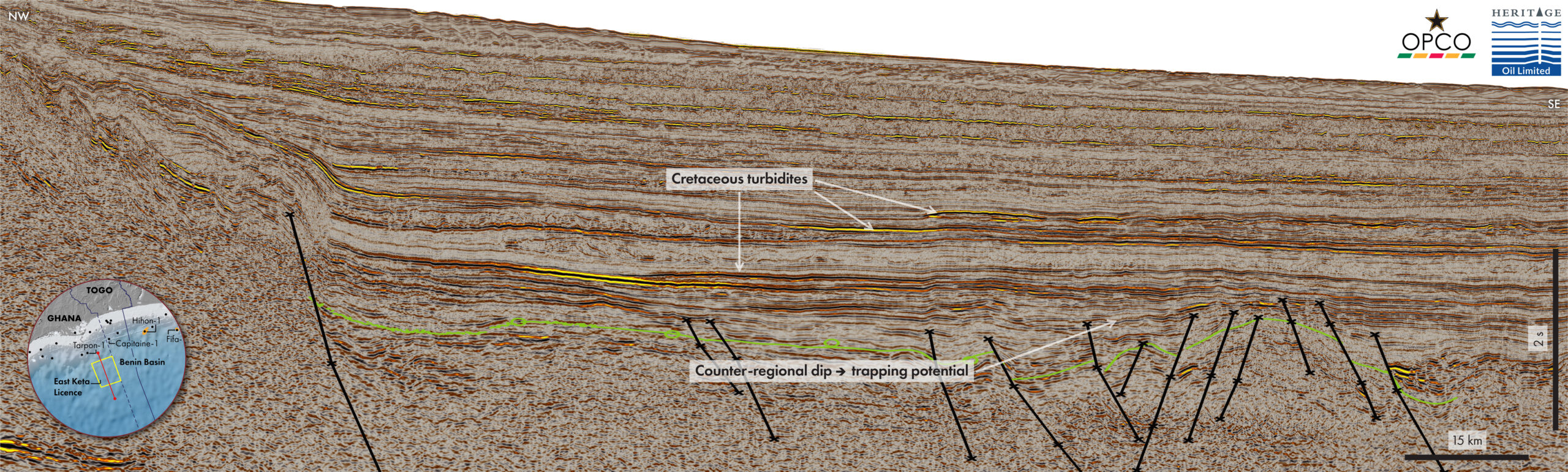
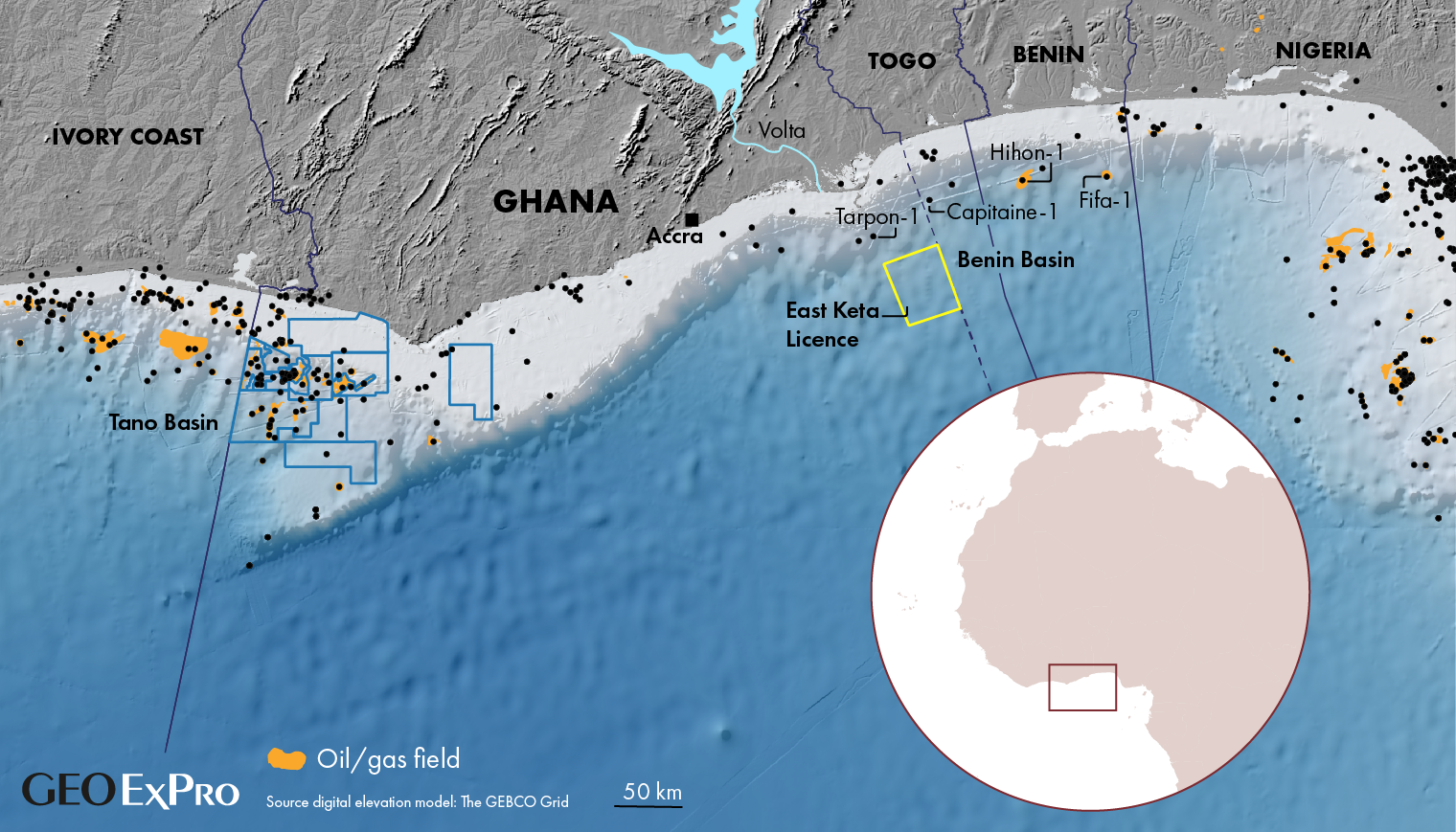
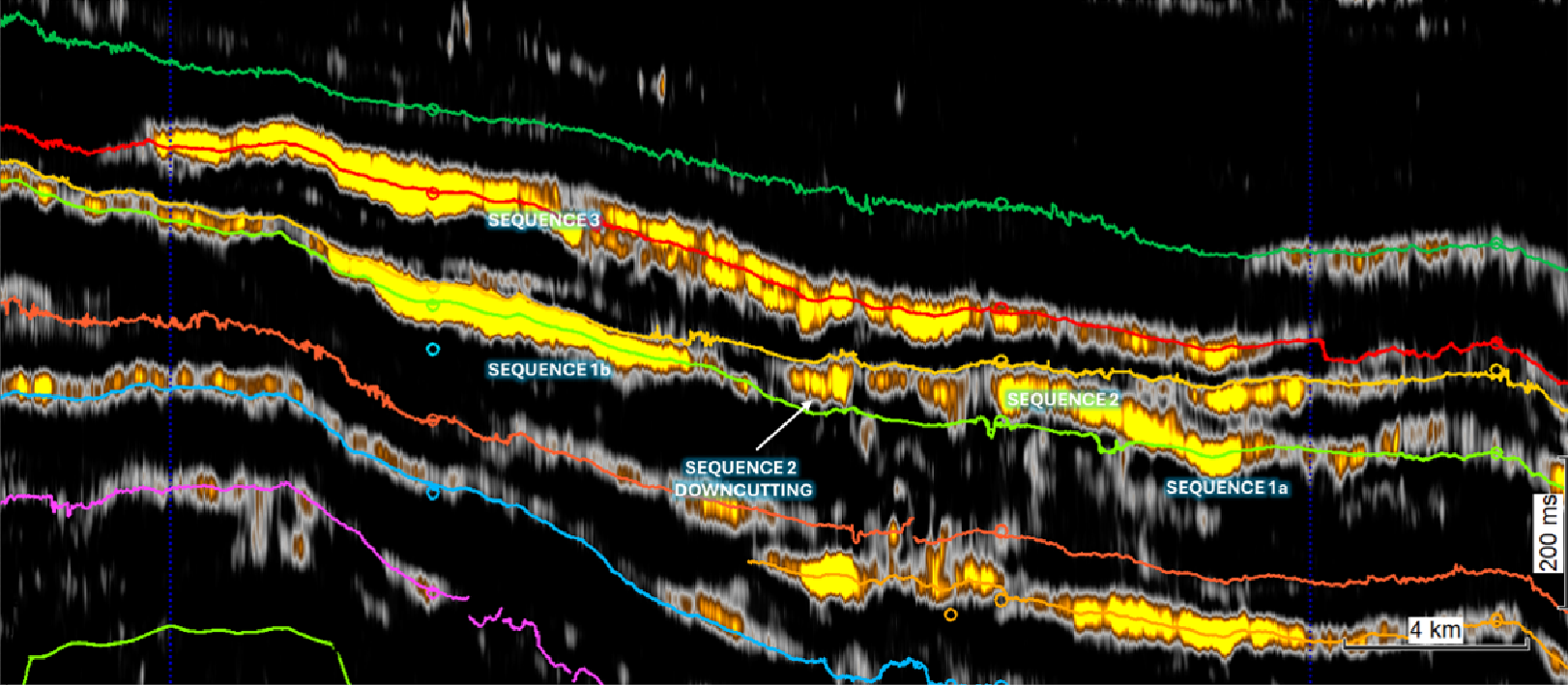
The underexplored Keta-Benin Basin is beginning to attract renewed interest as explorers reassess the hydrocarbon potential of one of West Africa’s least drilled deepwater provinces. Whilst the region has historically sat in the shadow of Ghana’s prolific Tano Basin, a growing body of geological evidence suggests the Accra-Keta section of the basin in particular may share many of the same elements that transformed the Jubilee trend into a world-class petroleum province and brought the Transform Margin turbidite play to the fore. Multiple encouraging indicators such as mature source rocks, stacked turbidites, high-quality reservoirs, and evidence of active hydrocarbon generation converge in the area as exploration trends towards ever deeper water. Heritage Oil, through the “OPCO” joint venture, operates East Keta, the only licensed acreage in the Accra-Keta portion of the basin. With a “Frontier Potential with Frontier Risk” profile, the area presents a prime opportunity for a major to take a leading position. This article further describes why. The East Keta acreage lies in the central portion of the Accra-Keta-Benin basin, formed during the Middle Cretaceous opening of the South Atlantic. Geologically, the basin shares some similarities with the Tano and conjugate Barreirinhas basins, but with its own subtle differences in maturation history and sediment supply due to its slightly earlier opening. Sediment provenance is linked to the Volta River and associated deltaic systems, as outlined in the article from GeoPartners and Trois (GEO EXPRO Vol. 22, Issue 4, 2025), indicating that Keta reservoirs may be related to the high-quality reservoirs found in the Tano Basin. The basin architecture comprises a progression of depositional environments, beginning with Lower Cretaceous syn-transform fluvio-deltaic and lacustrine sediments, overlain by Upper Cretaceous shallow-marine sands and shales, transitioning basinwards into deepwater slope-channel turbidite complexes. Together, these systems create multiple stacked reservoir intervals spanning from the Albian through the Tertiary. Lessons from historical wells provide evidence of the key elements of the petroleum system. At least two mature Cretaceous source intervals are expected across the basin, namely a Lower Cretaceous lacustrine shale sequence and overlying Turonian – Coniacian marine shales. TOC values are encouraging, reaching up to 5 % in some intervals, and kerogen types are predominantly oil-prone Type II and mixed Type II/III. In addition, thermal modelling indicates that much of the Upper Cretaceous section sits within the oil maturation window, while deeper Lower Cretaceous intervals may have entered the gas window. Timing also appears favourable. Structural inversion is interpreted to have ceased during the Campanian, suggesting hydrocarbon generation post-dated major trap formation, critical for effective charge retention. Despite limited drilling, reservoir presence has repeatedly been confirmed in the Keta Basin. Deepwater wells encountered an array of Albian shallow marine sands, Upper Cretaceous turbiditic sandstone intervals and Miocene fan systems, with porosities ranging from 19–30 % and permeabilities locally exceeding 500 mD. These reservoir parameters compare favourably with successful Atlantic Margin plays elsewhere in West Africa and South America. The basin contains multiple sealing horizons, particularly within Cretaceous and Tertiary shale packages. Both structural and stratigraphic trapping styles are interpreted, though stratigraphic pinch-outs and combination traps are expected to dominate in the post-rift section. The Keta Basin’s exploration history is best described as a series of near misses. Historical drilling has repeatedly confirmed key elements of a working petroleum system, providing evidence of mature source rocks, excellent quality reservoirs and hydrocarbon shows, but without a commercial breakthrough to show for it. Tarpon-1 encountered high-quality Miocene sands with porosities approaching 30 %, although the interval proved water-bearing and the deeper Cretaceous objectives remained untested. Capitaine-1 and Fifa-1 both confirmed good-quality Albian and Cretaceous reservoirs alongside mature source rocks, reinforcing the view that trap integrity and migration pathways remain the principal exploration risks. Most significantly, Hihon-1 recovered oil and condensate samples from Lower Cretaceous sands, including waxy 32° API crude, confirming an active Cretaceous petroleum system within the basin. Exploration momentum in frontier basins often returns when technology catches up with geology. That may now be happening in East Keta on the back of a seismic reinterpretation exercise that has identified the presence of large slope-channel systems within the Campanian succession. The presence of combination structural-stratigraphic traps, similar to those observed across the margin, will likely be the key factor in determining the future drilling success of these turbidite fairways. With water depths ranging between 2,500 and 3,500 m, the East Keta licence lies firmly within the modern ultra-deepwater exploration arena. Analogous developments elsewhere in the Atlantic Margin demonstrate that such settings can be commercially viable when scale and charge align. Fortunately for Heritage and the OPCO JV, the East Keta licence hosts prospectivity of the scale required to make such a frontier area attractive. Seismic interpretation indicates two main prospective sequences in the Miocene and Upper Cretaceous, with the latter showing the familiar multi-phase slope channel turbidite complexes with direct access to source rocks within the oil window. Additional prospectivity lies in the deeper Cretaceous in counterregional combination traps. The scale of the turbidite complexes is difficult to ascertain on the available wide-spaced 2D data, yet mapping within the Upper Cretaceous shows three parasequences covering a significant portion of the licence with multi-billion barrel potential on their own. Despite the growing optimism however, East Keta remains a frontier exploration province. The basin as a whole remains lightly drilled, with no modern deepwater well having fully tested the lower slope play concepts. Many of these challenges would be addressed with modern, high-resolution 3D seismic data. While Heritage currently has access to a sparse 2D grid, the scale of the identified prospectivity is very encouraging. For the industry, the Keta Basin represents the kind of opportunity that periodically reshapes regional exploration narratives: a basin long overlooked, technically challenged, but increasingly difficult to dismiss. The ingredients of a working petroleum system are present; reservoirs are proven and source rocks are mature. Oil has been recovered. What remains unanswered is whether the basin contains the scale, trap integrity, and migration efficiency necessary for commercial success. In an era where the big explorers are revisiting overlooked Atlantic Margin acreage, such as TotalEnergies in Liberia’s Harper Basin, with fresh seismic tools and renewed appetite for frontier potential, the Accra-Keta basin may yet emerge as one of West Africa’s more exciting deepwater frontiers.
The Keta Basin: Ghana’s deepwater frontier edges back into focus
The Keta Basin – a basin with familiar geological DNA
The petroleum system: Increasingly difficult to ignore
Reservoir quality
A history of near misses
Why interest is returning
The East Keta licence: The scale required to move the needle
A frontier worth watching
Related Articles