Photo: Subsurface Alliance.
The inconvenient truth about pore pressure prediction in unconventional plays
Some reasons why traditional normal compaction trendline workflows undermine pore pressure prediction in shale plays, and why basin-specific, physics-based adaptations are essential for reliable pressure prediction

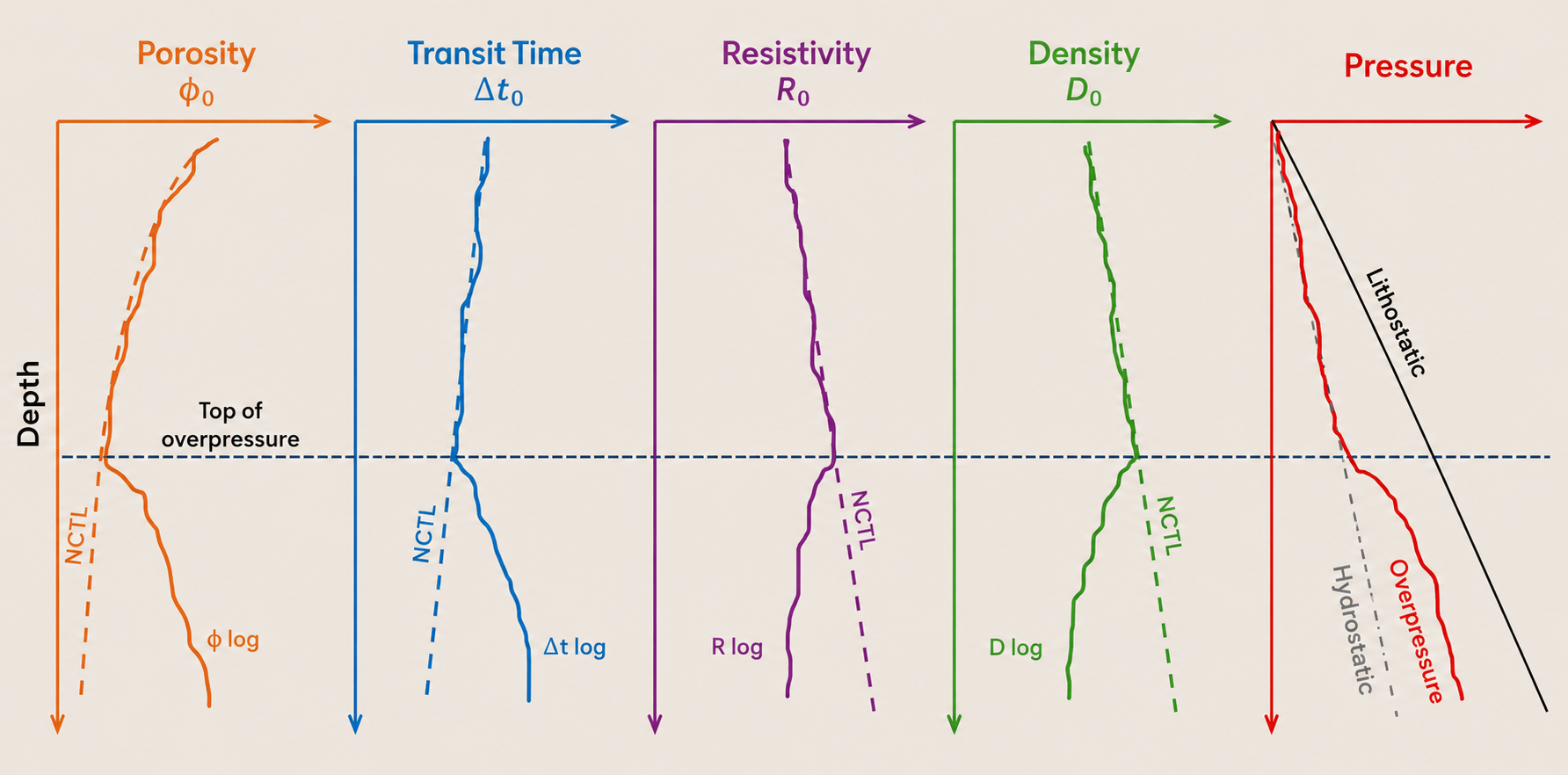
Pore pressure prediction has always been central to safe drilling and well planning. But in the last two decades, during which thousands of wells have been drilled across US unconventional basins, the industry has learned a hard truth: Unconventional basins often carry complex burial histories, gas effects, thermal anomalies, and late-stage erosion. These factors distort the assumptions behind log-derived normal compaction trendlines (NCTLs), the backbone of most pore pressure workflows. Classic NCTL-based techniques rely on identifying deviations from a “normal” porosity–depth relationship to detect the onset and magnitude of overpressure. This works well in basins like the Gulf of Mexico, where compaction is dominated by progressive burial and undercompaction.
But onshore unconventional plays frequently violate these assumptions. Gas-charged mudrocks, uplifted sequences, and eroded basins introduce non-unique porosity–stress relationships, making trendline-based predictions unreliable without modification. Here are three examples from three different basins demonstrating that unconventional pore pressure prediction is not a plug-and-play exercise.
Haynesville Shale
The Haynesville is a deep, hot, gas-bearing system with pore pressures reaching 18 ppg and temperatures near 350° F. Gas effects distort acoustic velocities, making uncorrected acoustic-based methods misleading. To overcome these challenges, Zhang & Wieseneck (2011) suggest building basin-specific correlations for density and overburden, correcting compressional velocity using shear velocity (Castagna’s mudrock line), and honoring first-principles compaction behavior. This workflow resulted in a simple, reproducible workflow that respects physics and performs reliably across the play.
Delaware Basin
Late-stage erosion in the Delaware Basin produces unloading, meaning porosity no longer maps uniquely to effective stress. Conventional NCTLs fail because the rocks “remember” deeper burial. To overcome these difficulties, Lockhart et al. (2023) proposed a modified approach through applying Bowers-style unloading relationships, incorporating eroded thickness into effective-stress reconstruction, and modelling drained vs. undrained responses using poroelasticity (Wang, 2000). Their method not only matched well data, but also explained sub-hydrostatic pressures at the top of drained zones, an outcome physically consistent with the basin’s history.
Niobrara Shale
A recently proposed model for the Niobrara (Orozco & Aguilera, 2021) claims to estimate pore pressure using “in-situ” Biot coefficients. However, the method yields Biot values greater than 1, which is a clear violation of poroelasticity theory (Wang, 2000) and contradicts both laboratory and numerical evidence. In contrast, Yale et al. (2018) offer a first-principles-based workflow that honors the geological basin history by using corrected velocities according to lithology and porosity using rock physics, applying a Biot coefficient within physical limits, and integrating thermal maturity with pore-pressure trends. Although the approach is robust, it still requires careful petrophysical calibration. Normal Compaction Trendlines techniques applied to well logs to identify and quantify overpressure zones.