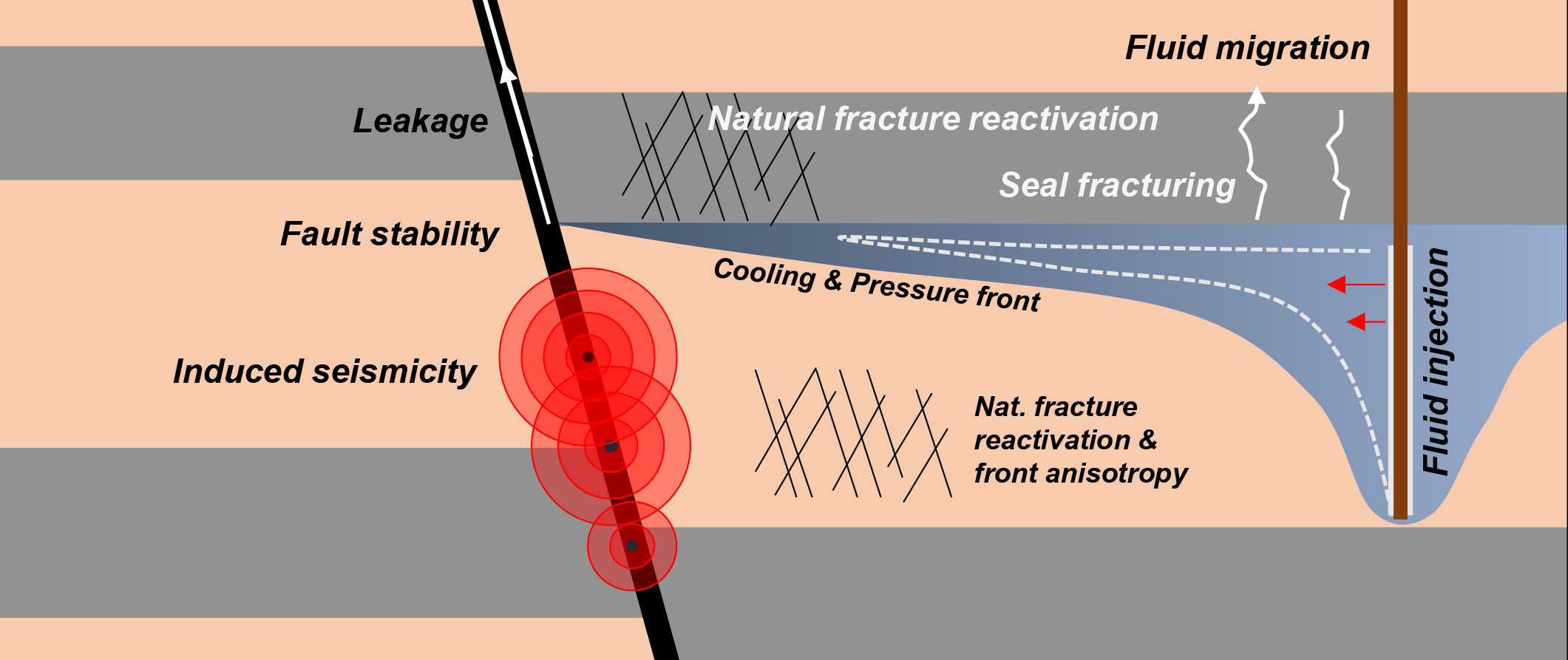
Schematic illustration of fault/fracture reactivation and other risks associated to fluid injection. Sketch focuses on CO2 injection and the potential for inducing fault slip and seismicity. Source: Subsurface Alliance.
Your fault stability analysis might be lying to you
The number your geomechanical model spits out looks reassuringly precise. A tau-ratio of 0.76. A critical pore pressure of 55 MPa. A sliding friction coefficient of 0.6. Clean. Definitive. Often misleading

The Mohr space represents stress states and, combined with fault strength criteria, is used to assess fault stability. It is simple, elegant, and widely accepted. It is also, when applied deterministically, rather misleading. Mohr circles are built on single best-estimate values for key geomechanical inputs, and they do not reflect the true variability and uncertainty of the subsurface. In other words, the number your model produces may look precise, but that doesn’t make it right.
Your model is not wrong in a way that it would get flagged in a peer review. It is wrong because every single one of those inputs has an associated uncertainty. Your friction coefficient? Likely taken from literature and assumed to be representative of your fault. Your stress magnitudes? Inferred from leak-off tests and borehole breakouts at best from a sparse borehole dataset. Your fault geometry? Interpreted from limited resolution seismic data… The deterministic model takes all the uncertainties, collapses them into a single number, and hands you a verdict: Stick or slip.
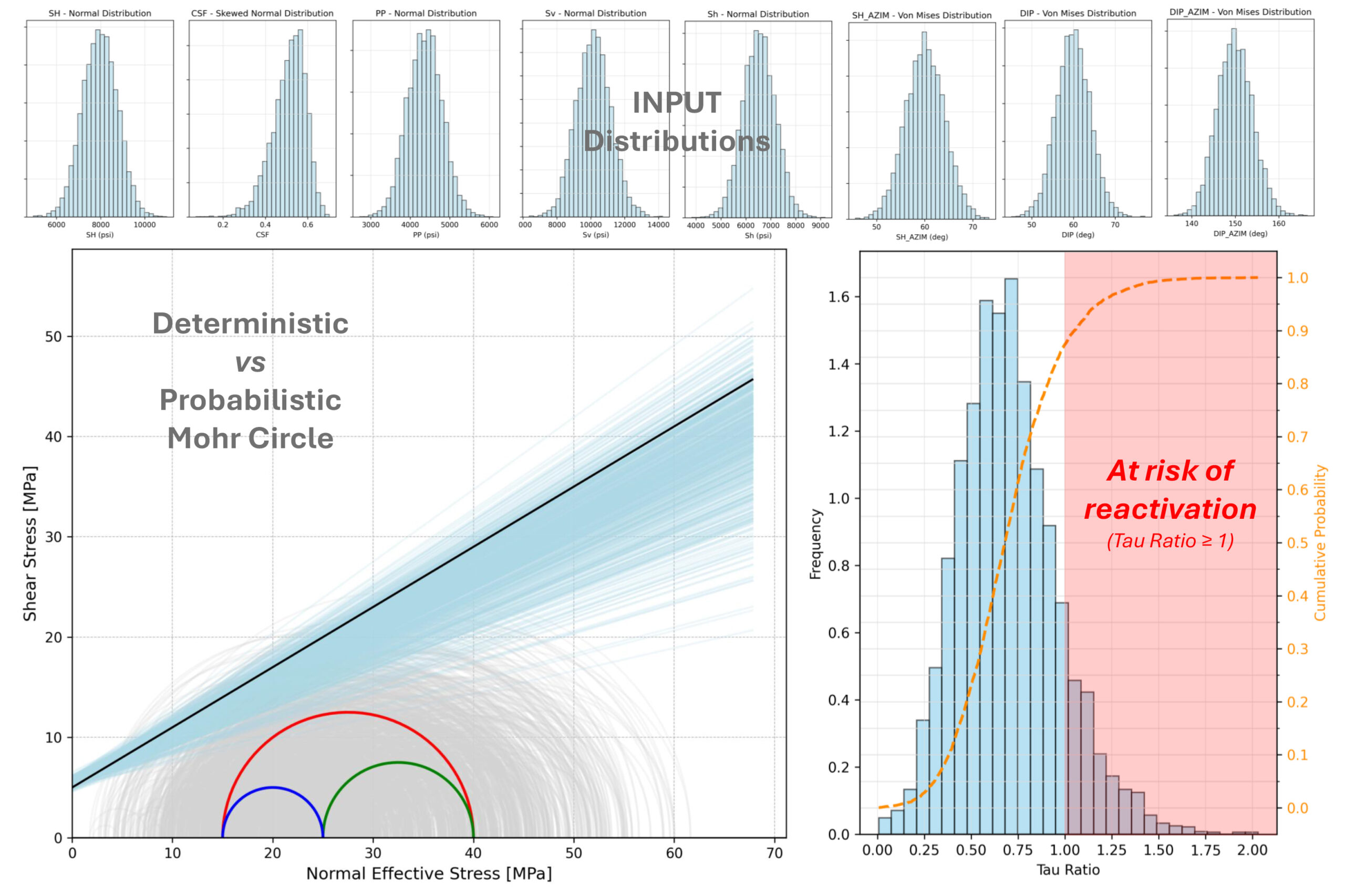
The final verdict is just one plausible scenario, presented without acknowledging the many others. And the one place this matters most is fluid injection. In CO₂ storage, water flooding, wastewater disposal, or geothermal operations, pore pressure increases while reducing the effective stress with every pore volume injected, effectively moving the Mohr circle towards failure. The margin between stability and reactivation often lies within the uncertainty range that deterministic models refuse to acknowledge.
The solution is not a complicated fix, yet we often fail to go the extra mile. Instead of treating inputs as fixed values, treat them as distributions: Ranges that, when possible, are quantitatively defined from observed variation across wells in an area. This distinction matters. Field-calibrated uncertainty limits mean the model reflects actual spatial heterogeneity and measurement variability, not generic assumptions. From there, a Monte Carlo simulation runs thousands of realisations, propagating uncertainty in stress magnitudes, pore pressure, and fault properties through the stability calculation. What you get back is not a single number, but a chance of fault slip.
Probabilistic analysis should not be an advanced tool, but due diligence. Before committing to the cost and complexity of full 3D numerical models, a Monte Carlo assessment can help depict your risk landscape. If the probability of reactivation is truly zero across the entire input distribution, then results are defendable and it may be all you need. On the other hand, if a chance of fault slip exists, that is your signal to go beyond and commit time and resources to advanced 3D numerical simulations.
The threshold between stopping at the probabilistic assessment or continuing to numerical models is not set in stone; it depends on your risk tolerance, your regulatory context, and the consequences of getting it wrong. Probabilistic analysis does not make the call for you. It just ensures you are making it with a clear perspective.