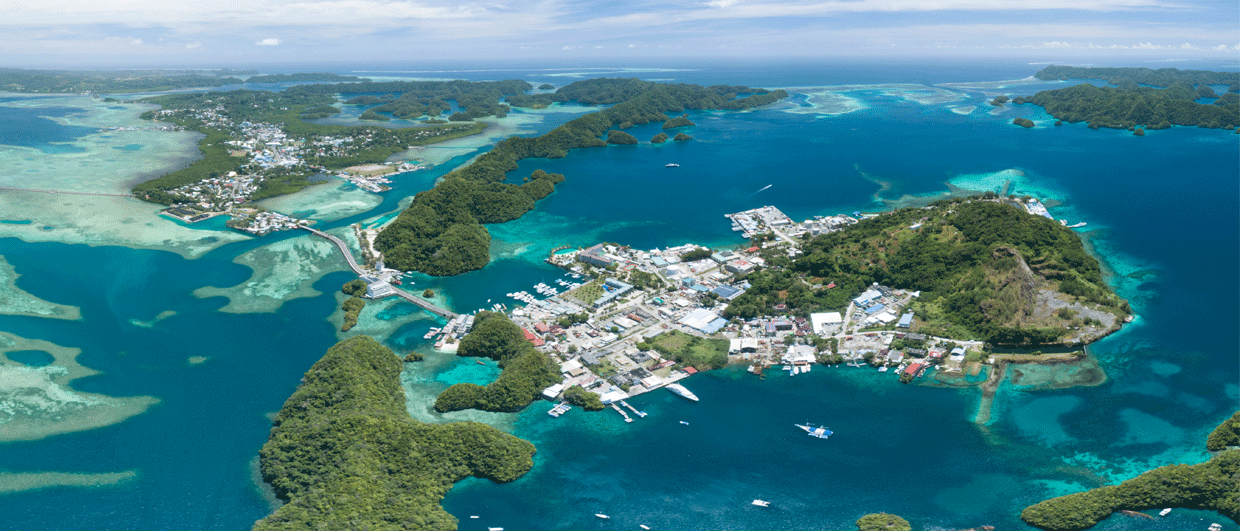
Santorini island, Greece. Photo: Patryk Kosmider via Adobe Stock.
Mediterranean eyes on Greece as deepwater drilling approaches
Testing a massive 10 Tcf Jurassic carbonate gas prospect, Energean will drill the Asopos-1 wildcat well in the northwestern Ionian Sea in early 2027, marking Greece’s first offshore exploration well in 45 years

The exploration hunt for hydrocarbons in Greece started in 1938 with the drilling of shallow wells. After a post-war lull, the passage of Greece’s first comprehensive petroleum law in 1959 drew immediate international attention, prompting Esso to secure exploration permits. By 1960, companies flocked to the country, including bp and Hunt Oil. However, this early wave of excitement proved short-lived, and following a series of highly disappointing drilling campaigns, most of these original concessions were surrendered by 1965.
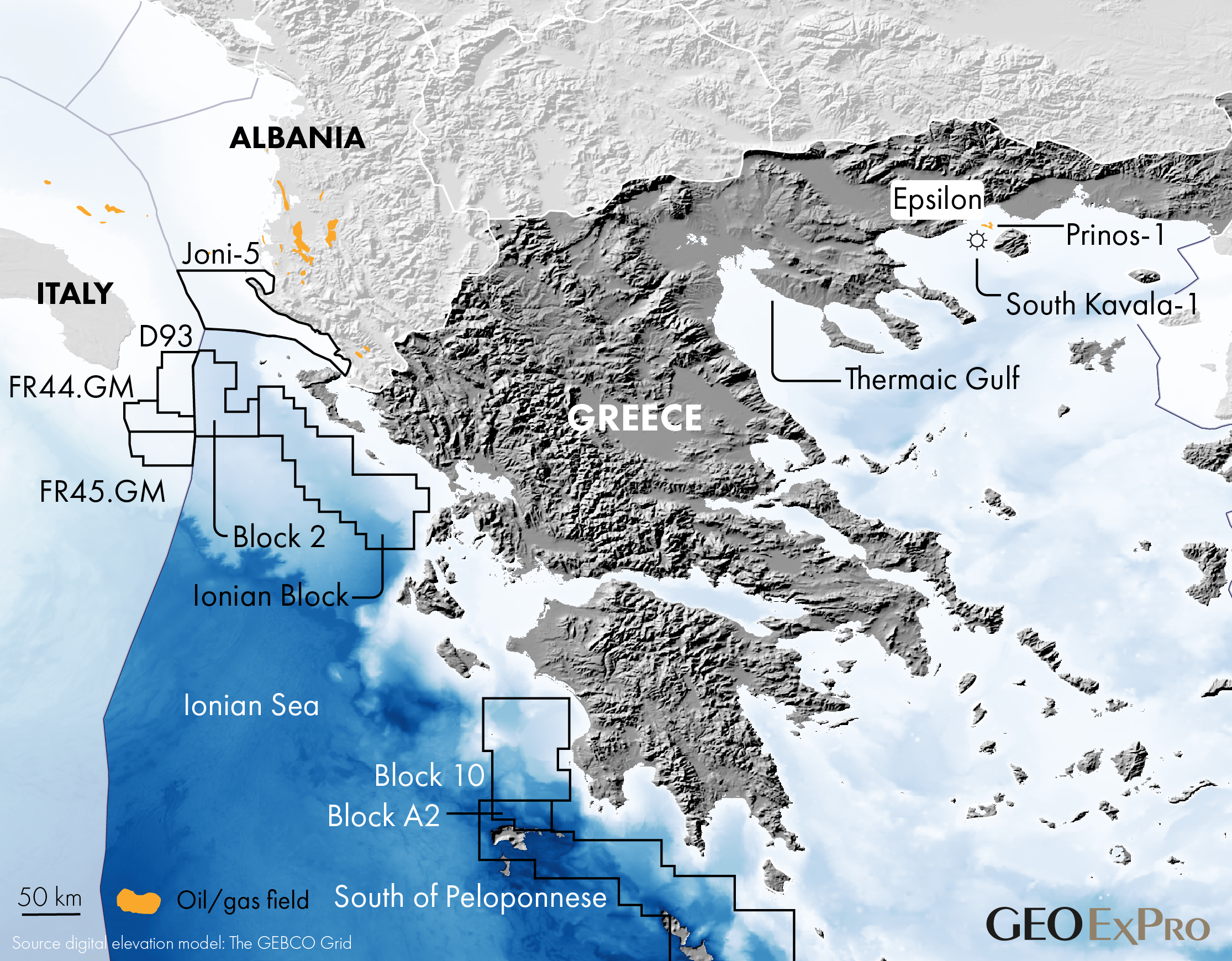
A second major wave of exploration kicked off in 1970 when Texaco entered Greece to take on an offshore concession located within the Thermaic Gulf. This era delivered Greece’s first commercial success when Oceanic discovered gas at the South Kavala-1 well in 1973, which they quickly followed up in 1974 with a moderately heavy oil discovery within Miocene sands at the Prinos-1 well in the Gulf of Kavala. Today, the concession is held with a 100 % working interest by regional operator Energean, formerly known as Aegean Energy. The Prinos, Prinos North, and Epsilon fields within this area remain the only producing oil fields in Greece, although their operations have been stop-start.
In 1996, Greece opened its First International Licensing Round and alongside local company Hellenic Petroleum, Enterprise Oil and Triton were awarded acreage. Exploration campaigns on and offshore were disappointing, however, and exits followed. After a 15-year lull, Greece launched an Open-Door Round in 2012 and the Second International Licensing Round in 2014. While initial industry interest was mixed, the global energy sector took notice after massive deepwater carbonate discoveries were made in neighbouring Mediterranean waters across Egypt, Israel, and Cyprus. This regional success attracted supermajors Total and ExxonMobil to apply for Greek deepwater acreage, alongside Repsol and Edison. Strategic corporate realignments later caused TotalEnergies and Repsol to pull out of the country entirely, while Edison’s exploration arm was swallowed up by Energean, sparking a reshuffling of concession interests.
The current landscape features a high-stakes return of major US energy companies supporting the Greek government’s push for domestic energy security. In November 2025, ExxonMobil increased its footprint and executed a farm-in agreement to take a 60 % stake in Block 2. Following this, Chevron expanded its Mediterranean growth strategy in 2026 by partnering with HELLENiQ ENERGY across five deepwater concessions, signing deals for South Crete 1, South Crete 2, Block A2, and the South of Peloponnese, followed by Block 10. In addition, Block 1 is the subject of a submitted bid.
This latest surge will reach an important milestone in 2027 with the drilling of the Asopos-1 wildcat well in Block 2. Approximately 40 % of the Asopos structure is understood to extend directly into Italian waters, and the prospect sits just south of Albania’s open Block Joni-5. Energean had previously applied for the adjacent Italian 84F.R-EL block (now designated as D93), and directly to the south in Italian waters, Globel MED of Denver operate FR44.GM and FR45.GM contiguous with the Greek waters.