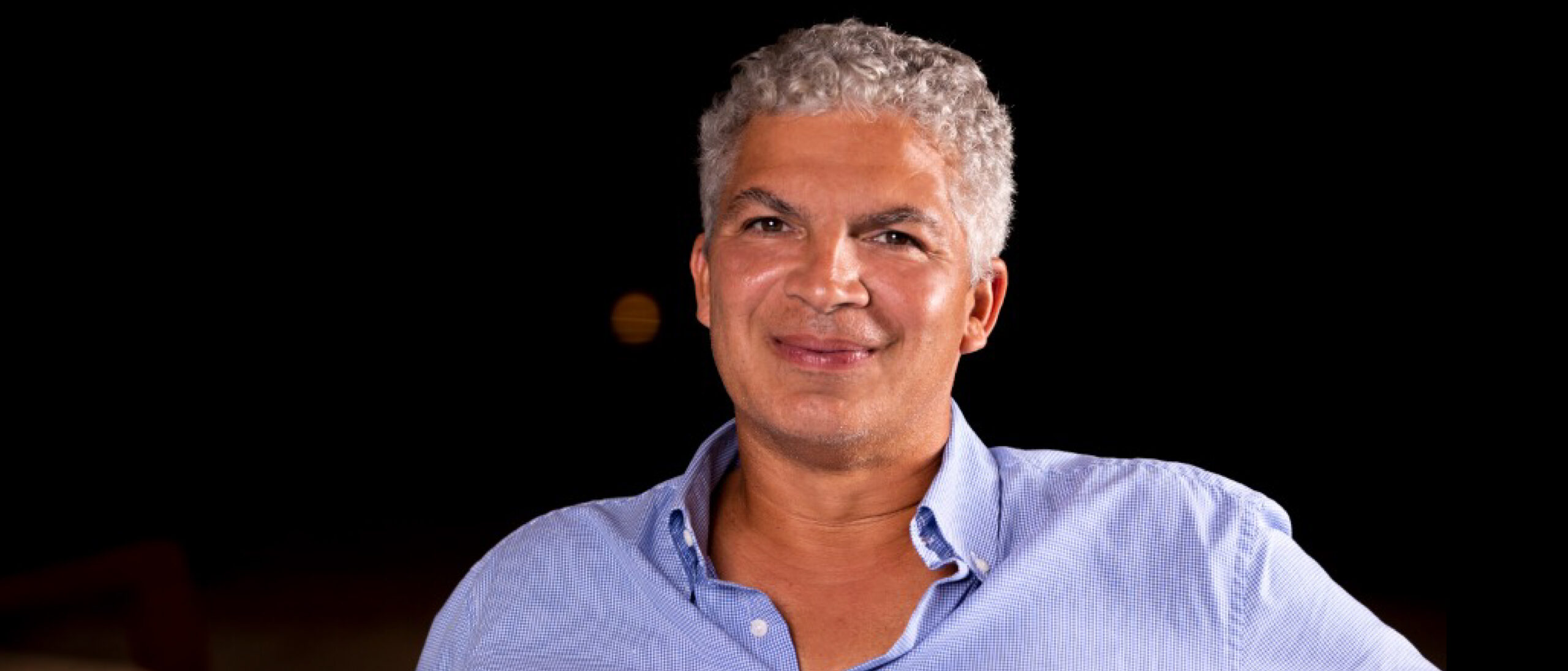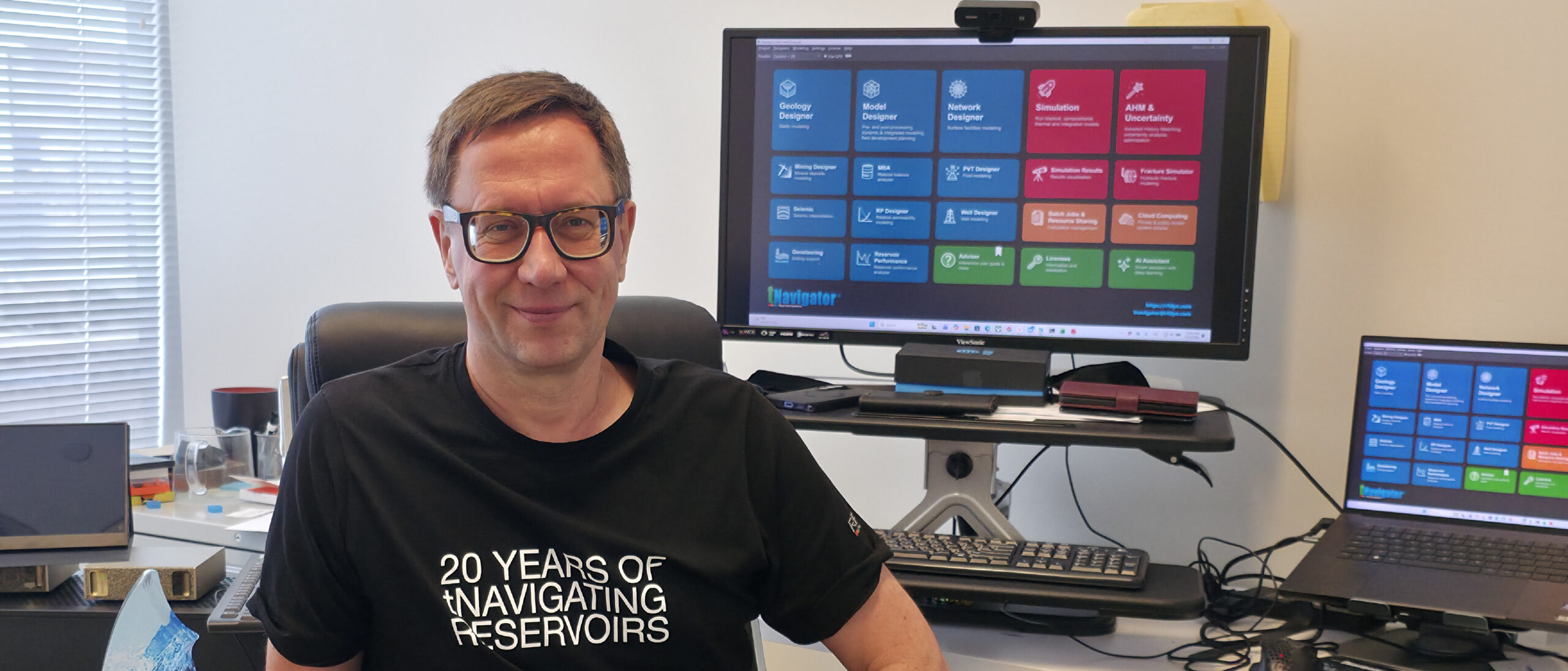
Surrounded by computers at the RFD Houston office. Photo: RFD.
“Running a company is like having a long-term relationship – you have to give and take, but always carry on”
A conversation with Vasilii Shelkov about how he established reservoir simulation software business RFD whilst coming from the academic world of physics and accelerators

“Moscow was a dark place near the end of the 1980s. Literally, dark. It was hard to find a bar to have a drink,” remembers Vasilii Shelkov when we start our conversation about his early years as a physics student in Russia.
It wasn’t a real surprise for Vasilii to go and study physics. “Both my parents were scientists,” he says. As a family, they moved to Dubna, outside Moscow, which was known as a science city. It was constructed in the 1960s with the idea of becoming a rival to Berkeley Labs in the USA. Little did Vasilii know that he would later make a name for himself at this US rival.
“I saw my dad having so much fun,” Vasilii continues. “They built all these new particle detectors, designed new experiments, and people were competing to reach another breakthrough. And we had access to computers much earlier than everyone else. I remember I was sending emails before I went to university, using mainframes that I I had access to through my parents’ work.”
“Times were a little crazy as I entered university during the last year of the Soviet empire in 1987,” he says. “For years, all university students had been taught a compulsory course on the history of the communist party. Then, all of a sudden, it was scrapped, with no real replacement. That’s why we ended up getting an overview of the world’s religions instead,” he laughs.
Russia changed fast as the country opened up in those years. “I took my future wife to Pizza Hut for our first date,” says Vasilii. “It was a big thing for my generation to see the first Western chain restaurants established in Moscow. People were queuing to get in.”
A move to Texas, but not for oil
Thanks to the country’s opening in the 1990s, Vasilii’s opportunities broadened to an extent that previous generations had not enjoyed. “Immediately, students began applying for universities abroad, especially in the USA,” he says. Including himself, as he found a PhD position at Southern Methodist University in Texas.
“Texas had become famous on the back of NASA,” he says, “and people wanted to achieve something similar by constructing a big particle accelerator, even bigger than we currently know from CERN in Switzerland.”
On the back of this promise, universities started to realise that they needed students to expand their research that could help build the accelerator. “I arrived during that time,” says Vasilii, “when there was a real buzz around all this happening.” And construction of the accelerator started, with two miles being completed before the Clinton administration pulled the plug in favour of more funding for the space agency.
“It all felt like landing on the moon,” he says. “But we got into the swing of things very quickly, and it was in fact a great time, even though the work on the accelerator came to an abrupt halt.“ As a result, he quickly moved to Cornell University, where he and his colleagues had access to an accelerator they “could do some pretty cool things with.”
When I ask if there was a big difference in the way universities worked between the US and Russia, Vasilii is adamant: ”Let’s not overegg it; of course, there are differences in PR and politics, but at the end of the day, we all tried to do science, and that was in fact quite similar. We all read the same books as well. It is the same language. Let’s not forget that scientific collaboration continued between the Soviet Union, Europe and America, even when geopolitical tensions were high.”
The Silicon Valley years
At the end of his PhD, Vasilii was not inclined to take a corporate job. On the back of making an exciting discovery during his PhD, he had built a bit of a name for himself. “It was kind of by accident that I found out more about the decay of Tau Lepton, which people hadn’t observed before,” he says. “I didn’t break the Standard Model, but it was still regarded as quite unusual to discover something like that.”
It got him a ticket to UC Berkeley, where he stayed for six years, doing two postdocs back-to-back. But whilst he was at Berkeley, his research was mostly centred around neighbouring Stanford, SLAC, where a new collider was being built. Vasilii primarily worked on the software side, both during the commissioning phase and during the first few operational years of the machine. “It got me into the very things that I’m still doing today,” he says, “it was the time I learned about neural networks, data analysis and C++.”
Living and working in Berkeley was instrumental. “As one of my supervisors always reiterated, it is good to spend some time in your career surrounded by the best people in the scientific community. Even when you don’t know them personally, you can see how they perform,” says Vasilii.
Berkeley was a place where that certainly applied, with so much money dedicated to hardware development from many different sources: the government, private sector and lets to forget, the military. “It’s a giant soup,” says Vasilii.
As a kid, it’s great to be in Silicon Valley, but once you grow up, unless you have your own start-up, you need to flee, as it is a machine that will gobble you up
But after he turned 35, having witnessed the cycle of relentless work and subsequent software releases a few times, he decided it was time to do something else. “I applied to some companies in Silicon Valley,” Vasilii continues, “but there was no match.”
Ultimately, it led to a move to another lab, this time on the US East Coast; Brookhaven Lab on Long Island, New York. “But I didn’t warm up to the work or the environment,” Vasilii says. “The people were great, but I got tired of doing the same thing again. I also realised how small the community really was.”
Yukos calling
Then, unexpectedly, a very different opportunity came along in Russia. “Some friends told me that there was an opening at Yukos, one of the larger Russian operators at the time, to work in the software development team,” Vasilii says. “To me, it felt like a good move to join a big company, and there seemed to be more momentum there – and in Moscow in general – than I had seen in New York over the past year.”
Back in Moscow, Vasilii was soon introduced into the world of oil production monitoring. “The group next to me in my office was working on a first-generation simulator to monitor water floods,” he remembers. It sparked his interest as he got to know them better.
But similar to his short spell in New York, his time at Yukos did not last long. Less than a year after joining the company, Yukos went under, and Vasilii and his colleagues were back on the job market.
“We stayed in touch as we all went out for interviews with service companies,” he says, “but there was a feeling of mutual dislike; they didn’t like us, and we didn’t like them. In addition, I was obviously seen as an outsider, with only nine months working in the industry under my belt.”
Scepticism
Against this backdrop, Vasilii and some of his friends decided to go for it themselves. That’s how Rock Flow Dynamics was born, with the right blend of software development skills and, obviously, the skill Vasilii brought from having seen how a place like Berkeley delivered its start-ups.
“We were met with a major degree of scepticism,” says Vasilii. “Who are you going to compete with, these established providers?” is something he heard all the time. “Are you crazy? They hate you and will always claim to be better than you.”
But Vasilii was convinced. “In fact,” he says, “when you start a company, the first one you need to convince of your idea is yourself. Only then can you hit the road and convince everybody else. Otherwise, it is a road to hell.”
Early on, the company recorded only limited sales. At that point, Intel came along. “They wanted to work with start-ups and invited us to join,” says Vasilii. “We were using their hardware and were expected to attend trade shows with Intel where we could tell the world what we were doing.”
“Ultimately, it was a positive development, both in terms of motivation and as confirmation that a major industry player saw potential in our technology.”
It also led to Intel investing $2 M in RFD because they saw the potential and were excited by what Vasilii and his colleagues were doing. “We had crossed that bridge of initial negativity,” he says. “We were still alive.”
“And whilst the company grew steadily,” Vasilii continues, “whenever we had money, we always hired more software developers. That’s what we have always done. Don’t hire salespeople when your product doesn’t sell. It’s probably the product itself that needs to be improved first.”
One world
In those years, Vasilii frequently travelled between Moscow and the USA. “It was one world, much better than what we are seeing today,” he says. “For example, I had my eyes on the first workstation that had eight CPU cores, the MacPro workstation. It turned out to be unavailable in Europe and in Russia. The first store that offered it was the 5th Avenue Apple Store in New York. So on a Tuesday, I flew to New York to join the queue on Thursday, and on Monday, we showed our Moscow clients how we ran our models on this eight-core device.”
Vasilii moved back to the US in 2010. “Opening our Houston office was a great move,” he says, “as I did all sorts of things that I had never done before.” Within eight months, the team made their first sale to an exploration company in Dallas. From then on, things started to snowball, with the company opening offices in more and more countries. “I’m used to checking a new place for two essential things straight away,” says Vasilii: “Is there a rack room for our computing cluster, and is the electricity supply sufficient?”
The move to the USA was an essential part of the company’s journey. “You really have to move into new countries all the time,” Vasilii says convincingly. “The market is too small for our type of software to limit ourselves to one country, even like the US or the Middle East. Sales cycles are long, and you need to have things going in multiple places to keep the momentum.”
He also remembers the feeling of having no money in earlier phases of the company. “In those cases, we were saved by international clients coming in,” he says. “It shows the philosophy of going international. You are forced to go beyond borders.”
“What happened with the Intel Capital involvement?” I ask at that point during the conversation. “We bought them out,” says Vasilii. “At the end of the day, these companies want to cash in on their investments, but we did not want to be sold. That is why we initiated discussions directly with Intel, ultimately arriving at a solution in which we paid them to become independent,” explains Vasilii. “But all in all, it was a true partnership and thanks to them we managed to grow the business in the early years.”
A pond of slow-moving animals
“How has the attitude from the major service companies towards RFD changed over the years?” I then ask. “The oil industry is a slow pond of animals,” Vasilii says. “People don’t move much, and that’s why the penetration of the brand takes a long time. Any type of conservative industry is like that, so you have to present a story, you have to present a case.”
“And even after so many years in business, we still come across companies that don’t know us,” Vasilii says. “A lot of people don’t go to exhibitions at all; they tend to see their managers, and that’s about it. So you can present at conferences all the time, but who is actually there? That’s why you need to do other things as well to get your name out, in addition to having a lot of patience and persistence.”
For Vasilii, these facts are enough to convince him that you need to cast your net widely. “We want to find those people who really want the technology, instead of fighting the gatekeepers who are only preparing for retirement.”
“Yet, I don’t want to complain,” he says, “it’s just the nature of the business.
At the same time, Vasilii has also recognised that the oil industry itself is not growing, which has made him and his team decide to expand into related sectors as well, such as mining, geothermal and lithium extraction. “Once again, you move away from your comfort zone,” he says. “They send you to hell, and you have to build it all up yet again. But I tell my sales guys not to give up too easily. They do like our product, but they don’t know about it yet!”
THE PANDEMIC BROUGHT POSITIVE CHANGE
Where you often hear how detrimental the pandemic was for businesses, Vasilii is convinced that overall, it was a net positive. “It allowed us to experiment with remote work to an extent we had never done before,” he says. “And now, as a result, we are actually saving money because we don’t need everyone in one place all the time. It also allows us to recruit in areas where we would not have recruited before. In terms of sales, the company was not too badly affected either. “Our revenue started to go in the wrong direction in the beginning,” Vasilii says, “but went back to where it was before once people got accustomed to the new way of working. At the end of the day, what do you do when you sit at home? You run some models!
Being realistic about AI
“How does AI affect your business?” I ask. “You see the excitement of users all the time, especially when you show something really AI-driven,” Vasilii says. “But when you try to pull together a complicated subsurface workflow, it is not always obvious that AI is a huge time saver because it still needs a lot of teaching. That’s why I am not 100 % sold on AI, and I think there is still a major role for experienced people driving these things.”
“In addition, there is also the concern that you become too dependent on data centres that you don’t control,” says Vasilii. “For us, it is a matter of how far you want to integrate with external AI companies.”
Yet, Vasilii acknowledges that the pace with which the industry is moving is incredible, and agrees that AI has gained its place. “As an example, we use Claude Code to talk to our software, and it has become a systems administrator in that way. And it can do a lot.”
“What is supercool as well,” Vasilii adds, “is to anonymise a log file, take out all the field names, and let AI analyse it and provide a summary. That was a real wow moment, because it checks things that humas will never be able to do.”
“Ten years ago,” Vasilii continues, “it was the gaming industry that pushed the way performance computing innovated, with the shift from GPU to CPU. Nowadays, it is AI that is driving innovation, with much more focus on efficiency and electricity consumption. That’s why platforms like ARM are now in focus in the industry, because they offer energy-saving technology. It is the same technology that enables your smartphone to be charged for a few days. It’s a matter of time until this percolates to our business too.”
A software factory
“If you promise people that you have all this shiny technology, you have to put something behind the words,” says Vasilii when we start talking about software development. “The algorithm has to produce a result that makes sense, and that’s why we shy away from becoming a visualisation-only tools company.”
“We have a group of engineers that continuously tests newly developed code against existing lines,” explains Vasilii. “We call it regression testing.”
“It is our heartbeat,” he continues, “our clients expect a swift fix, and we have to provide it. In the early days, you could fix things quickly on the go, but now, with more than 10 M lines of code, it has become much more protocolised just because of the size of the operation.”
That’s why the company recently opened a new data processing centre in Serbia. “Before we launched it,” Vasilii continues, “it could take up to three days to test a new fix. Now we can do it in eleven hours.”
“We still do four major releases per year, but in between there are around 10 minor releases,” Vasilii explains. “It’s a mockery of real technology not to continuously upgrade and update your software. It is a genuine factory now.”
Companies and relationships
“I compare having and running a company with being in a long-term relationship,” says Vasilii, as we come to the end of our conversation. “It’s not always fun; there are always some issues that need to be resolved, but you have to keep going to survive. If you go ballistic at every conflict or misunderstanding, the whole thing will be over very quickly.”
“What is important is to create a filter that allows you to red-flag the things that have to be resolved quickly,” he continues. “In our case, that can be a bit of technology that we see our competitors use, but we haven’t looked at yet. Then you need to push it through, even when your colleagues may not talk to you for a few days.”
“What all this basically shows,” concludes Vasilii, “is that things never stop. There will always be something new around the corner. In a way, it is similar to my early days as a scientist. There is always something new to be developed. It keeps you alive. And I feel energised to bring that to oil and gas.”