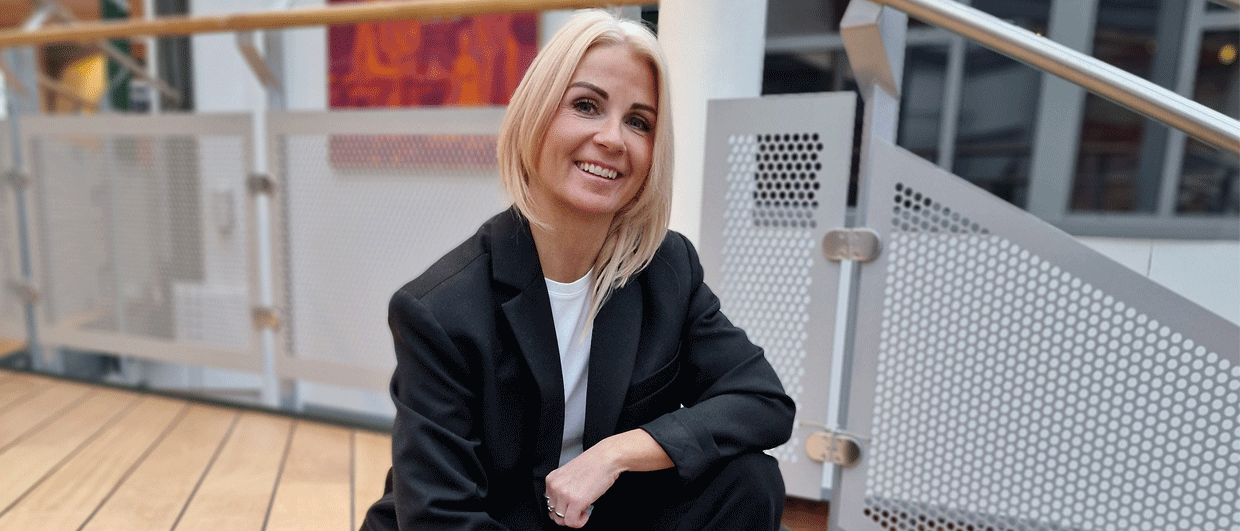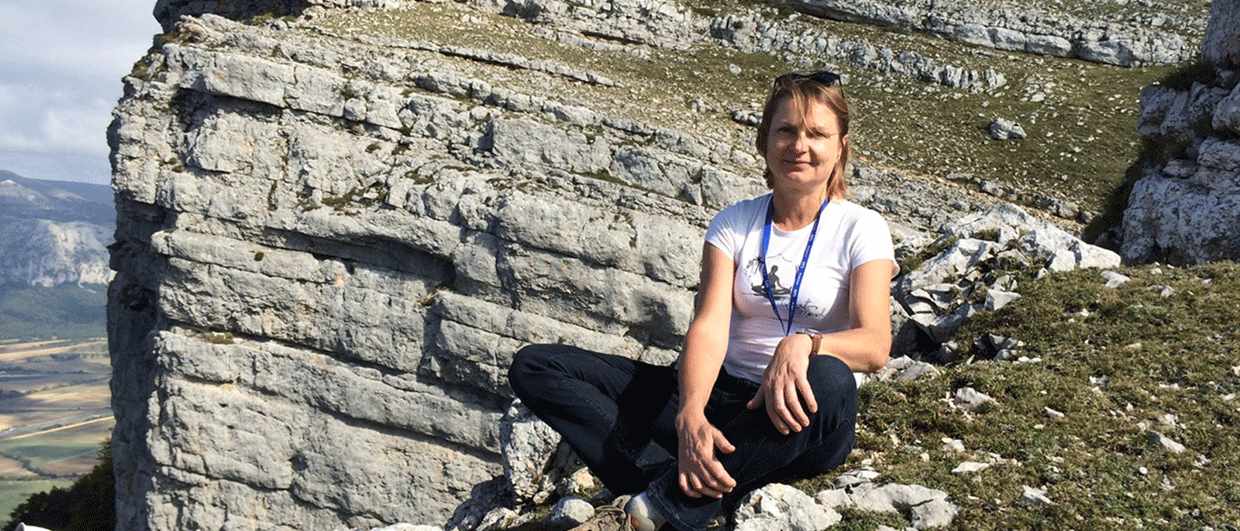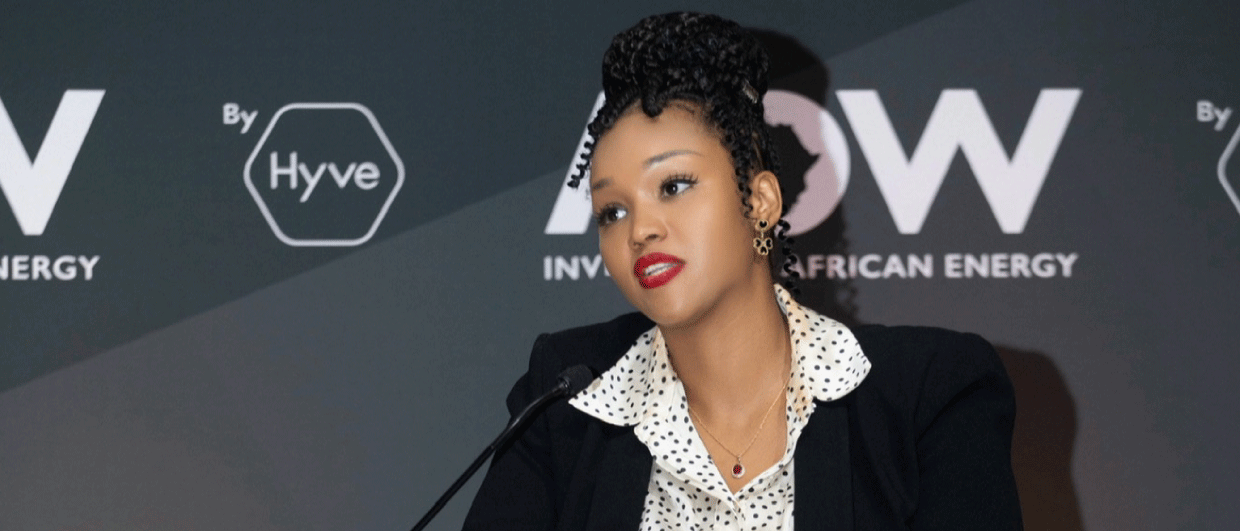
Speaking on a panel at Africa Oil Week (AOW), Cape Town, South Africa. Photo: Cany Jobe private archive.
Always on the lookout for new frontiers
A conversation with Cany Jobe, Director General of the Petroleum Commission in The Gambia, about how she got into oil, and how she is determined to make her country share in exploration success

“My mother was very patient with me,” says Cany Jobe. “When I needed to make a big decision about which direction to take in high school, I gave her a hard time. I didn’t want to choose between arts, science or commerce. I wanted to do them all.”
But that’s not how the system worked in The Gambia. So, Cany decided to talk to various people to seek advice. “The most intriguing recommendation I received was from a politician,” she says. “He told me to choose the subject that wasn’t where my heart was.” “The thing you are most passionate about will endure anyway,” he said. “Go for the science stream, it is a national priority.”
“And that’s what I did,” says Cany. It says a lot about her sense of responsibility and her openness to opportunities. And that continues until today.
Cany excelled at school and was therefore selected to study abroad under a government-run scholarship scheme. The only caveat was that you couldn’t pick your study yourself. “It was chosen for us depending on where the national priorities were,” explains Cany.
“At some point, I was going to be sent to Malaysia to embark on a biochemistry course. But then there was a shift towards completing a medical degree in Moscow. This was followed by Cany finding herself on a shortlist to go to Houston for a petroleum course, as the president at the time had a meeting with a group of Canadians who suggested that there were good indications of a working petroleum system in The Gambia.
“Then,” continues Cany, “there was a diplomatic interaction with the Taiwanese government, whereby they offered to pull together a dedicated petroleum programme.”
That was the last switch of direction, and Cany flew to Taiwan together with a group of students. “I was never frustrated about this ping pong game,” she says, “it was all just very exciting. We were the first group ever from The Gambia to study in Taiwan; it was very special.”
And it was a decent amount of time, four years, with internships at the Chinese Petroleum Corporation as well. Cany immersed herself in the new country. “It was a real cultural sensation,” she recalls. “You won’t believe it, but many locals had never seen a black person at that time, and we’re talking between 2004 and 2008. People queued up to take photos with us all the time, and I was often called Serena Williams or some other African American star on TV who I looked nothing like.”
Following her time in Taiwan, Cany got the opportunity to work in Venezuela. “Hugo Chavez and PDVSA had a good relationship with The Gambia, and they offered spaces for us to learn more about the profession,” she says. “It was formative, and it really cemented my plan to be part of the oil industry.”
Back in The Gambia, Cany won an Australian development award to do a master’s course in Petroleum Engineering in Perth, Australia, where she also worked on the Browse FLNG project after completing her studies. “Again, I felt like going to the edge of the world, but spending three years there almost convinced me of wanting to stay forever.”
A call from home
But home called. And in 2014, Cany moved back to The Gambia. She became the technical focal point with the National Oil Company of the Gambia (GNPC) straight away, forming the technical liaison between explorers and the government.
I don’t want to be just a cog in a wheel
“In the job I had in Australia, I felt like quickly becoming a technical expert on a very specific thing, such as risers or subsea infrastructure,” says Cany, “but at GNPC, rather than remaining in a single technical discipline, I found myself involved in everything from technical work and negotiations to strategy, governance and stakeholder engagement. It felt more meaningful to negotiate directly with the companies exploring our offshore and contribute to the decisions shaping the sector. I also felt that working in a young national oil company allowed me to earn a seat at the decision-making table much earlier than I might have in a large IOC, where career paths are naturally more specialised and hierarchical.”
“I also worked in administration, HR and procurement, but whatever role I was in, I always loved the fact that I influenced the course of action, and the ability to take initiatives. As an example, I was the driver behind introducing energy efficiency initiatives, including the solarisation of our head office and the petrol stations GNPC operates. I was also keen to identify and implement measures that aligned the public role of the company with national development priorities. At the end of the day, it is not only about turning a profit.”
The experience she gained through all these different roles at the NOC put Cany in a great position to start a new role at the start of this year.
A new role at the right time
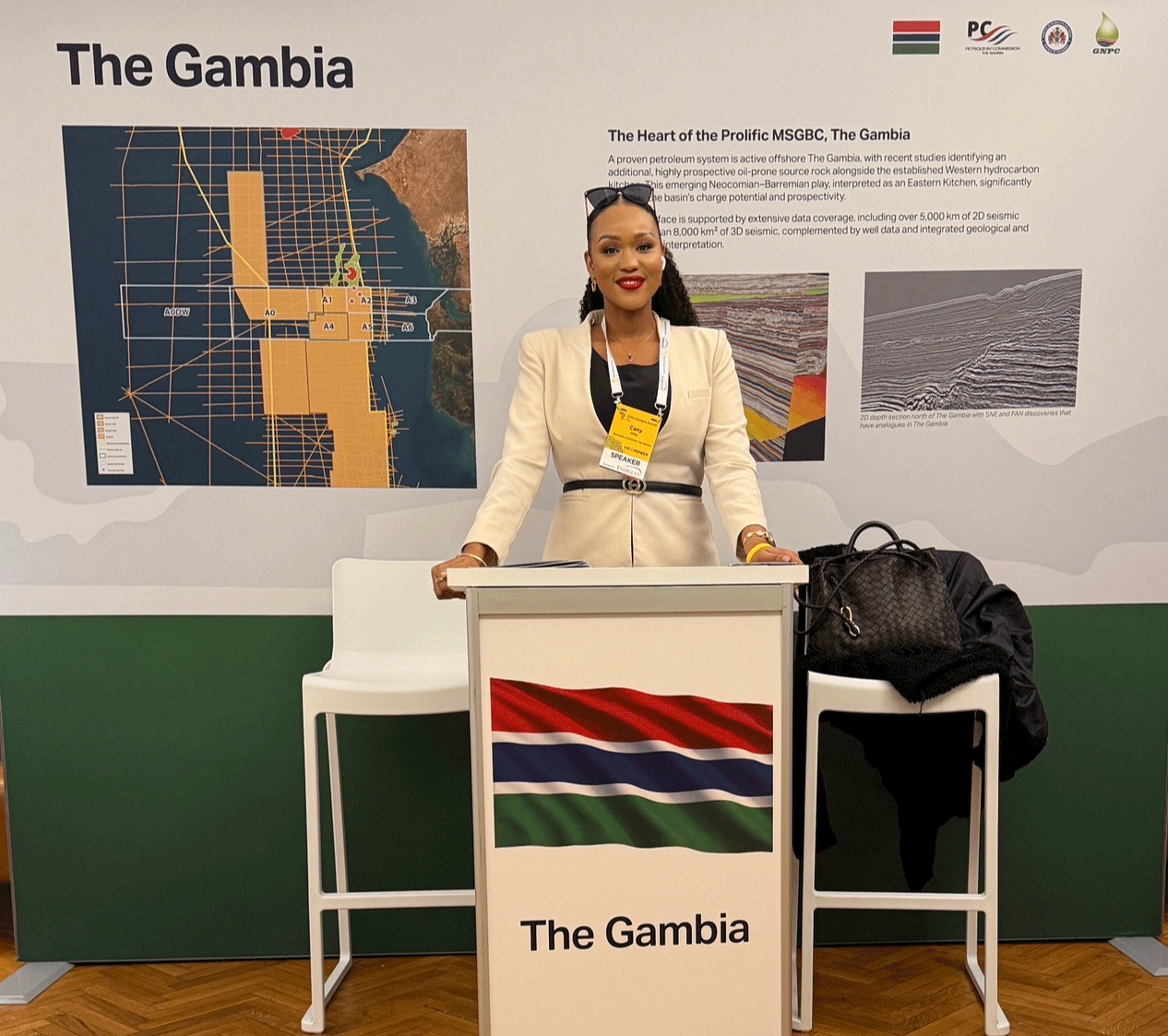
Seven months ago, Cany became the Director General of The Gambia Petroleum Commission, the licensing regulator. With that change, she moved back to where she wants to be: In the exploration space. “The thing is,” Cany says, “because we don’t have an active upstream sector in the Gambia yet, the NOC is mainly dealing with the downstream side of the business – import of fuel, distribution, and trading. At the commission, we are mostly dealing with the upstream side of things.”
She came in at a key moment in time. “We were having negotiations around offshore licences when I started in January this year. Through my role in the NOC, I had already been part of that, but I suddenly moved from contributing to negotiations to now leading the Commission’s role in bringing negotiations to a conclusion.”
“At first glance,” she explains, “signing an exploration licence seems relatively straightforward. You might assume that what the state wants is the same as what the investor wants, that is, to get the deal done. But every clause represents a balance between attracting investment and protecting the country’s long-term interests. Reaching an agreement on a single provision can sometimes take hours or days of discussion.”
Three offshore blocks have so far been awarded, one to Eni and two to Atlas Oranto. None has yet reached effective status though, with the Eni licence expected to become effective in the coming months.
“All our licences are broadly based on the Model PEPLA,” explains Cany, “which includes firm drilling commitments during the Initial Exploration Period. So once an exploration licence becomes effective, the agreed work programme takes effect. ”We have not issued Reconnaissance licences yet, which IOCs are increasingly gravitating towards when it comes to the recent flurry of exploration licences across West Africa.”
Reconnaissance licences generally don’t come with drilling commitments, which is sometimes a point of criticism towards the industry. “I see why that happens,” says Cany, “but my take is that if a block has had a decent dataset acquired, with the associated studies that could have been done, there is not much point for companies to go for a Reconnaissance licence across those blocks.”
“Are you open to issuing Reconnaissance Licences?” I ask. “Yes,” she says, “but it depends on the work program, and it depends on the blocks these are applied for.”
Increased interest
Apart from the licences already issued, Cany observes a strong interest in what remains. “We do see that there is increased interest in the open blocks as well,” she says, “including some blocks that have never been licensed before. The A4 block, which is still open, is also progressing towards negotiation status. Overall, I see a massive potential for oil and gas across the entire West African margin.”
When it comes to Sangomar, the field that is located just north of the maritime border with Senegal, Cany confirms that the wells drilled by FAR a few years ago do not see an extension of Sangomar into the Gambia. “However,” she says, “we expect there is geological continuity. We can’t speak with certainty as to whether Sangomar extends into the Gambia or not; there still needs to be more drilling to confirm that is the case. Bamboo wasn’t entirely a failure either, as it had good shows. That’s why I think further exploration is justified, because I believe it will take more effort to either confirm or rule out the presence of hydrocarbons in Gambian waters.”
“At the end of the day, we only have five wells in total drilled across our onand offshore acreage. Whilst in neighbouring Senegal, around 120+ wells were drilled before the discovery of Sangomar. Onshore, we had gas shows in the two wells that were drilled by bp in the 1960s. But at the time, gas wasn’t regarded as a commercially viable product. We have never seen significant interest in these wells since, even though we are now also working on finding interested parties to have another look at those.”
“Over the next few years,” says Cany, as we are approaching the end of our conversation, “I want to be in the position to say that we have licensed all our blocks, and have shown moveable oil rather than an oil show.”
“Look at Fahud in Oman,” she says. “There, the reservoir was missed by the first exploration well, because normal faulting had cut out the productive part. In hindsight, it later turned out that the well only missed pay by a couple of hundred meters. You have to be an optimist, and I really am.” Always looking for new frontiers.