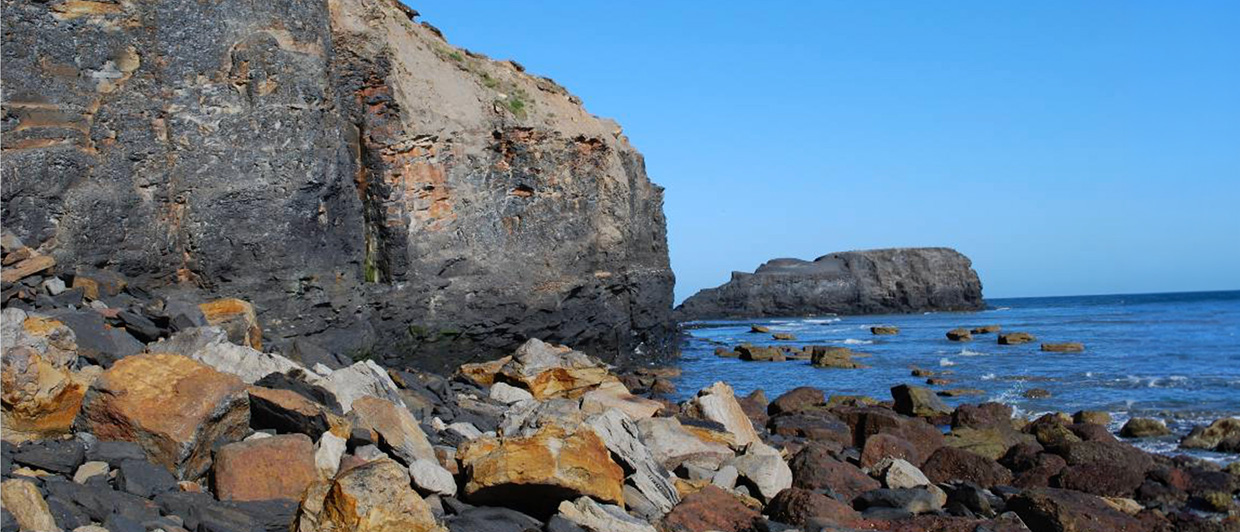
Shale outcrops on the coast of North Yorkshire. Source: Paul Wood.
A UK shale gale coming?
UK Bowland Shale gas in-place resources are estimated at a quadrillion cubic feet

Exploitation of onshore shale gas resources in North America has, in the past few years, reversed a decline in domestic natural gas production and helped reduce gas prices. This has driven a surge in the evaluation of similar resources in other countries such as the UK to determine if the North American success can be replicated.
The most extensive shale gas play in the UK is in the Carboniferous Bowland-Hodder unit that is located, at prospective depths, across Northern England in a strip stretching from the Lancashire coast in the west to the Yorkshire coast in the east. In 2010, the UK Department of Energy and Climate Change (DECC) commissioned the British Geological Survey (BGS) to evaluate the potential of the Upper Bowland Shale. The study used simple basin-sized analogies to evaluate the yield at from about 2.1 to 4.7 Tcf of gas.
In 2011, the UK company Cuadrilla Resources, a specialist in exploitation of unconventional hydrocarbons, started hydraulic fracturing (fracking) tests at a site near Blackpool on the Lancashire coast. The tests were suspended when they were shown to have induced minor earthquakes and a ban on fracking was imposed. In 2012, DECC/BGS started on a more detailed resource estimate for the Bowland-Hodder unit, using all available data including outcrops, boreholes and seismic data. The results were published in a report issued in July 2013 and are available online.
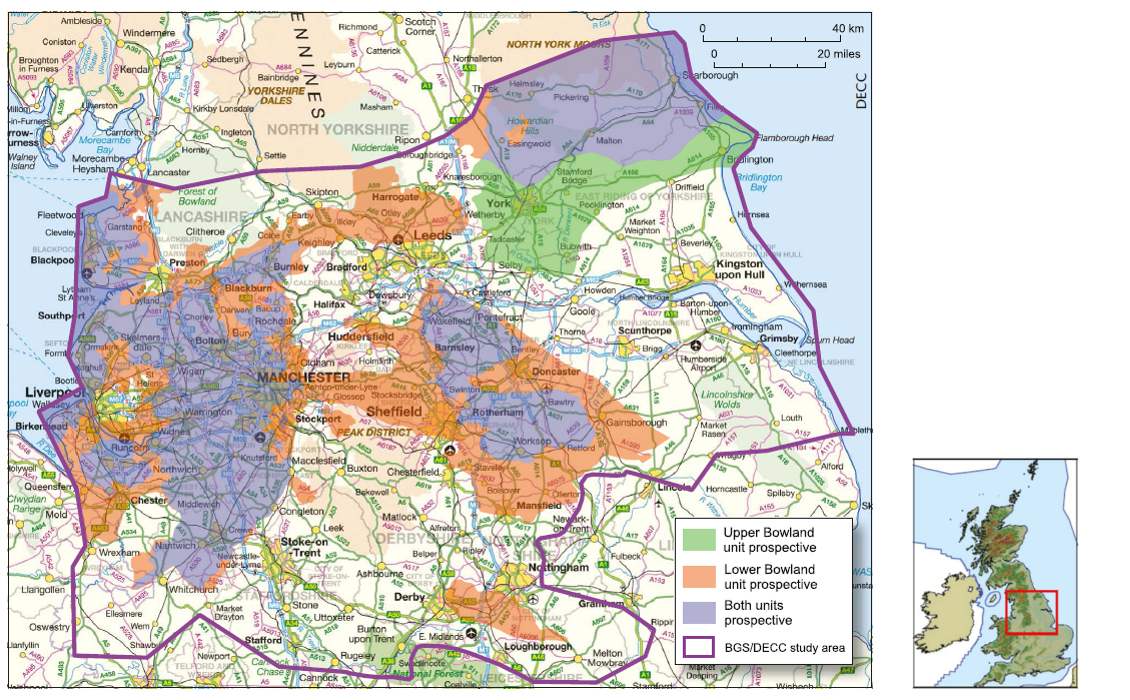
The new study has split the Bowland-Hodder into two separate intervals – the upper and lower units. The upper unit is up to a few hundred metres thick and reasonably well constrained in terms of borehole penetrations, core samples and seismic definition. The lower unit is up to thousands of metres thick but much less explored with few well penetrations and, in general, poor seismic resolution.
Challenges ahead
The report states the resource estimate of the upper unit as a P50 (50% probability) of 264 Tcf (7.5 Tcm) and, for the lower unit, a P50 of 1,065 Tcf (30.2 Tcm) total gas in place (GIP). Because of the uncertainties, in particular for the higher risk and poorly defined deeper unit, there is a wide range in the estimate, with the P90-P50-P10 for the whole of the Bowland-Hodder unit stated as 822-1329-2281Tcf (23.3-37.6-64.6 Tcm).
The report notes that this GIP estimate is very large when compared with the Ultimate Recovery (UR) of the total offshore UK gas, which currently has a P50 of about 100 Tcf. The Bowland-Hodder play is much more complex than US analogues as it is broken up over several basins and troughs and has experienced significant tectonic activity. Because of the geological uncertainties, lack of knowledge about producibility and the significant social and environmental concerns in the UK of shale gas production, the report has not attempted to state an estimate of recoverable volumes.
The fracking ban has now been lifted provided operators can demonstrate that they have the proper controls and seismic monitoring in place. The UK government also announced, coincident with the DECC report, incentives for communities near boreholes where fracking takes place. Cuadrilla with partners Centrica have now announced plans to restart their evaluation of the Bowland-Hodder play. Press reports have appeared that imply that shale gas could provide enough gas for the UK for the next 40 years. But clearly it is too early to make such estimates – very little is known of the play and there are many technical and social challenges ahead.