Sabah, Malaysia, where exploration is moving into ever-deeper offshore waters. Photo: MaciejBledowski via Adobe Stock.
A jump in the deep
With Petronas drilling the Megah-2 appraisal well offshore Sabah, it is a good moment to look at the region’s exploration history and what is currently being chased

As with many offshore basins, exploration offshore Sabah, Malaysia, kicked off during the 1970s, and mostly in shallow water. This was successful though, with a long string of discoveries announced over an extensive period of time. The main play in the shallow offshore consists of Miocene turbidite sandstones within structural traps of the Sabah fold and thrust belt, which developed when Sabah collided with the Dangerous Ground continental terrane during the early Miocene.
When this shallow water play creamed in the early 2000s, wells started to be drilled in slightly deeper water, leading to Murphy striking the Kikeh discovery in 2003. This triggered a second wave of exploration, still targeting the same Miocene turbidite sands, but in less deformed strata. However, this play creamed relatively fast, and in 2019, Westwood reported that only 0.5 bnboe had been found.
The next step was to move even further out, into what is known as the Sabah Trough. As can be seen on the seismic line, the Sabah Trough is the foreland basin associated with the Sabah fold and thrust belt to the southeast. In this case, however, prospectivity is not in Miocene siliciclastics, but in the pre-collision Oligocene succession just beneath the foreland basin fill, when the area still experienced an extensional phase as a result of the formation of the South China Sea.
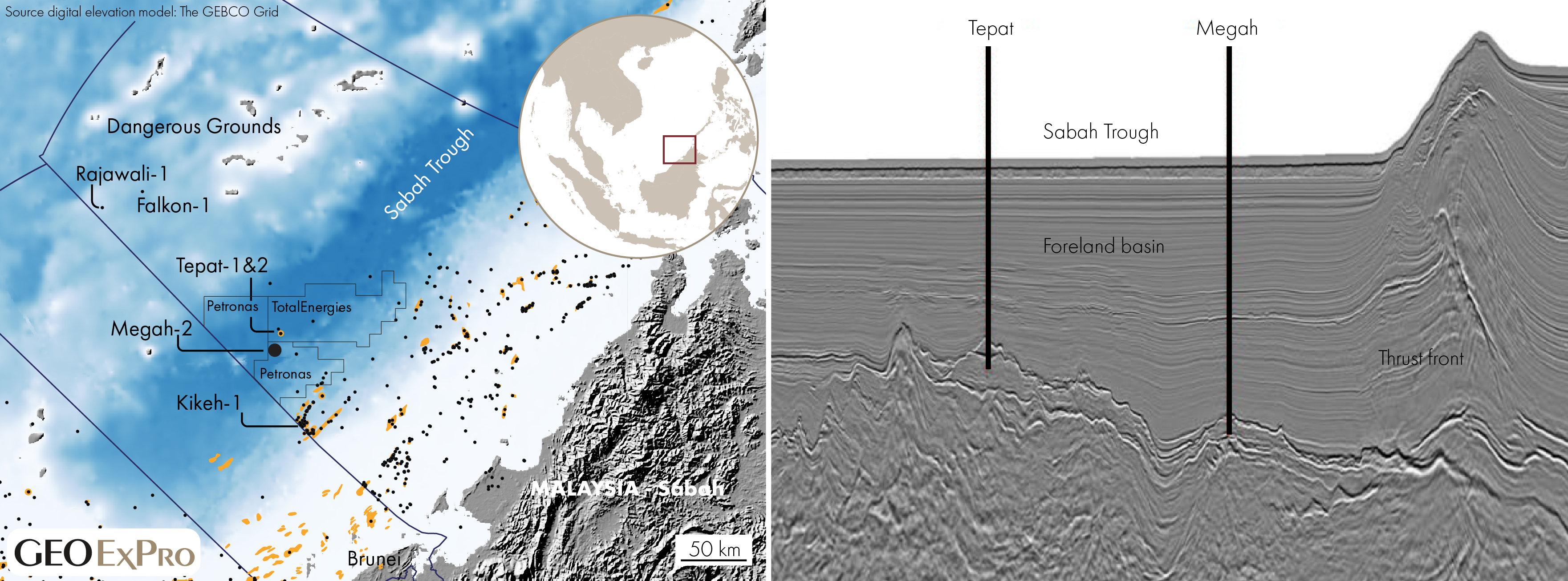
This exploration phase started in 2012 when Petronas drilled the Rajawali-1 well, initially avoiding the deepest water region in the Sabah Trough. Falkon-1 was drilled a few years later in 2016. It is likely these wells did not find economic volumes of hydrocarbons.
By then, it was time to explore the real deepwater region, and exploration shifted to the Saba Trough. The first well drilled here was Tepat-1 by TotalEnergies in 2018, targeting Oligocene carbonates below the Miocene deposits of the foreland basin fill. The well apparently tested a large gas column with an oil rim, but it was likely too small to warrant a standalone development. TotalEnergies subsequently drilled the Tepat-2 appraisal well in 2022, confirming the discovery.
The Megah-1 well, drilled by Petronas in 2025, tested the carbonate play again. Megah-1 encountered oil resources estimated at 200 – 300 MMbo, potentially the largest deepwater discovery in two decades. That’s why in August, Petronas initiated a pre-qualification process for a floating production, storage and offloading (FPSO) vessel. However, before fully committing to this, the company is now appraising the Megah discovery with another well, Megah-2. In the meantime, TotalEnergies has not forgotten about the area either. The company just finished drilling the Jambuk-1 ultra-deepwater well in the same block as Tepat, but results have yet to be announced.
It is still early days for the Sabah Trough to be called a new exploration hotspot. The deepwater carbonates may be easy to spot on seismic, but reservoir quality and connectedness can be more of a challenge compared to siliciclastic sands.