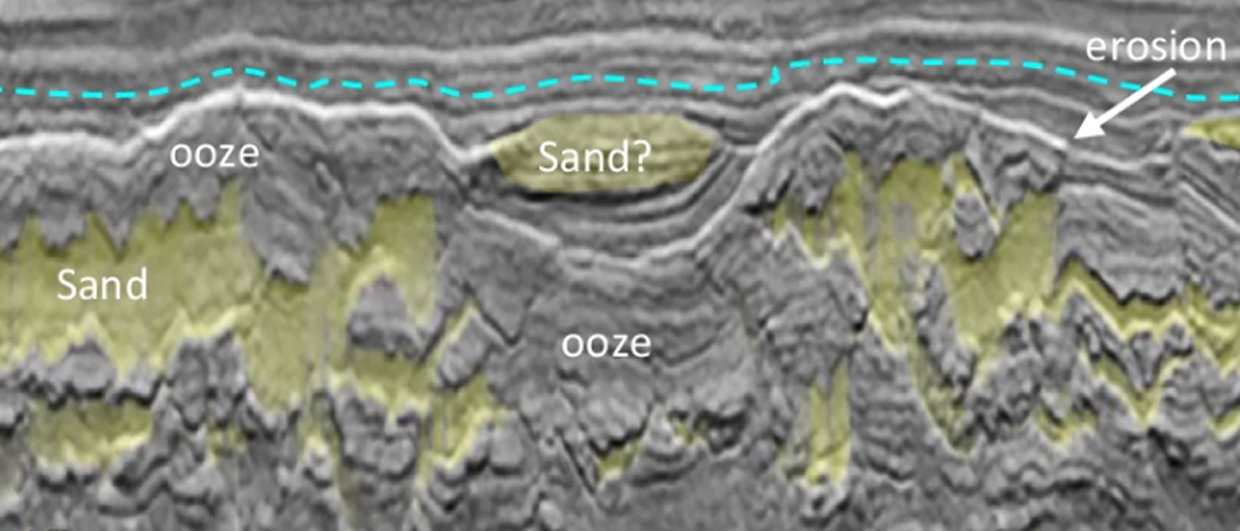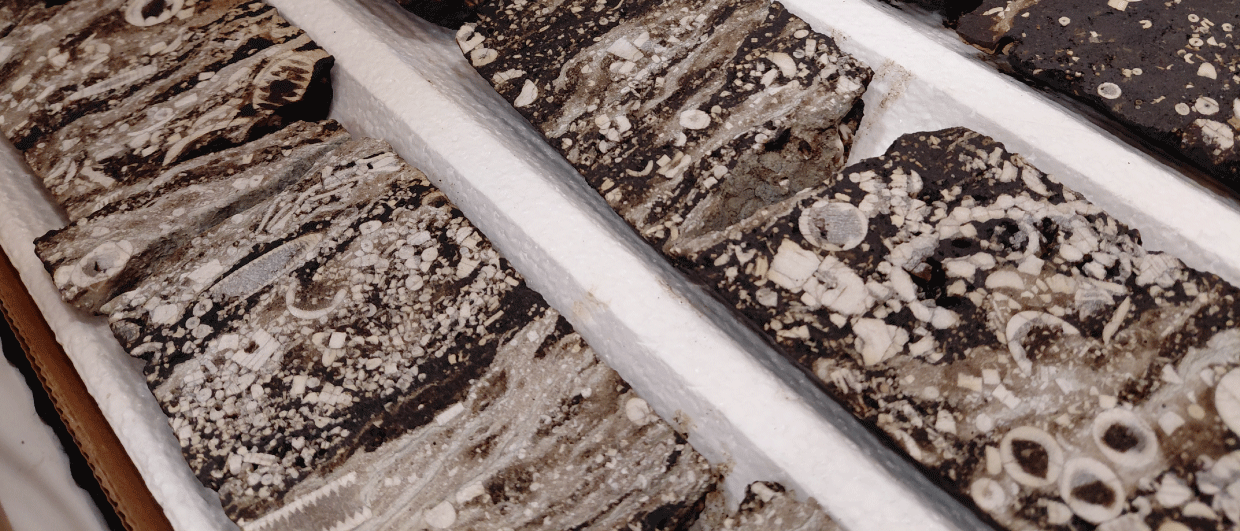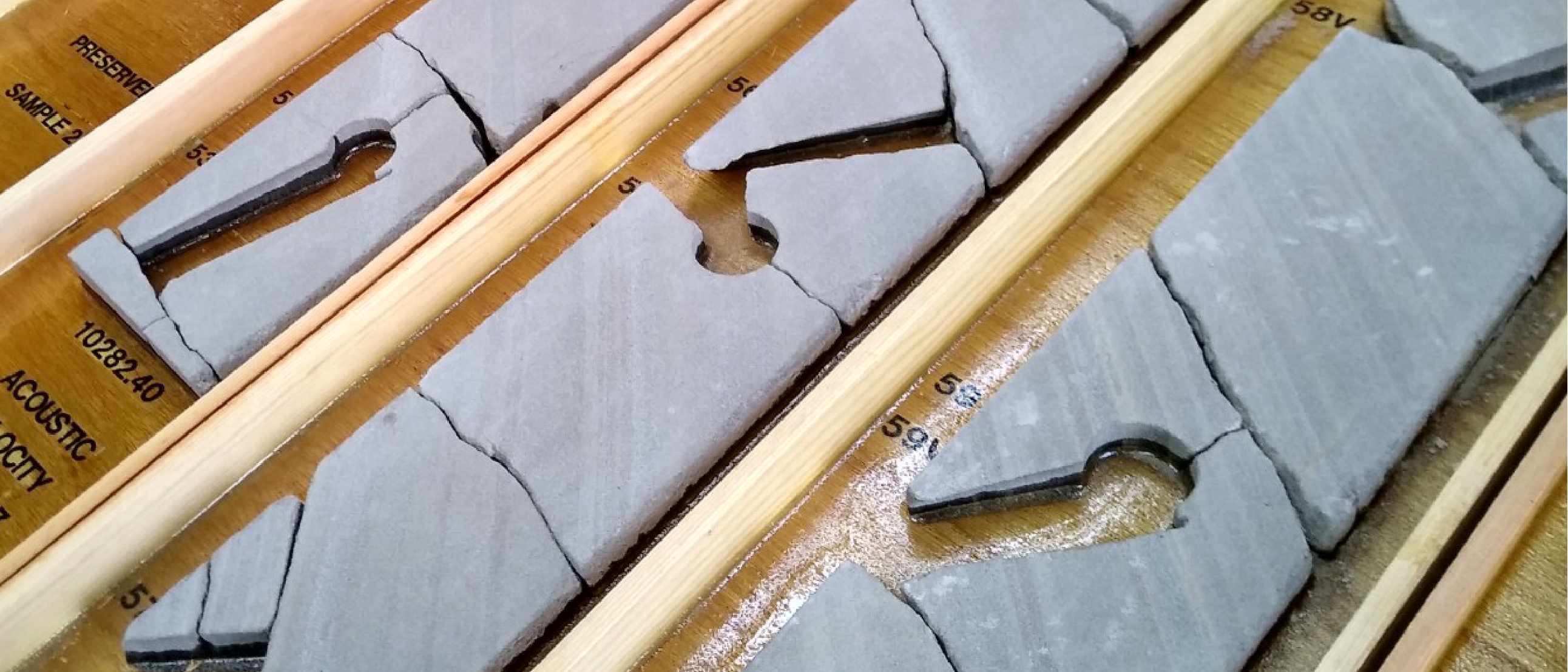
Rotliegend eolian sands from well 48/11b-5 in the UK Southern North Sea. Photo: Henk Kombrink.
When fast gas becomes slow gas
How ancient dunes control gas production

Permian Rotliegend sandstones form one of northwest Europe’s most important gas reservoirs. Yet, despite decades of mature field production and apparently excellent reservoir properties, something has never quite added up. On paper, these reservoirs look excellent. Core measurements often show high permeability and good reservoir quality. Once taken into production, however, they can behave very differently, with effective flowing permeability sometimes 100 to 1,000 times lower than the values measured from core.
A well can begin life producing strongly at high rates, only for pressure and production rates to fall rapidly. Yet, the well does not die. Instead, gas continues to arrive at much lower rates for years, sometimes decades. Individual wells exhibiting this characteristic “slow-gas effect” can remain in production for 30 – 40 years.
At first glance, there is an obvious explanation: Compartmentalisation. Perhaps faults are breaking an otherwise good reservoir into poorly connected pieces. But what if the problem is not structural at all? What if the answer lies within the dunes themselves?
Check out James’s paper about this topic here
To find out, we went to the deserts of Arizona and Utah. Here, spectacular exposures of the Entrada, Navajo and Page Sandstones reveal outstanding 3D outcrops of aeolian sedimentary systems. From a distance, these sandstones look like giant bodies of homogeneous sand, but when looking in more detail, they are separated and bounded by low-permeability wind-ripple deposits and a hierarchy of erosional surfaces. We used these analogues to reconstruct 3D reservoir models, populated them with properties representative of producing Rotliegend reservoirs, and simulated 20 years of gas production. The resulting models reproduced the same distinctive production behaviour without requiring faults to compartmentalise the reservoir.
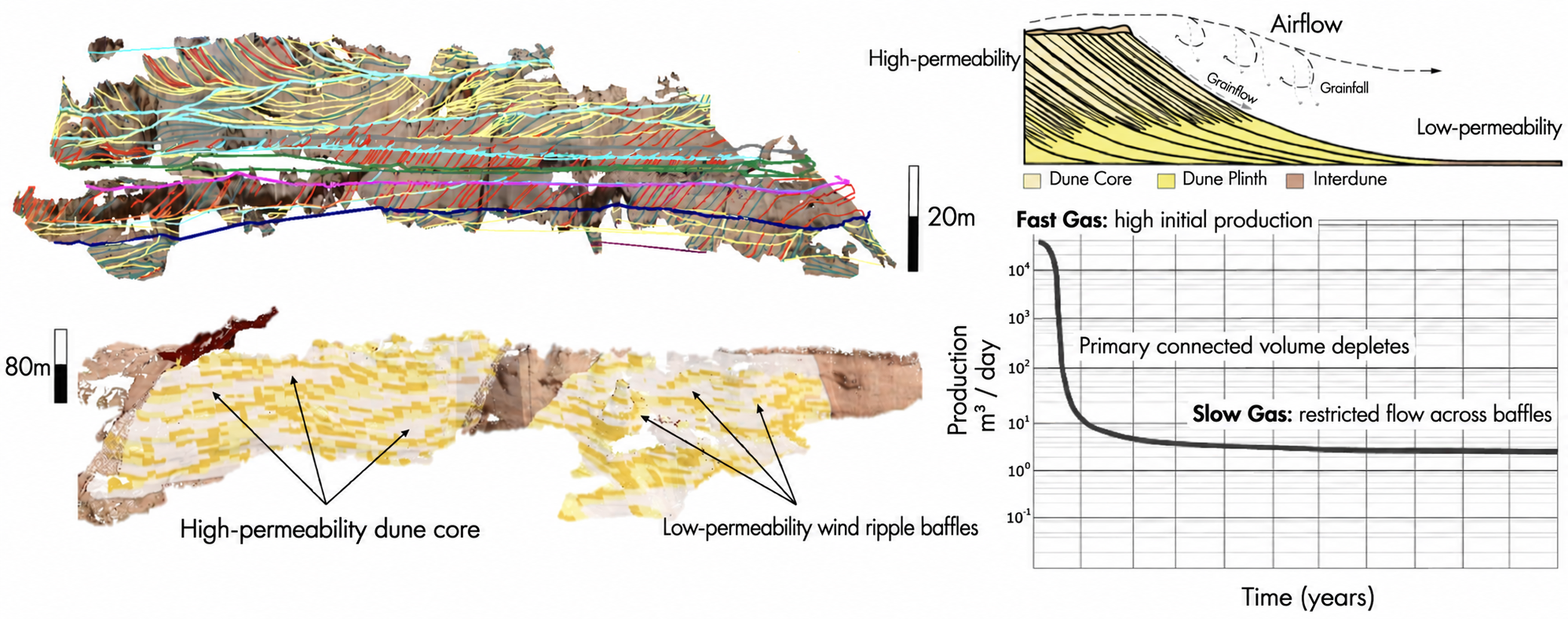
At the start of production, the well has easy access to gas stored within the high-permeability dunes immediately around it. This connected volume provides the “fast gas”, supporting the high initial production rates. The larger the primary connected volume, the longer those high rates can be sustained. Eventually, however, the easy gas runs out.
The remaining gas is not necessarily trapped behind sealed compartments. Instead, it has to find an increasingly tortuous pathway across low-permeability wind-ripple deposits separating individual dune bodies. These layers act as baffles rather than seals: they restrict flow without stopping it. Driven by pressure difference, gas continues to migrate from the surrounding reservoir back towards the depleted near-well volume. It arrives too slowly to restore the initial production rate, but it can sustain production for years. This is “slow gas”.
Understanding this reservoir architecture has practical consequences. If the volume of readily accessible “fast gas” depends on the number and size of dunes connected to a well, then well trajectory and spacing become part of the depletion strategy. Periods of shut-in may even allow the depleted near-well volume to recharge as gas slowly migrates across the surrounding baffles. In the Rotliegend, architecture inherited from an ancient desert continues to control how gas moves millions of years after the dunes themselves disappeared.