Illustration: Kateryna via Adobe Stock.
The energy that never arrives
It’s not what we produce, it’s what we keep

In the previous article, we talked about geology being the ultimate scorekeeper and that what exists is not the same as what we can use. This time, I want to take that a step further. Because between what exists, what gets claimed, and what is actually delivered, there is a gap, and it is larger than most people appreciate. That gap is created by physics. We’ve become used to systems improving almost frictionlessly; just look at the iPhone. But the energy system doesn’t behave like software; it cannot be compressed or scaled without loss. It must be physically worked for, at every step.
We tend to start energy conversations with endowment. The world is rich in hydrocarbons, sunlight, wind, heat, and minerals. On paper, there is no shortage of energy. But systems do not run on what exists. They run on what arrives. And what arrives is always less. Every unit of energy must pass through a chain: Extraction, processing, transport, and conversion. Each step consumes energy itself. Not as an accounting detail, but as a physical necessity. The system feeds on its own output to keep moving, and the losses accumulate.
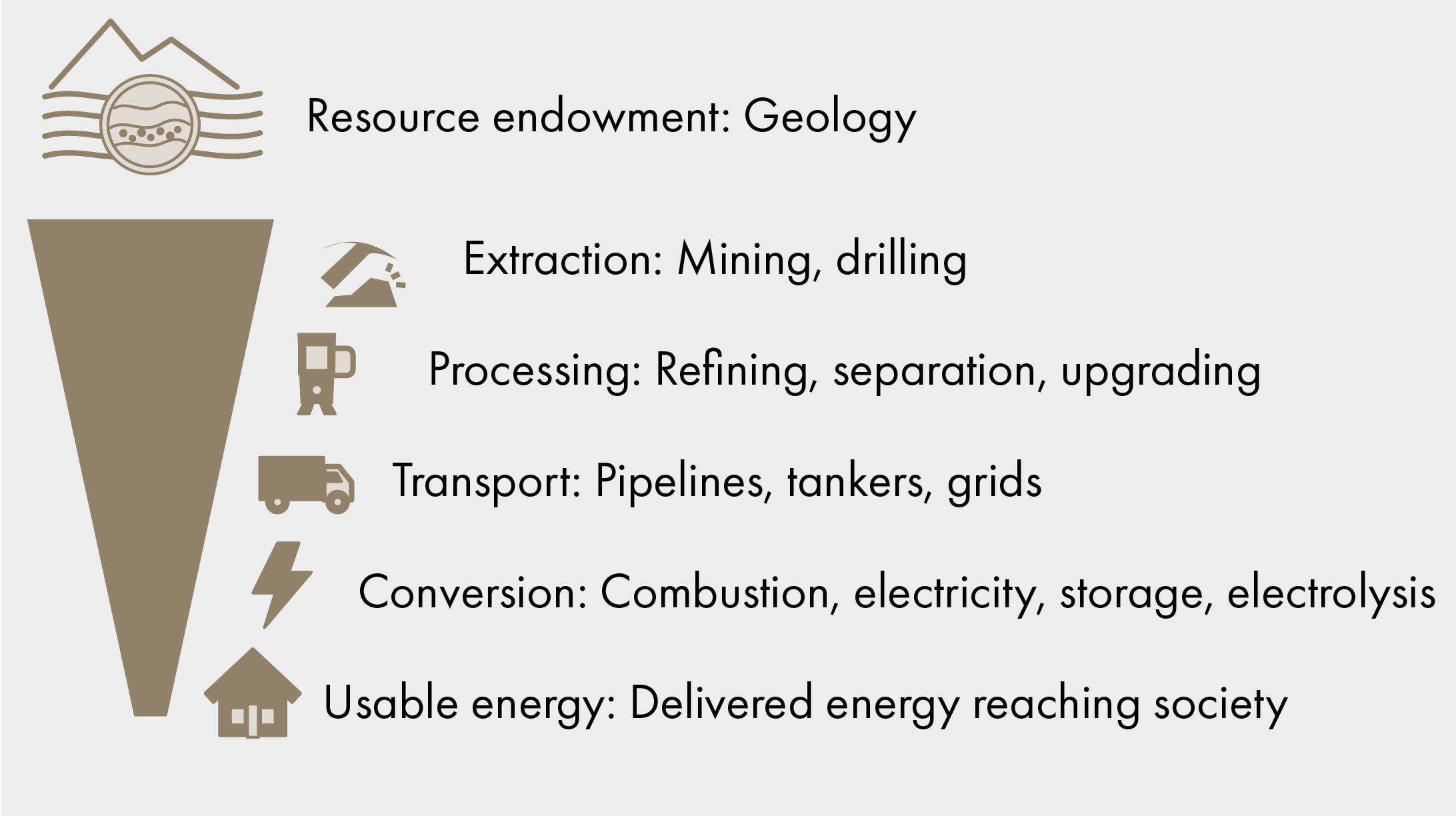
Let’s start at the subsurface. The best resources come first. What follows is deeper, tighter, leaner, and more complex and more capital intensive. More wells, more water, more intervention. It takes more energy to extract energy than it did before. That is the first erosion. Then processing. Refining, separation, upgrading, each governed by thermodynamics. Heat, pressure, and chemistry impose their own cost. These stages cannot be bypassed, only managed, even if more efficient processes are devised.
Transport adds the next layer. Molecules move through pipelines and tankers; electrons through grids that must be balanced continuously. Both systems incur losses. Both depend on infrastructure that expands slowly and resists compression. Then comes conversion. Combustion, storage, electrolysis, inversion – each step trades energy for usability. Each layer reduces what remains.
Because as the chain lengthens and complexity increases, more of the system’s output is required just to sustain itself. What appears abundant at the source becomes constrained at the point of use. This is why energy systems can feel tight even when supply appears to grow. Why surplus and scarcity can coexist. Why adding capacity does not always translate into more usable energy. It is also where the idea of energy return on energy invested (EROI) quietly becomes critical. Not all energy is equal. Some arrives with much of its value intact. Some arrives diluted, delayed, or diminished by the system required to deliver it. And that difference matters more than we often admit.
Because energy systems do not fail on annual averages or theoretical supply. They fail at the margin, when demand meets whatever energy actually arrives, in the hour that matters. This is not a failure of markets or policy. It is the accumulation of physical limits, decline, conversion losses, and infrastructure constraints asserting themselves through the system.
So the question is not simply how much energy we have. It is how much survives the journey. The harder we work to make it arrive, the more the geology reminds us who is setting the terms.
This article is adapted from Rodney’s forthcoming book – Rock Hard Truths: Energy, Risk, and the Limits of Narrative; Physics and geology don’t negotiate; the consulting class does.