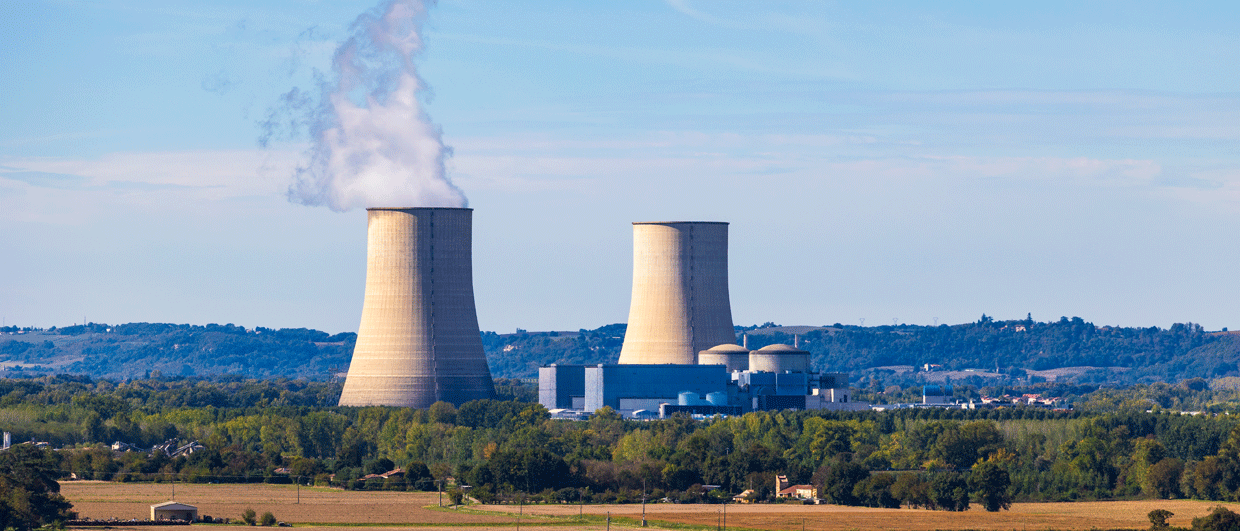
Golfech nuclear power plant in the Garonne plain seen from the hills above Auvillar. Photo: ldgfr photos via Adobe Stock.
Ideas over barrels
In 1974, France turned a crisis into a playbook. In 2026, Europe needs to steal the same page – only this time, the opponent isn’t scarcity alone. It’s physics, finance, and political whiplash

When France launched the slogan «On n’a pas de pétrole, mais on a des idées» during the oil shock, it wasn’t clever copy – it was national reframing. Lacking domestic crude became a spark for ingenuity: Efficiency drives, speed limits, insulation campaigns, and a bet on nuclear that still anchors one of the world’s lowest-carbon grids.
Crucially, France didn’t just build reactors – it built a fuel cycle: Reprocessing at La Hague, MOX fabrication at Marcoule, and a recycling architecture that treated spent fuel as material flow, not wishful waste. That’s geology-level thinking: Resources are finite, materials are stratified, and residues demand stewardship across time.
Half a century later, Europe faces a different kind of shock. We’re not short of ideas; we’re short of projects with clear physics and math: Offshore wind, geothermal, hydrogen, grids, storage, CCS – every pillar now meets hard constraints: Energy density, intermittency, seasonal balancing, geotechnical realities, and the price of money. If projects can’t be financed, permitted, and dispatched at a predictable cost, they won’t be built – no matter how beautifully we reorganise the org chart.
Meanwhile, the next chapter is quietly breaking ground. While much of Europe debates frameworks, France, the UK, and parts of Eastern Europe are doing something refreshingly oldfashioned: Moving dirt. From EDF’s NUWARD program to early works at sites in Romania, small modular reactor efforts are progressing through soil investigations for foundation pads and early civil works. Geologists know the difference between a model and a pit: Progress is real when you start to measure disturbed earth, groundwater behaviour, and bearing capacity.
What 1974 got right – and we keep forgetting
First, respect physics and geology. Hydrocarbons are dense; electrons are fickle; molecules are hard to store. Batteries shine for short durations but stumble at seasonal scales. Hydrogen may be essential for steel and chemicals, but unless conversion losses and real‑world storage constraints make economic and technical sense from the very start, the model doesn’t hold. In 1974, France didn’t argue with thermodynamics; it worked with it – pairing efficiency with firm, low-carbon capacity and a materials pathway to manage fuel over decades.
Second, make scarcity a design constraint, not a moral crusade. The 1970s response didn’t scold consumers; it invited them to coauthor resilience. Today, pragmatism means retrofit programs that move meters, demand-side signals that reward timing, and permitting standards that measure impacts in months, not years – with site characterisation, including seismicity, hydrology and slope stability, integrated early, so projects survive due diligence and the courts.
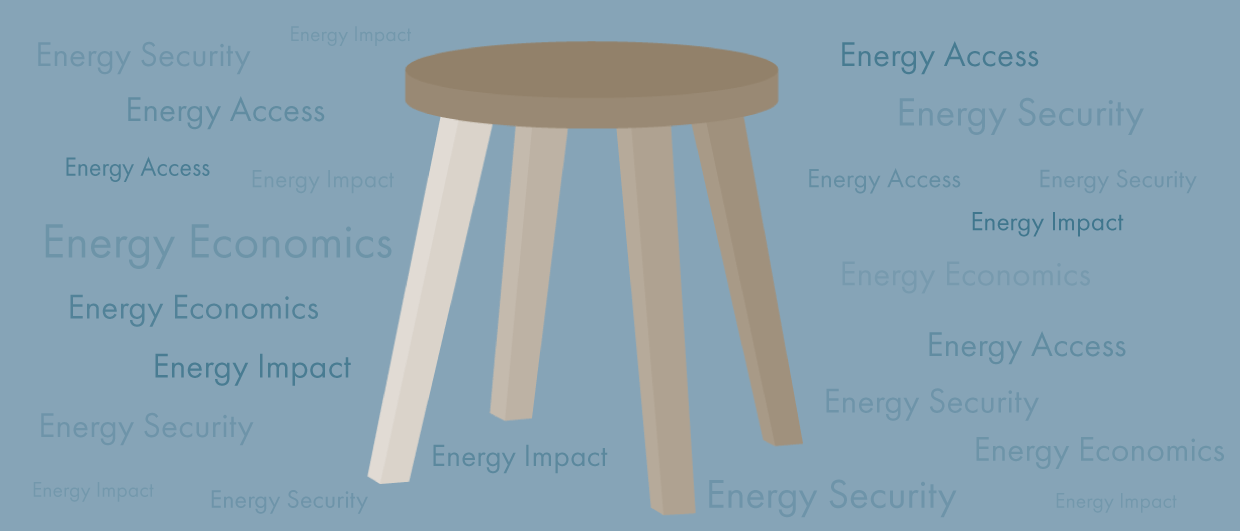
Europe’s 2026 energy transition needs the same architecture. Ideas that ignore physics fail; ideas that ignore finance won’t fund; ideas that ignore people won’t last. The fuel‑cycle story adds a fourth rule: Ideas that ignore materials and time won’t close. If we want electrons we can count on, we must build like geologists think – start with the ground, respect the physics, price the time – and then turn that discipline into steel, concrete, and kilowatt‑hours.