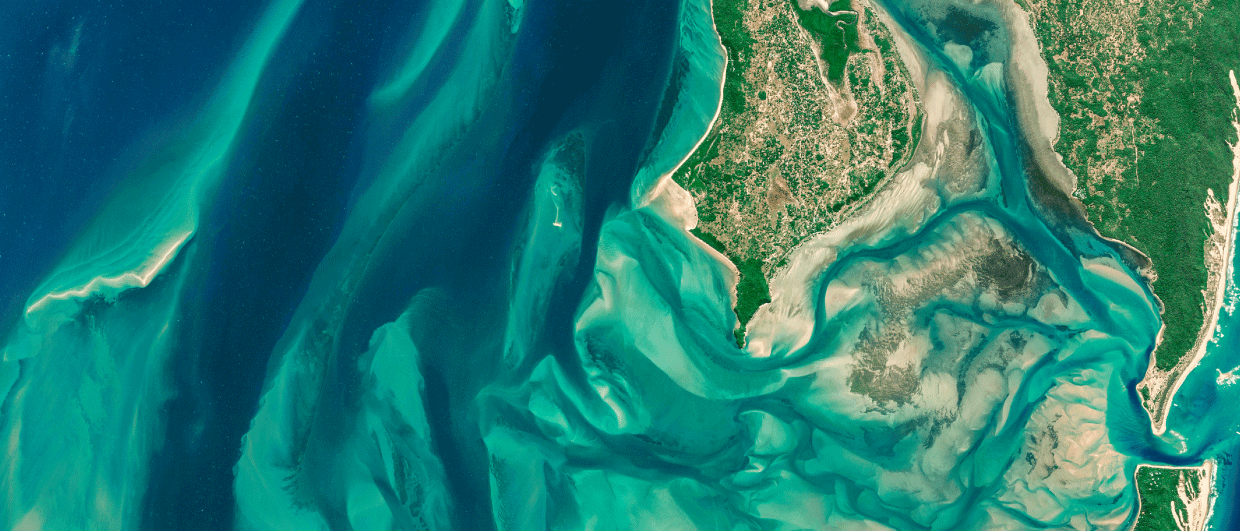
Satellite view of the coast of Mozambique. Source: NASA, Naeblys via Adobe Stock.
Contrasting fortunes in Sub Saharan Africa
Whilst East Africa continues to experience ups and downs in terms of oil and gas developments, there is enough to be upbeat about

Exploration is firmly back on the agenda for many oil and gas companies, regulators and NOCs. This is especially clear in Africa, where large tracts of open exploration acreage have been taken up. This is particularly the case in West Africa, with new basin-scale permits keeping the supermajors focused on finding the next “Liza”. East Africa, though, with its vast reserves both onshore and offshore, seems to be holding on to its reputation for slow progress. Intensive development programmes deep in the hinterland, the predominance of gas offshore (to date) and the slow progress towards improving oil and gas fiscal terms all play their part.
Somalia
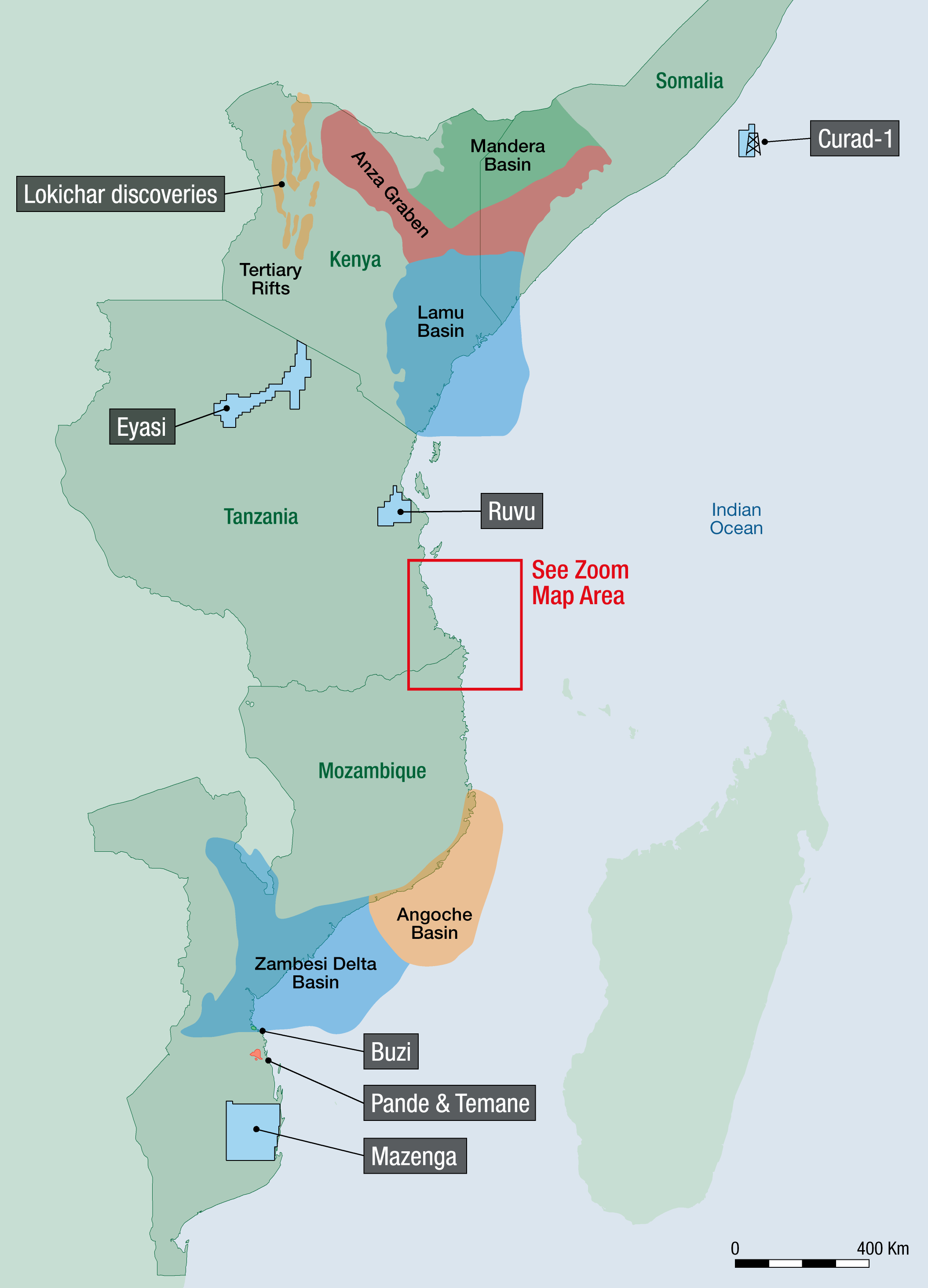
But for those with the right mindset, uncertainty can also mean opportunity. Recently, Türkiye, via its state oil and service companies, launched a major exploration campaign offshore Somalia after both governments signed a wide-ranging cooperation agreement in March 2024. Soon after, a 15,000 km2 3D seismic survey was acquired by the Turkish research vessel Oruc Reis (June 2025) over Block 142 on the Mid Somalia High and blocks 152 and 153 in the Coriole Basin / Mogadishu Deep Basin. These blocks were subsequently awarded out of round to TPAO in April 2025. The Cagri Bey drillship is on location (August 2026), drilling the Curad-1 exploration wildcat on the Mogadishu Deep Basin Block 153. Success here would kick off a rush for acreage in a country that was abandoned by the supermajors in the late 1980s.
Kenya
Kenya has not seen any significant discoveries offshore since the 1970s Pate gas discovery and Sunbird in 2014 (BG at the time). Deepwater wildcats tested various plays at Simba 1 (TotalEnergies, 1977), Mbawa 1 (Apache, 2012), Kubwa 1 (Anadarko, 2013), and Pomboo 1 (Woodside, 2006). The Ministry of Energy and Petroleum is determined to raise the profile here and attract new exploration. The State Department for Petroleum (SDP) is expected to launch a major licensing round in 2027, for at least ten premium blocks, with preparations and pre-qualification in 2026. This will involve licensing new blocks across the Lamu, Anza, Mandera, and Tertiary Rift basins, as well as establishing a new National Petroleum Data Centre. With limited success offshore Kenya, all eyes are on the potential to develop the Lokichar oil discoveries, first drilled by Tullow in 2012. Auron Energy (Gulf Energy) bought the rights in 2025, and plans are underway for a major development.
Tanzania
In Tanzania, mixed results over the years have led to reasonable gas production from two major coastal centres (Mnazi Bay and Songo Songo), while major multi-TCF gas fields have remained undeveloped offshore. The Tanzania Petroleum Development Corporation (TPDC) is expected to issue an Expression of Interest to find new partners and investors for four blocks currently being managed by TPDC: Mnazi Bay North and West Songo Songo offshore, and Eyasi Wembere and Lindi and Mtwara Blocks onshore. Although this does not represent a new country-wide bid round, TPDC have often announced plans to do that soon.
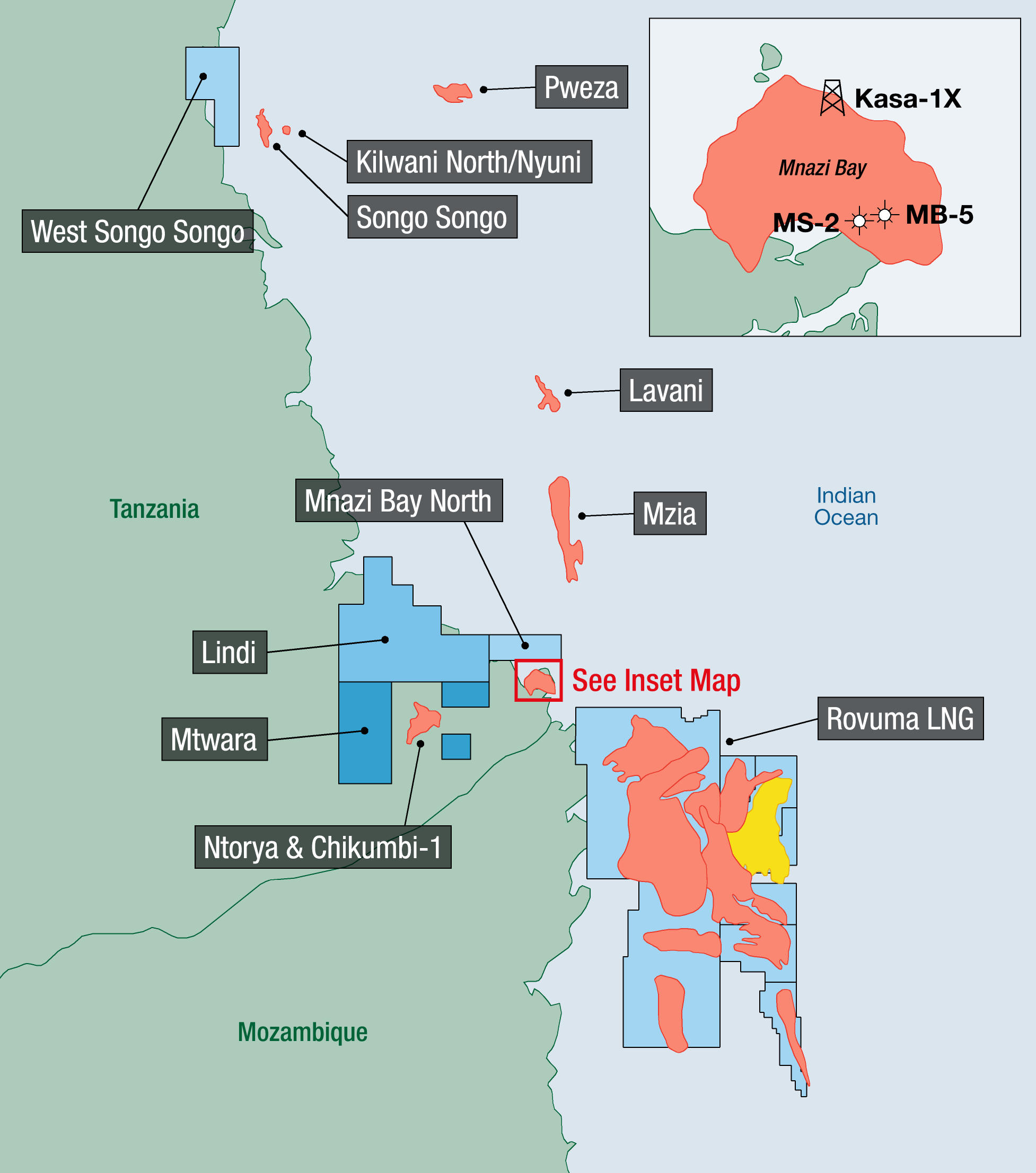
In the meantime, exploration efforts continue in Tanzania, albeit at moderate levels. Dodsal Resources drilled for gas onshore Ruvu block in 2015, with no clear progress updates announced. In the south, ARA and Aminex are planning a field development over the Ntorya gas discovery, first drilled by Aminex, Solo Oil and Tullow in 2011.
At the Mnazi Bay field, Maurel and Prom have been busy drilling the Kasa 1 well. Including the completion of MB-5 and MS-2 during the first half of 2026, the production potential of Mnazi Bay is now nearing 200 mmcfd.
A cornerstone of the Tanzanian gas industry, Songo Songo (1974) supplies a good proportion of industrial gas and local electricity in Tanzania. However, the ageing field, which is still producing around 85 mmcfgd, is in need of redevelopment. Whether the new owners, Dubai’s Amber Energy Investment (51 %) and Taifa Gas (49 %) can pull that off is now the question.
Immediately east of Songo Songo, UK firm Aminex, through Ndovu Resources, appears to continue to hold interest in the Kilwani North gas discovery and the Nyuni exploration opportunity, along with partners RAK Gas and Scirocco Energy.
There is also a “sleeping giant” offshore Tanzania, with the trend of major discoveries made in the offshore Rovuma Basin in Mozambique extending further north. However, these multi-TCF discoveries have yet to be developed. Companies like Shell (Pweza, Mvia) and Equinor (Lavani and Tangawizi) continue to evaluate these major gas fields with a view to monetisation if commercial terms improve.
Mozambique
Mozambique is benefiting from a major LNG export industry thanks to enormous gas reserves offshore the Rovuma Basin in the north of the country. ExxonMobil and ENI, along with various international partners, now export around 6 mmtpa, with a further FID announced in 2026 for Rovuma LNG (18 mmtpa). TotalEnergies also has mature development projects for further LNG.
Onshore Mozambique, Sasol run one of their mainstay gas supply projects at Pande & Temane, with a gas pipeline to South Africa. The fields have produced well over the years (around 250 mmcfgd), and Sasol continues to develop the resources there.
Elsewhere, exploration campaigns are planned and underway. ENI and CNOOC hold large blocks offshore the frontier Angoche Basin, while CNOOC hold another two blocks offshore the Zambesi delta. ExxonMobil exited both basins recently. Onshore, further exploration is taking place around Pande & Temane, and the Buzi field is yet to be developed north of Temane. To the south, Aiteo have completed a magnetics and gravimetry survey over the large Mazenga block, ahead of possible seismic acquisition.
Whilst the basins of the west coast of Africa take centre stage, major oil and gas developments are finally bearing fruit in East Africa, and major opportunities lie in wait. Governments across the region are launching investor promotion, bid rounds and new opportunities to participate. The challenge remains to draw the eye from the West African hotspot and refocus on these established and promising oil and gas-producing countries in the east.