Source: Nventures.
What is the driver for drilling two costly exploration wells offshore Bulgaria?
It’s the success that the neighbours reported in the Western Black Sea. Not once, but multiple times now

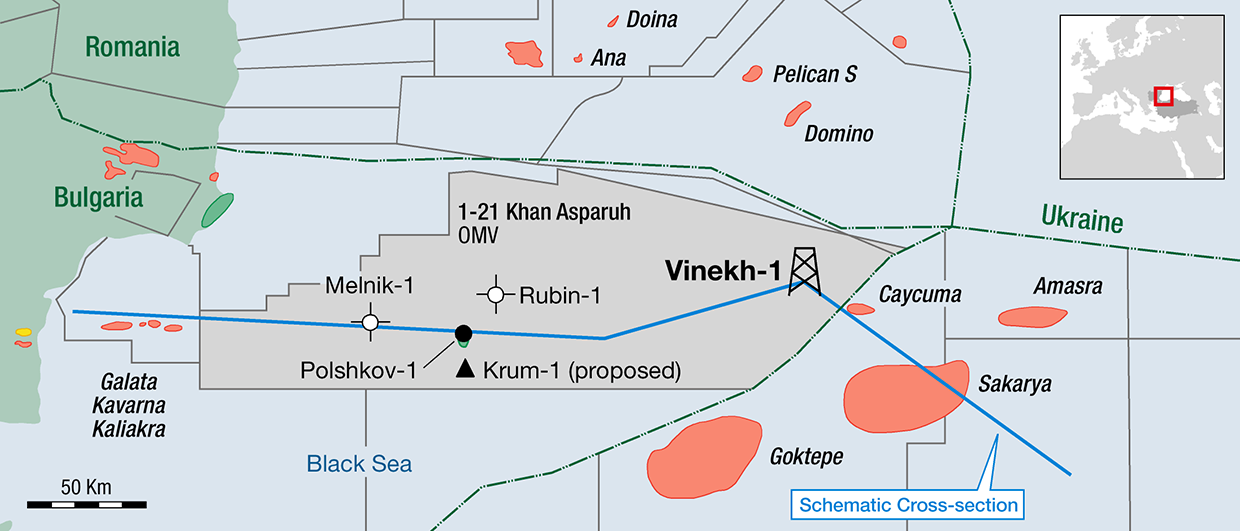
The spudding of wildcat Vinekh-1 in the Han Asparuh block marks the entry of Bulgaria into high-impact deepwater biogenic gas exploration in the Western Black Sea. And that’s not all, straight after completion of Vinekh-1, Krum-1 is expected to be drilled, also in Bulgarian waters. This is quite a step up in activity, but the explanation is straightforward: Exploration success in Türkiye and developments in Romania.
The exploration history of the Western Black Sea begins, as usual, with the proximal onshore and shallow water areas. Here, off Romania, Bulgaria and Türkiye, minor biogenic or perhaps mixed biogenic/thermogenic gas discoveries have been made, such as Ana-Doina, Galata-Kavarna- Kaliakra and South Akcakoca. But due to limitations in trap size and reservoir thickness, commerciality has proven to be an issue for these finds.
Then, the promise of thermogenic kitchens of the regional Paleogene “Maykop” rich source rock drove exploration to look for significant structural traps in deeper waters, resulting in Bulgaria’s 2016 Polshkov sub-commercial oil discovery with potential reservoir sequences in the Oligocene and Lower Cretaceous. Follow-up wells Rubin-1 and Melnik-1 were dry.
The first large deepwater biogenic gas discoveries had already been made by this time, off Romania in the Neptun Deep licence, at Domino (2011) and Pelican South (2015) by OMV. To be simplistic, the exploration philosophy is straightforward: Look for deepwater reservoirs off a major delta, in this case the Donau, which has been delivering large sediment volumes since the Miocene.
Neptun Deep is expected to produce first gas from its 3.5 TCF resource in 2027. Plateau rate will be 775 MMscfpd delivered from ten wells, and it will make Romania the largest gas producer in the EU. Further exploration to extend field life is planned.
Reservoirs are in a slope-to-basin-floor setting in the Plio-Miocene. Both Vinekh and Krum prospects are along trend from Neptun Deep.
How far across the Black Sea do distal Donau fan sandstones extend? The answer lies in Turkish waters, where TPAO announced the Tuna-1 gas discovery in 2020. Renamed the Sakarya field, initial resource estimates were reported to be 11 TCF, which seemed a lot following one exploration well. The next discovery, along trend from the Tuna-1 well, was Amasra, discovering reportedly 8 TCF. Any scepticism about the significance of these discoveries fell away with the successful Caycuma-1 well, adding a further 6 TCF and bringing the total discovered volume to 25 TCF. Water depths are around the 2 km mark with sub-seabed target depths ranging 1,800 to 2,800 m. Further exploration continued; in June 2025, TPAO announced the successful appraisal of the Goktepe discovery, adding a further 2-3 TCF.
TPAO moved swiftly to exploit the discovered resource; some 210 MMcfgpd now flows to Türkiye’s domestic market in Phase 1 of the Sakarya project via a 155 km pipeline. Phase 2 is underway to deliver a total of 325 MMcfgpd by 2028. In addition, ExxonMobil have signed an “exploration pact” with TPAO for the Black Sea in early 2026.
Stacked sands
The reservoirs in the Black Sea biogenic petroleum play consist of multiple, sometimes stacked, fine-grained basin floor sands deposited in an overall mud-rich Plio-Miocene system. These muds both provide the seal and the biogenic gas source. Traps are simple four-way dip closures, possibly stratigraphically enhanced, draped over deeper structures. On seismic, the gas-charged reservoirs may provide simple direct hydrocarbon indicators, such as at Amasra; but there are imaging challenges at or near the seabed from canyons, shallow gas including hydrates, and complex stratigraphy including debris flows from the seismically active southern boundary of the basin. On well logs, there are challenges as well; a limited gamma-ray contrast between reservoir and non-reservoir, and a high level of bound water in the fine-grained sands, complicating the interpretation of the resistivity log. The gross reservoir interval is reported to be up to 130 m thick by TPAO. But the standard advantages of producing biogenic gas apply: Dry, so no liquids to process, and some 98 % methane that can go straight to market.
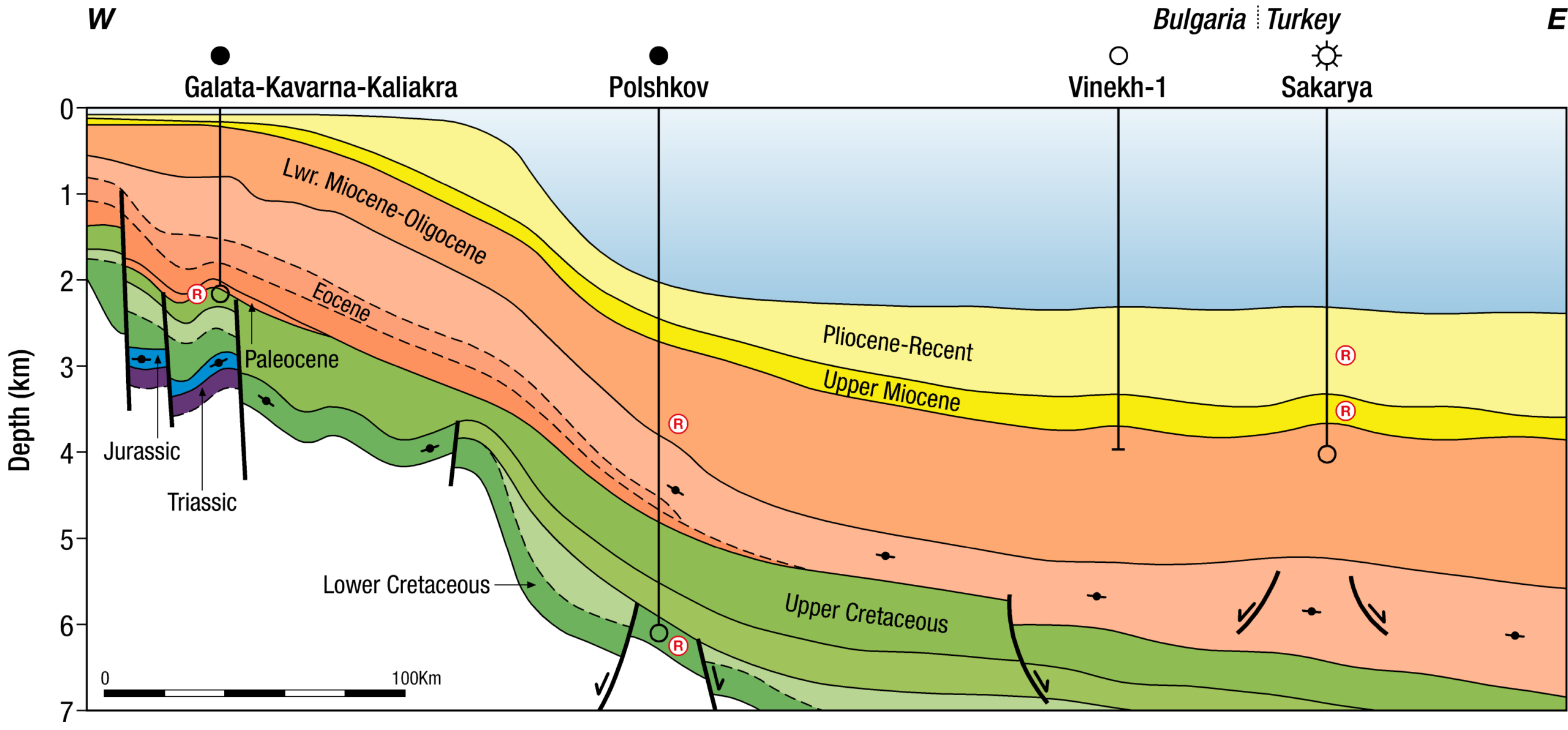
To circle back, the Turkish Caycuma discovery borders and may extend over the maritime boundary with Bulgaria. Figure 2 is a schematic cross-section illustrating the relationship between Sakarya and Bulgarian waters. Vinekh-1 lies less than 30 km from Caycuma and is reported to share as one of its targets an equivalent reservoir interval, “A1”, with prospective resources according to a competent person’s report of 2 TCF at a geological risk of 43 %. Secondary targets add a further 1.4 TCF at a risk of around 25 %. The follow-up Krum prospect, which lies further west away from the Turkish proven resources, has aggregate prospective resources of 7.5 TCF in three reservoir targets at risks between 16 and 32 %.
Establishment of a biogenic gas play
Success at the scales predicted in these two forthcoming Bulgarian wells will complete the establishment of a proper Western Black Sea biogenic gas province. It is a matter of time until the more northerly part, offshore Ukraine, will be tested too.
The operator of the Han Aspurah licence is OMV, in a 50:50 partnership with NewMed. The latter is farming in by paying the premium of the first €50 M of both the Vinekh-1 and Krum-1 wells. The Vinekh-1 well is in 1,900 m of water, around 160 km offshore, and will be drilled by the Noble Globetrotter drillship. TD is estimated to be at 3,250 m, 1,350 m below the mudline. The dry hole Authorization for Expenditure cost is €89 M, with contingent testing a further €20 M. Immediately following Vinekh-1, the drillship will move to drill the partly analogous Krum prospect, at a gross estimated cost of €86 M, to a depth of 3,540 m in water depths of 1,760 m.