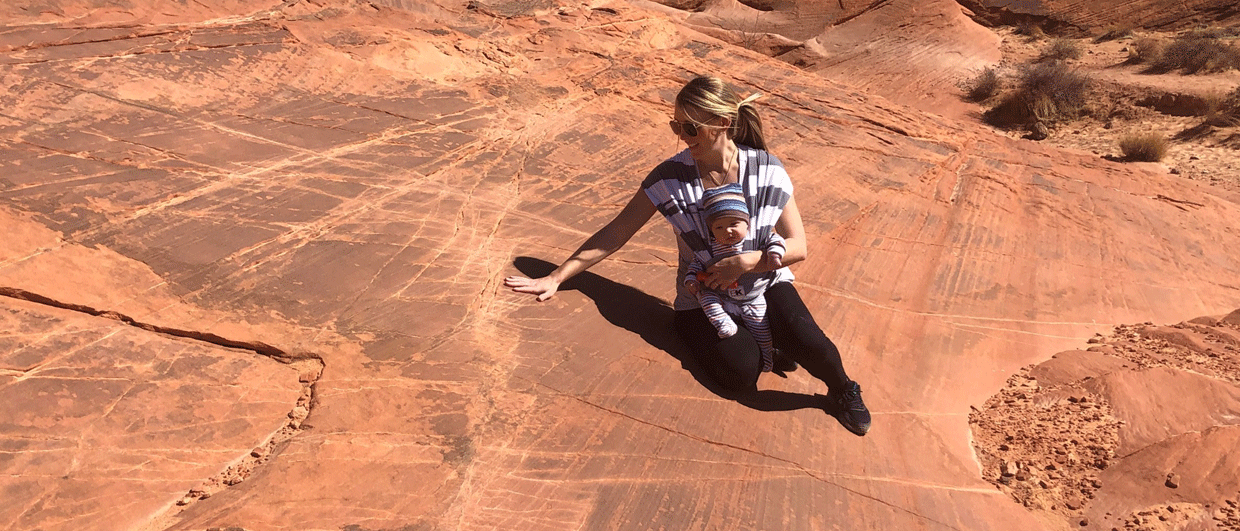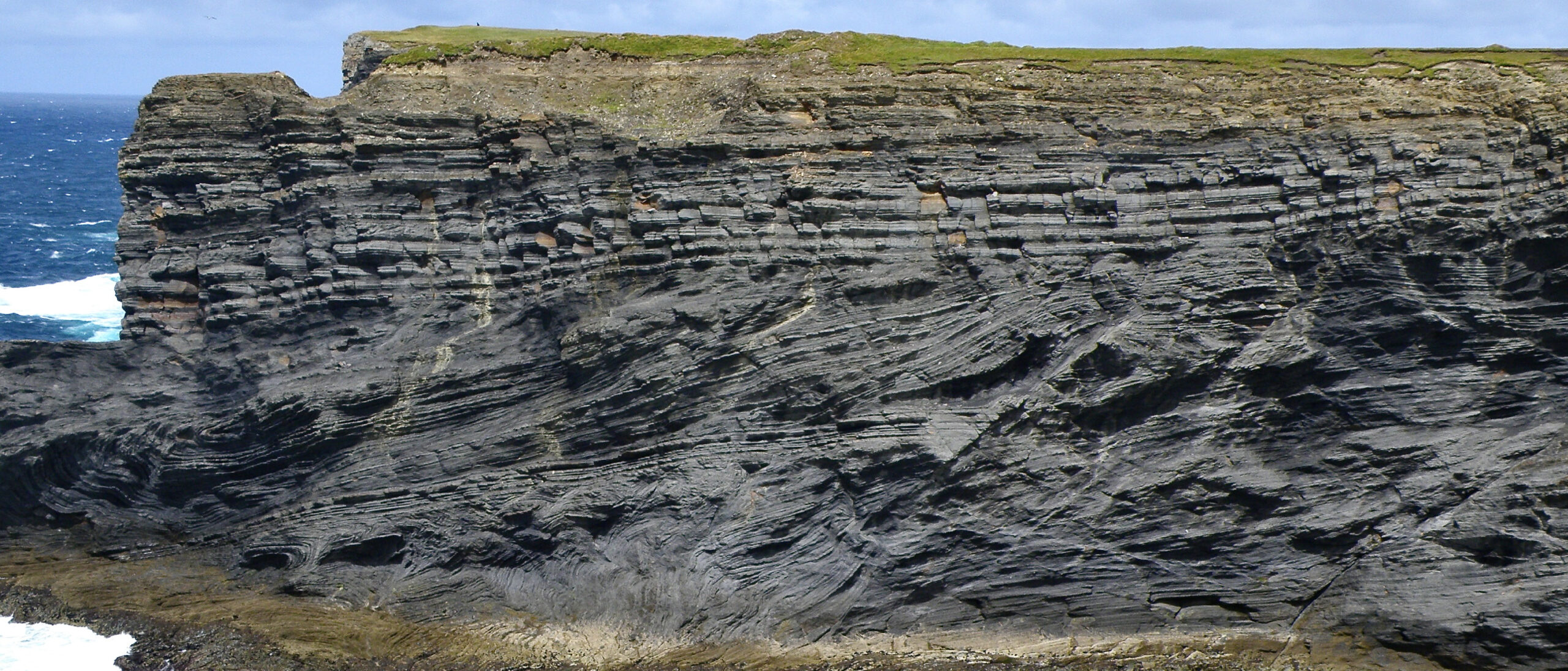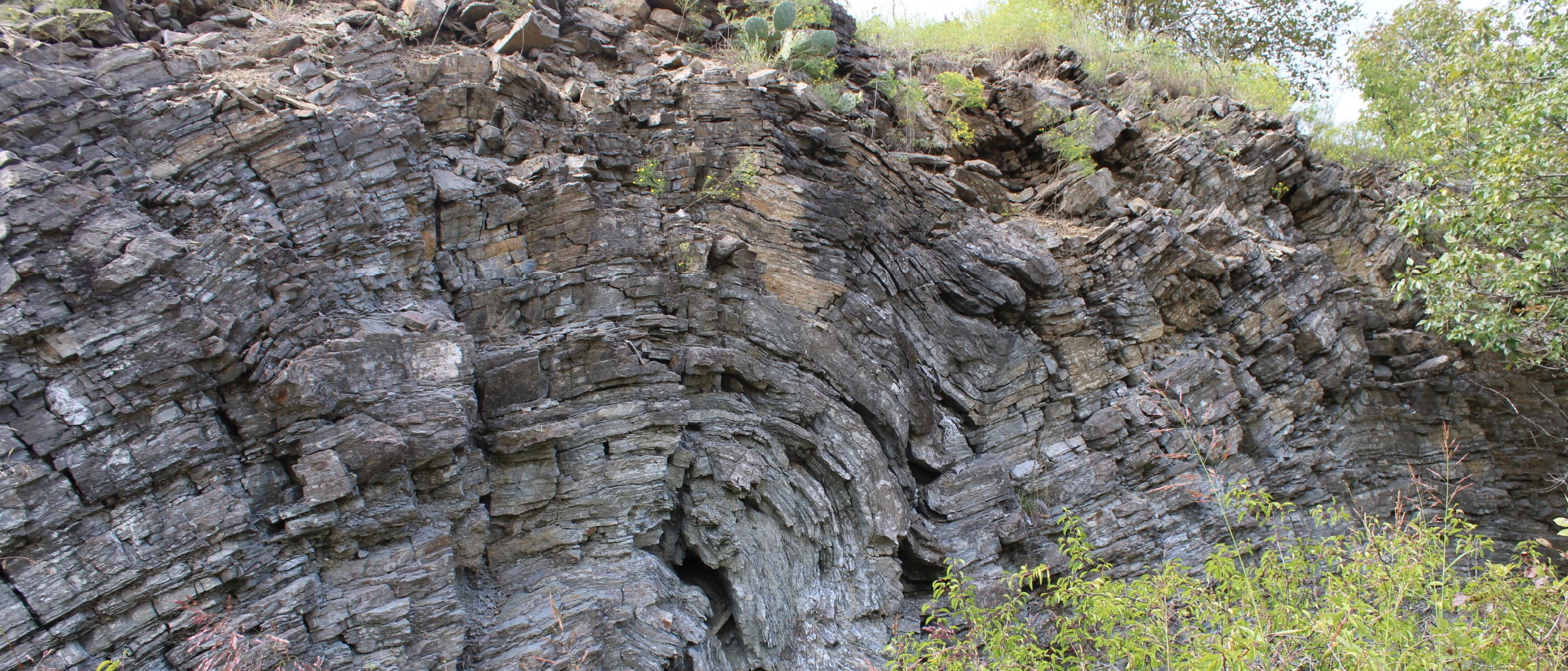
Fold in Arbuckle Mountains. Photo: Molly Turko.
Know your faulted folds
Stratigraphic controls on contractional architecture

The concept of “mechanical stratigraphy” is a staple in structural geology, yet we often confine our focus to the small scale, analyzing how individual beds or fractures respond to stress. By scaling up this perspective, we can leverage stratigraphy as a predictive tool to determine the specific styles of faulting and folding likely to emerge during an orogenic event. In thin-skinned deformation where the basement remains uninvolved, structural styles are heavily dictated by the macro-scale stratigraphic framework – whether the section is dominated by thinly bedded clastics, massive carbonates, or significant volumes of salt or shale.

Three primary styles of fault-related folding illustrate this relationship: fault-bend folds, fault-propagation folds, and faulted detachment folds. A fault-bend fold occurs as rock layers translate along a fault that changes dip, forcing the strata to conform to the ramp-and-flat geometry while largely preserving bed thickness. In contrast, a fault-propagation fold develops at the leading edge of a growing fault tip where slip has yet to break through to the surface, accommodating shortening through the development of asymmetric anticlines. Finally, a faulted detachment fold begins as a fold above a weak, low-angle décollement and is subsequently modified by faulting as deformation progresses.
The development of these styles is closely linked to the mechanical properties of the rock column. Fault-bend folds typically occur in stratigraphy characterised by massive, competent units – such as thick carbonates – separated by thin, incompetent shale layers that facilitate slip before ramping upward. Fault-propagation folds tend to favour more homogeneous, thinly bedded mechanical stratigraphy, such as mixed sand-and-shale sequences. Faulted detachment folds are most prevalent in sections containing substantial thicknesses of salt or overpressured shale, where the weak décollement allows for significant ductile folding prior to any fault breakthrough.
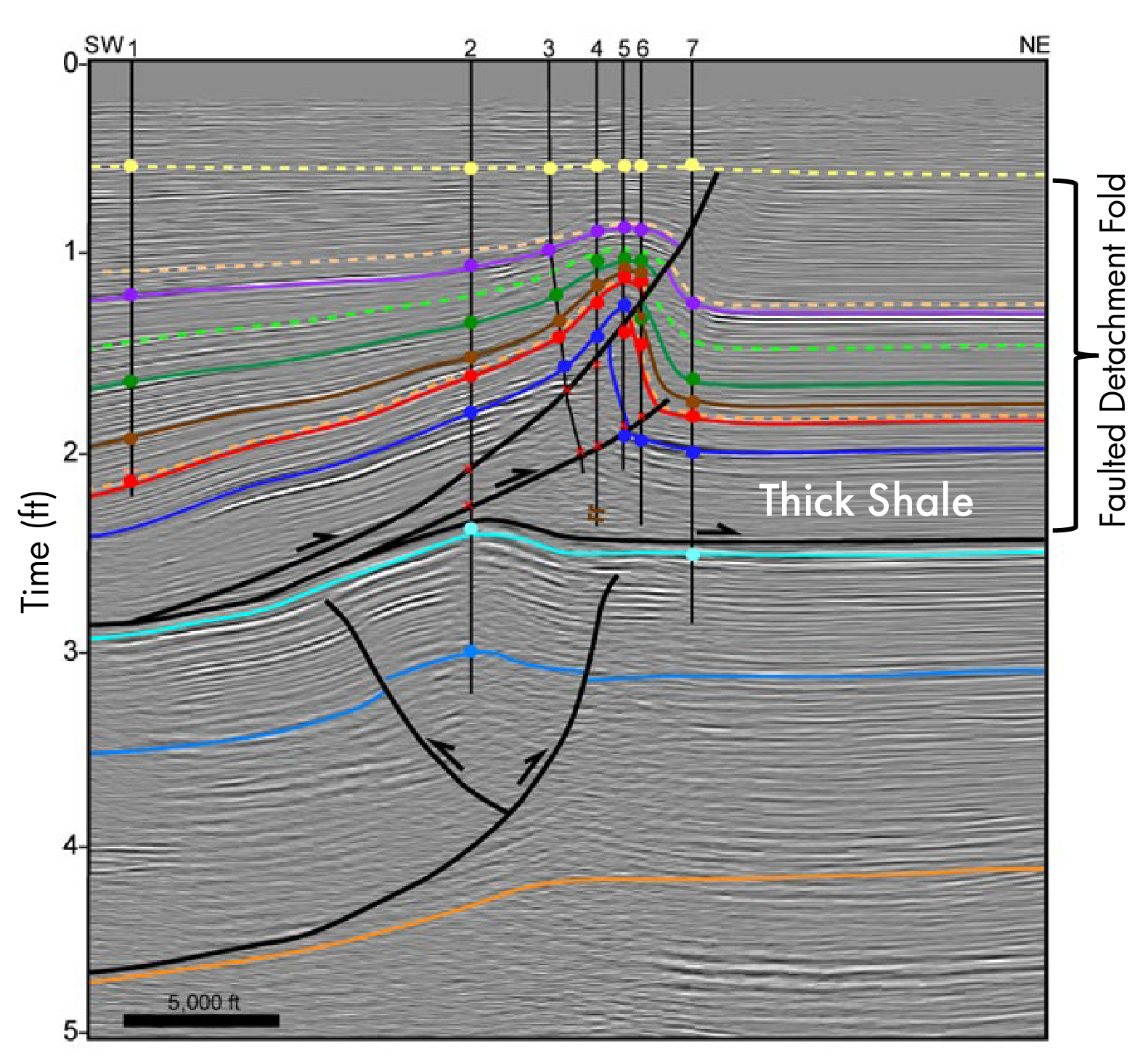
These relationships are clearly visible in the subsurface of southern Oklahoma. Seismic data from the southeastern Anadarko Basin reveal two distinct levels of structuring: an upper faulted detachment fold situated above a thick shale, and a lower fault-related fold within thick, competent carbonates. While the lower structure is currently classified as a fault-related fold, continued deformation would likely have driven it toward a fault-bend fold geometry due to the competent nature of the units involved. Although nature often produces complex hybrids, these simplified models serve as a vital reminder that the mechanical stratigraphy is a fundamental blueprint for the structural styles we observe.