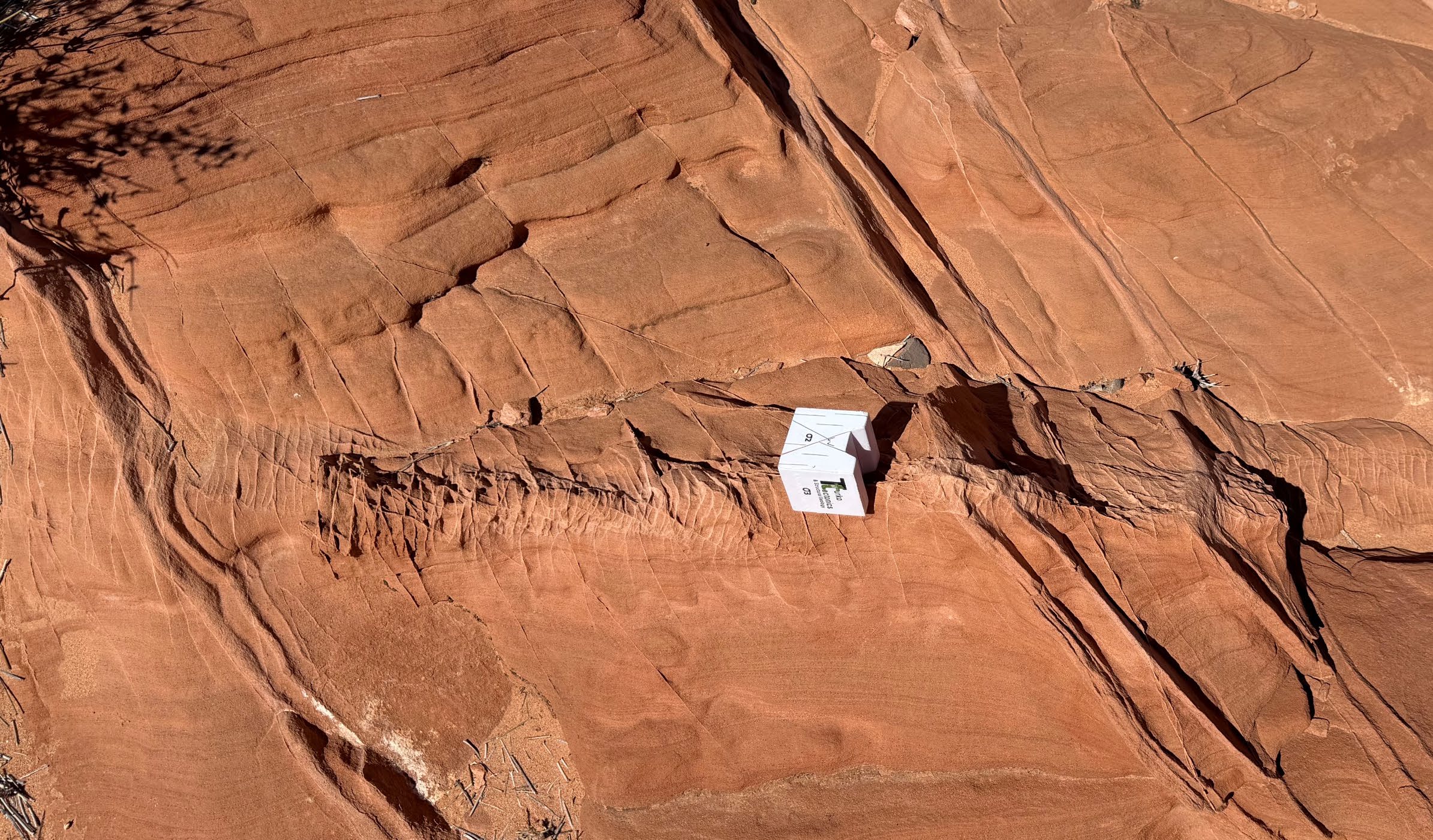
This baby knows everything about faults and fractures! Do you? Photo: Molly Turko private archive.
The rebellious proto-Riedel shear zones
Fault nucleation order is not universally synthetic-driven but depends on lithology, fluid pressure, and boundary conditions

Classic Riedel shears are the first subsidiary fractures that form prior to breakthrough of a master fault. They appear as low-angle (~15°) en echelon arrays oriented synthetically to the principal displacement zone (PDZ), sharing the same sense of slip. This synthetic-first sequence is widely assumed to control fault nucleation in brittle crust. Although best known in strike-slip settings, Riedel shears also occur on normal and reverse faults, where the low-angle synthetic set (R shears) and high-angle antithetic set (R′ shears) are often simply called synthetic or antithetic relative to the master fault.
Proto-Riedel shear zones (PRZs), defined by Ahlgren (2001) in the porous Jurassic Navajo Sandstone of southern Utah, are fundamentally different. They are the earliest tabular precursors to linked strike-slip faults and begin as spaced, en-échelon, high-angle (55° – 85°) deformation bands oriented antithetically to the overall zone. These bands nucleate under elevated fluid pressure via compactional cataclasis and granular flow. With increasing strain, the zone hardens, conjugate low-angle synthetic (R-equivalent) bands form, and the original high-angle bands are recycled as R′ shears. The result is a helicoidal, sigmoidal array that eventually localizes into a principal shear zone (PSZ). Similar PRZs occur in the age-equivalent Jurassic Aztec Sandstone at Valley of Fire State Park, Nevada – both eolian sandstones – where awkward spine-like fracture geometries (pictured here) fit Ahlgren’s model.
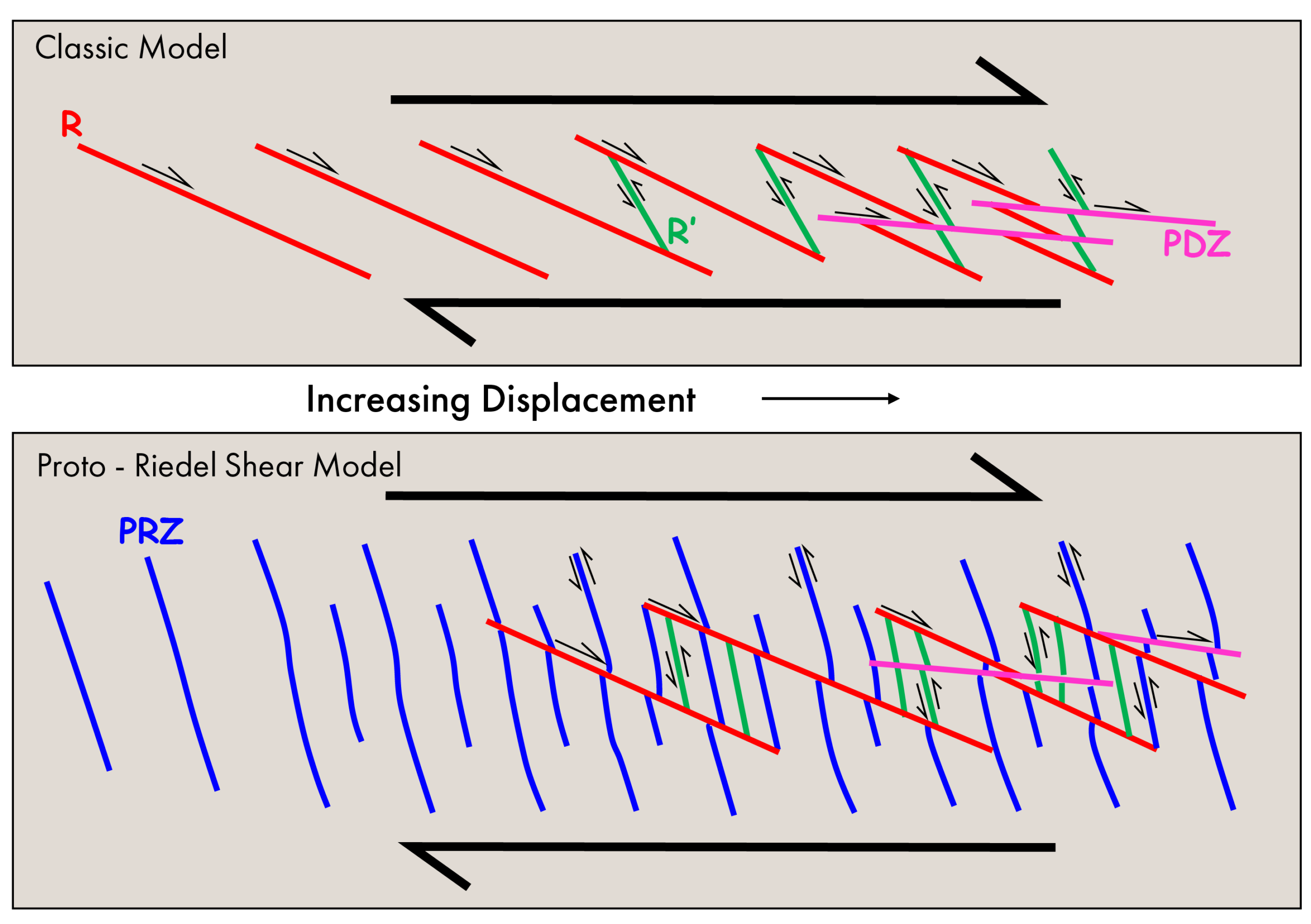
Ahlgren’s 2001 work is controversial because the nucleation sequence is antithetic-first, opposite to classic models. It challenges the universality of the synthetic-first paradigm and shows that lithology and pore-fluid pressure can control whether R or R′ shears dominate early growth.
Post-2015 studies have broadened the discussion, though direct replication of antithetic precedence is still rare. Camanni et al. (2023) describe contractional relay zones on normal faults where multiple antithetic (R′-like) faults transfer throw between synthetic segments in Riedel-like geometry; later linkage of the synthetic faults bypasses the relay, preserving the antithetic array inside the fault zone – similar to PRZ recycling.
Thus, while Ahlgren’s antithetic-first PRZs remain the clearest natural counter-example to lab models, recent work on normal-fault relays and numerical / induced-seismicity settings shows that early antithetic activity is more common than previously thought. The controversy continues: fault nucleation order is not universally synthetic-driven but depends on lithology, fluid pressure, and boundary conditions.