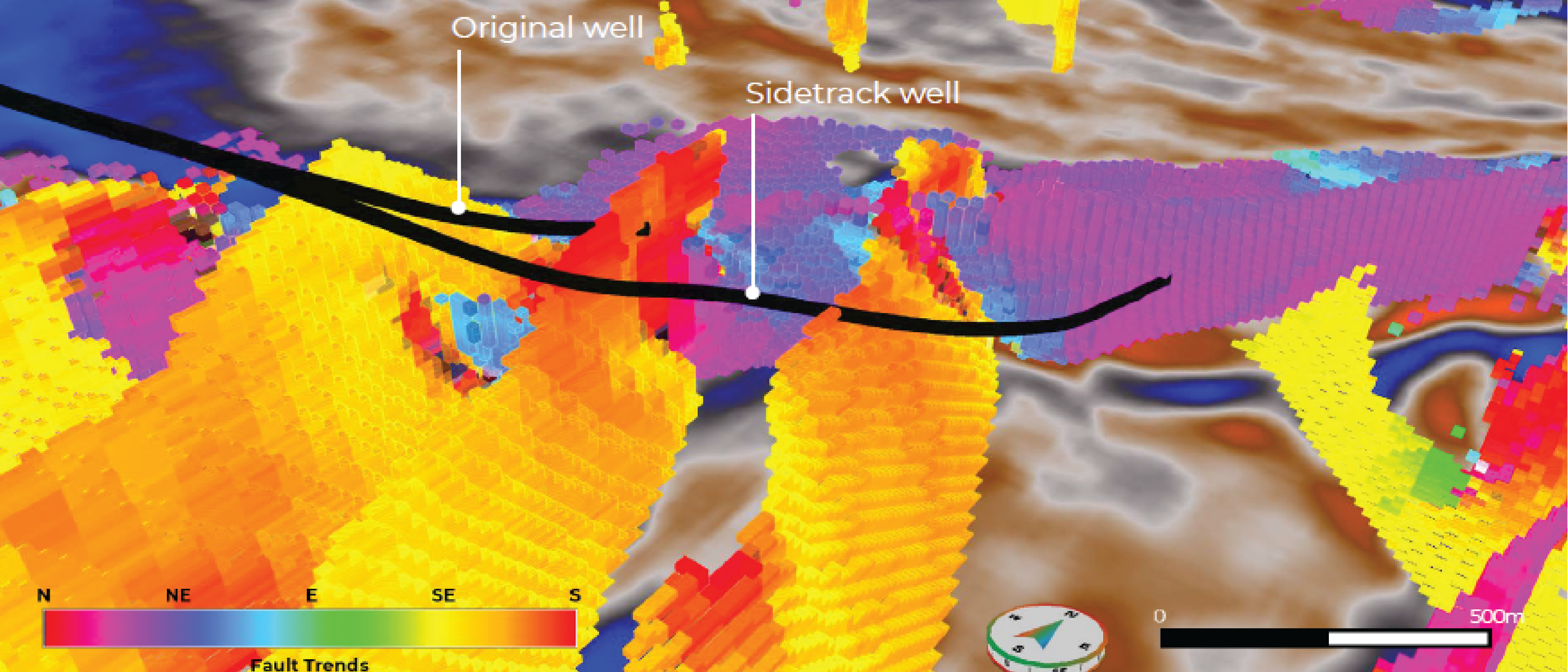
3D view of AI-interpreted faults, highlighting a previously missed fault linkage along the original well path. Source: Geoteric.
Finding hidden faults
How AI delves deeper into the structural geology of the Tern Field, UK North Sea

Found in 1975 with the drilling of well 210/25-1, the Tern Field was one of the major Brent discoveries in the UK Northern North Sea. Over the decades, a total of 77 wells were drilled in the field – four exploration, four appraisal, and an impressive 69 development wells.
Development well 210/25a-A49, and its sidetrack, A49Z, were completed in 2013 and 2014. The sidetrack was required after wellbore instability compromised the original well during hole-cleaning operations. Post-well analysis linked the instability to an unrecognised fault, one that had not been interpreted in the structural model and therefore had not been risked during planning.
The operator’s end-of-well report, available through the UK National Data Repository, highlighted the need for more detailed seismic evaluation of the overburden in future drilling campaigns. Although the sidetrack successfully navigated several interpreted faults and landed in the intended target, the incident underlined a broader issue: Traditional seismic interpretation can miss subtle structural features that nonetheless pose significant drilling hazards. As the operator wrote in the document, “When faulting is known, wellbore stability issues should always be planned for to avoid or reduce potential problems.”
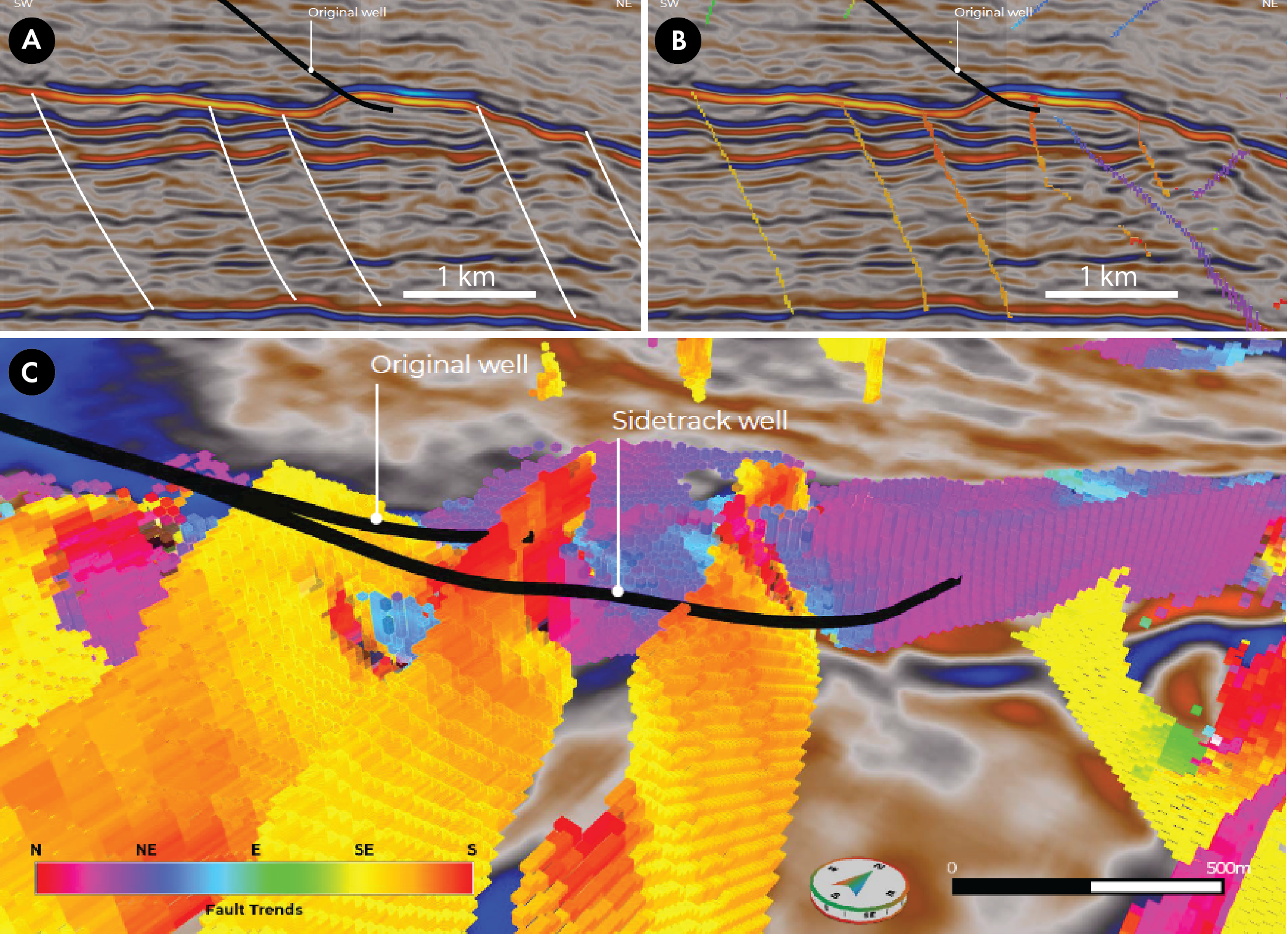
The seismic dataset used in this study, acquired in 1995, reflects the technological limitations of the time. Optimised for imaging Middle Jurassic Brent deltaic sands, the data lacked the resolution expected from modern acquisition. However, after running a series of Geoteric data conditioning tools and subsequently AI Foundation Network, the resulting AI Fault Confidence volume revealed a far more intricate fault network than previously recognised. Distinct structural panels emerged, each defined by delicate fault linkages and subtle lineaments that traditional interpretation had overlooked.
The AI Fault Confidence volume provided an unbiased detection of faults regardless of size, illuminating features that interpreters might have dismissed as insignificant. To test the effectiveness of the AI-derived interpretation, the original development well was subsequently imported into the project. The previously uninterpreted fault responsible for the wellbore collapse was clearly visible in the AI volume.
Further analysis showed why the fault had been missed. When coloured by orientation, two faults displayed contrasting trends: One parallel to the section, shallow and difficult to detect; the other perpendicular but near its tip, exhibiting minimal offset. Visualising these relationships in 3D revealed that the original well trajectory would have intersected an additional fault linkage point – another potential hazard.
Ultimately, the AI Fault Confidence volume demonstrates how advanced interpretation workflows can improve drilling safety and reduce unplanned downtime. In the Tern Field case, nine days were lost between the collapsed well and the sidetrack. With clearer structural insight, such costly interruptions are far less likely, making the case for an AIassisted fault detection exercise.
This article is the first in a series of articles with Geoteric in which the benefits of AI-assisted fault detection are demonstrated through real case studies.