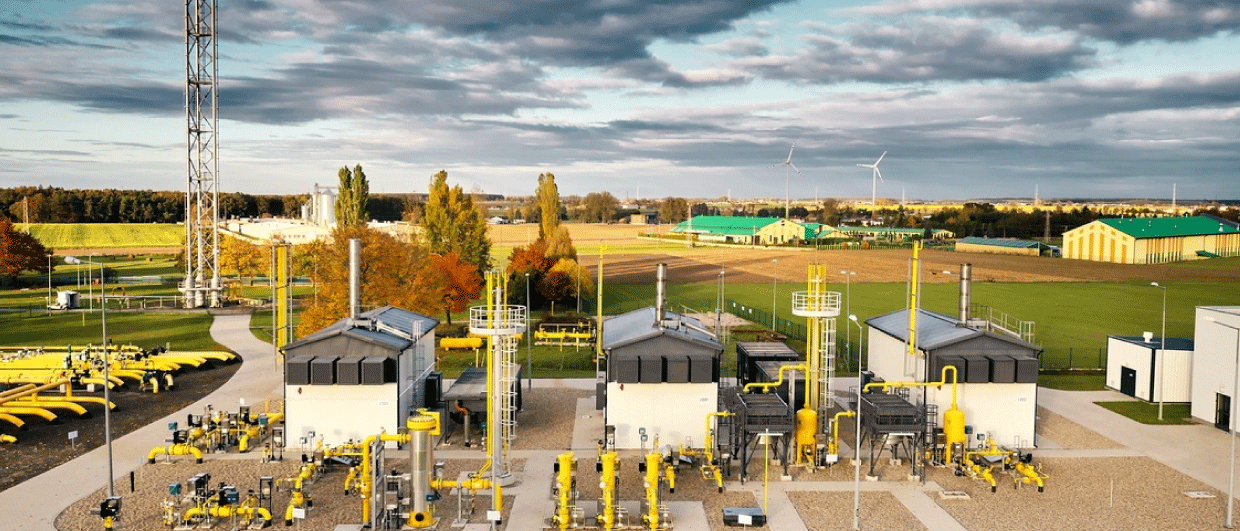
Gas compressor station, Odolanów, Poland. Photo: www.gaz-system.pl.
Poland is the only serious helium supplier in the EU, but not because its subsurface is so special
Europe’s Critical Raw Materials Act stipulates that by 2030, 10 % of the EU’s helium consumption should be extracted by the member states themselves. An ambitious goal, given that the European Commission acknowledges that its proven reserves are only 0.2 % of the global proven volume

The European Union has marked 34 substances as ‘critical raw materials’. Helium is among them due to its significant industrial importance and the high chances of supply chain disruption. Those supply vulnerabilities are currently more acute than ever; 40% of EU helium is imported from Qatar, but shipments can’t be delivered due to the conflict in the Middle East. In addition, Russian helium is banned under sanctions related to the war in Ukraine. The majority of Europe’s helium is thus imported from the United States and Algeria.
Poland is the EU’s only significant helium producer. My estimate is that it covers around 7-8 % of EU consumption. That’s not bad, given that Poland’s natural gas fields generally contain less than 0.4 % helium.
Poland achieves its high helium output because the country has made it mandatory for operators to evaluate the helium resources of a field if the concentration exceeds 0.2 vol.%. This has resulted in the assessment of 17 gas fields, giving a combined contingent helium volume of 24 Mm3.
However, 76% of Polish helium is actually produced from fields containing less than 0.2% helium. The reason is that the Polish national oil and gas company (Orlen) needs to denitrify the natural gas to raise the energy density, and having this process in place means that it is relatively straightforward to simultaneously capture helium.
All helium is produced from the Wielkopolska petroleum province in the west of the country. A study assessing a further 30 natural gas fields in the province has established 35 Mm3 in prospective helium resources.
Plenty of additional helium exploration opportunities in the rest of the country remain, with four prospective areas for helium exploration identified based on correlating basement geology with the existing petroleum provinces. Hard data are scarce, unfortunately, with helium concentrations lacking for most legacy wells in these areas. At the same time, it is well-known that a few aquifers in Paleozoic strata in the east of the country demonstrated up to 10% helium.
Not all of Europe’s hope is focused on Poland. 45-8 Energy is actively exploring the Baltic coast in Germany, where a series of dry wells proved to have elevated nitrogen and helium contents. The company is also drilling for helium at two locations in France. A recent exploration well at the site of a natural spring discovered 0.33% helium, an 8-fold increase from the concentration naturally bubbling up to surface. The other well encountered up to 0.31 % helium and had positive flow test results.
And finally, something could also be done on the demand side. For example, Poland’s current production is enough to fill all EU party balloons that are used annually, consuming around a third of the helium needed by the medical industry. Not a trivial amount.