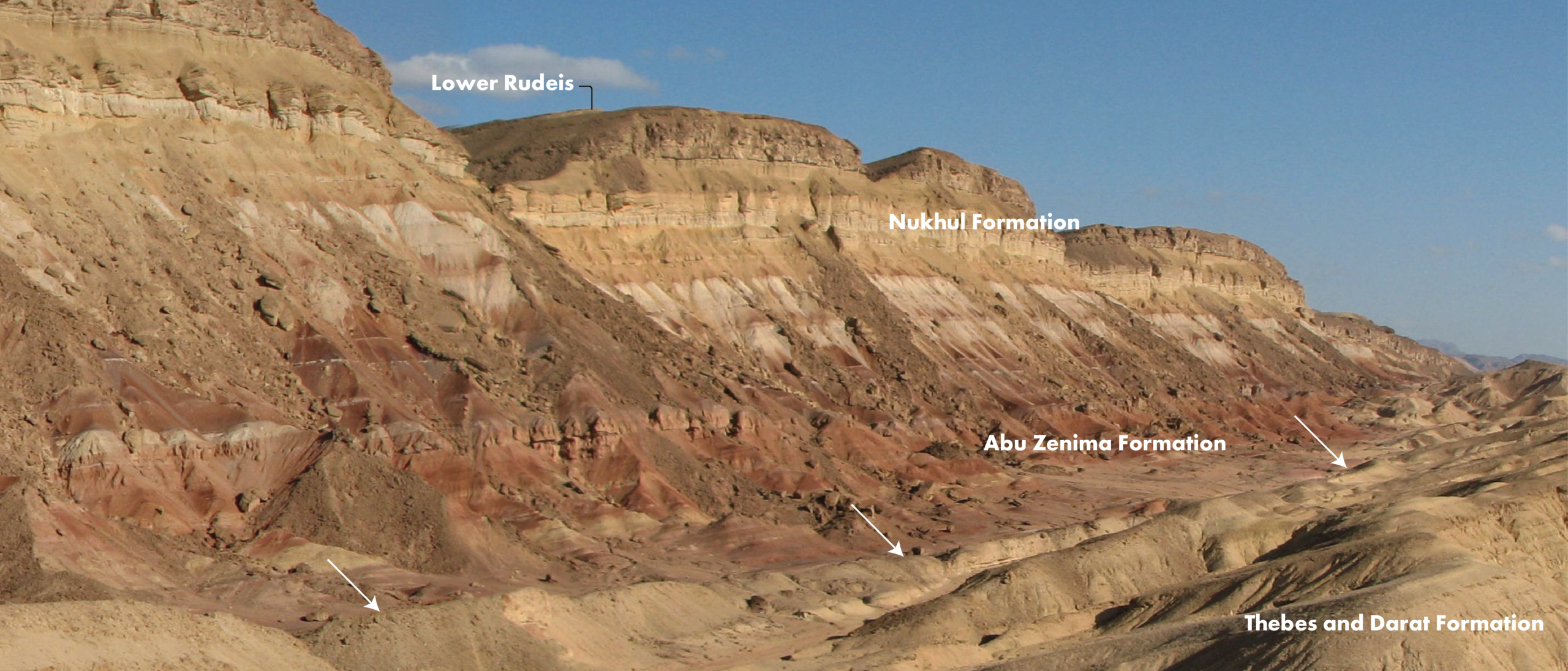
Photo: Ian Sharp.
Wadi Nukhul – a glimpse of the Red Sea-Gulf of Suez rift system

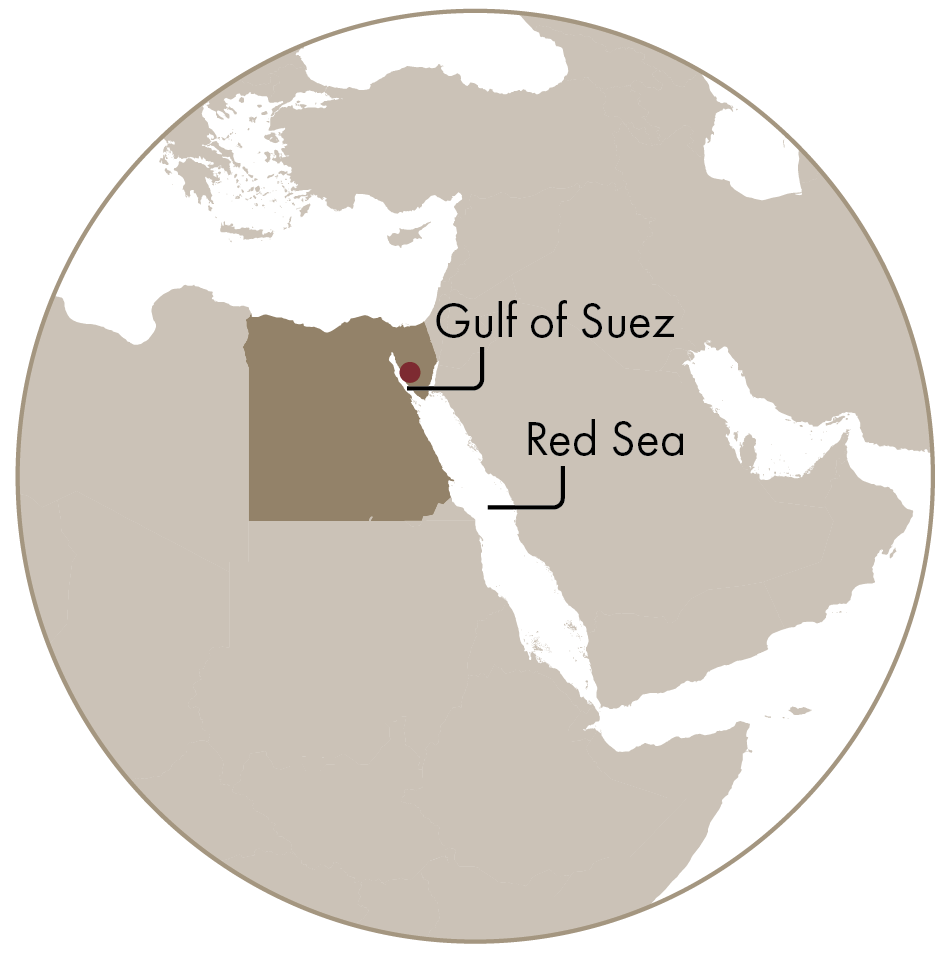
During the Oligocene and Miocene, a 2,000 km long zone of extension developed that formed the Red Sea-Gulf of Suez rift system. In this outcrop photo, we are looking south in the Wadi Nukhul region on the east coast of the Gulf of Suez, and observe the pre-syn-rift unconformity (arrows) that developed as a result of the rifting event.
 In this view, pre-rift Eocene limestones and marls of the Thebes and Darat Formations are unconformably overlain by fluvial and lacustrine red bed facies of the Rift Initiation Abu Zenima Formation, which fills major erosional valley systems cut into the pre-rift strata. The valley fill consists of a basal unit dominated by overbank heterolithics, mature paleosol / caliche horizons and local fluvial channel systems which pass upwards into a lacustrine to brackish mudstone interval (white units).
The buff to brown-colored units in the upper part of the cliff are tidal facies of the Rift Initiation Nukhul Formation, which include excellent high N/G estuarine tidal channel complex reservoirs and interbedded thin-bedded tidal flat hetero-lithics. The Nukhul Formation is overlain by off-shore to shelfal mudstones and sandstones of the Lower Rudeis Rift Climax succession (topmost outcrops). Note the progressive decreasing dips up-section, related to syn-depositional growth on the Wadi Nukhul and Rift Bounding faults. The syn-rift cliff section is circa 150 m high.
In the offshore Gulf of Suez, circa 30 – 40 Bbbl (OOIP) have been discovered to date (10 – 12 Bbbl recoverable), split roughly 40 – 60 between pre-rift and syn-rift reservoirs / plays, charged by Cretaceous and Miocene source rocks and sealed by a super-regional seal of Mid to Late Miocene evaporites. Similar plays might be expected in the relatively unexplored inboard parts of the offshore northern Red Sea.