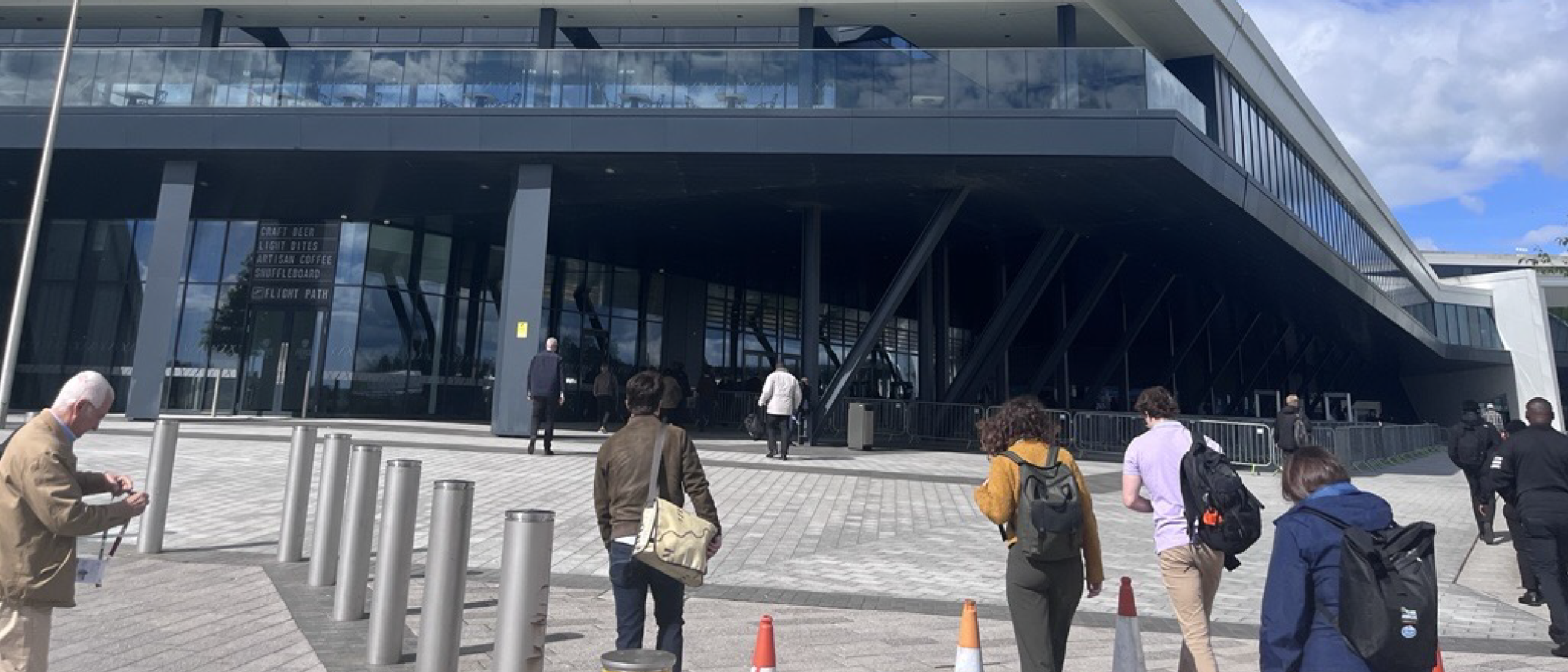
Delegates arrive at P&J Live, Aberdeen. Photo: GEO EXPRO.
Why physical collaboration matters in a digital subsurface
Building advanced systems is meaningless if you ignore the human architecture required to run them

I will be honest: I was sceptical about bringing EAGE to P&J Live in Aberdeen, Scotland, this year. Historically, out-of-town campus venues risk fracturing a conference. You fight the traffic, you miss the organic energy of a city centre, and you worry the layout will split the audience into isolated silos. But setting out for the Granite City, still the operational base of the UK North Sea operator landscape, that scepticism evaporated the moment I hit the Icebreaker. The air was immediately thick with familiar faces, carrying an energy that felt less like “business as usual” and more like a collective statement of intent.
In an era dominated by peak uncertainty, remote workflows, and digital connections, 6,000 people still chose to make the journey. We stood shoulder to shoulder on an exhibition floor where service companies brought their absolute best: Impeccably turned-out booths, tight technical programs, and genuine platforms for collaboration.
The true buzz of the week wasn’t basic machine learning or large language models; it was agents – autonomous workflows capable of executing complex, multi-step reasoning. Based on what I witnessed on the floor and in the technical sessions, we have officially moved past the naive phase of “what can AI do?” and entered a highly pragmatic era focused squarely on what we should do and how we should execute it.
Yet, as we rush toward this agentic future, a critical truth emerged from the peer-to-peer sessions – building advanced systems is meaningless if you ignore the human architecture required to run them.
This is exactly why physical conferences and meetings still matter in an increasingly digital world. They provide the definitive space for true human interaction and high-stakes debate about what we are doing and why – an environment that touches on the full spectrum of operational, economic, and ethical issues. While the comprehensive list of takeaways is exhaustive, three main themes stand out as the pillars defining our industry’s path forward.
First of all, there is empathy in design. We have to build AI agents that respect and elevate the hard-won intuition of senior geoscientists, rather than treating human expertise as a data bottleneck to be bypassed. Secondly, we need pragmatic guardrails that ensure the transition to autonomous workflows is handled in a transparent, human-verifiable way that actively safeguards operational and geological integrity. And finally, collaborative problem-solving is essential by recognising that the ultimate goal of an AI agent is to free up human capital, allowing professionals to focus on the highest-value, most complex challenges facing global energy security.
This brand of pragmatism highlights that geoscientists are not waiting around for massive software conglomerates to hand them polished, one-size-fits-all tools. We understand the limitations of top-down software deployment in a domain built on ambiguity and specialised interpretation.
Instead, by developing and maintaining a highly engaged, collaborative subsurface community, geoscientists are actively building their own agentic future from the ground up. We are proving that the future of subsurface intelligence will not be dictated to us – it will be co-authored by us.