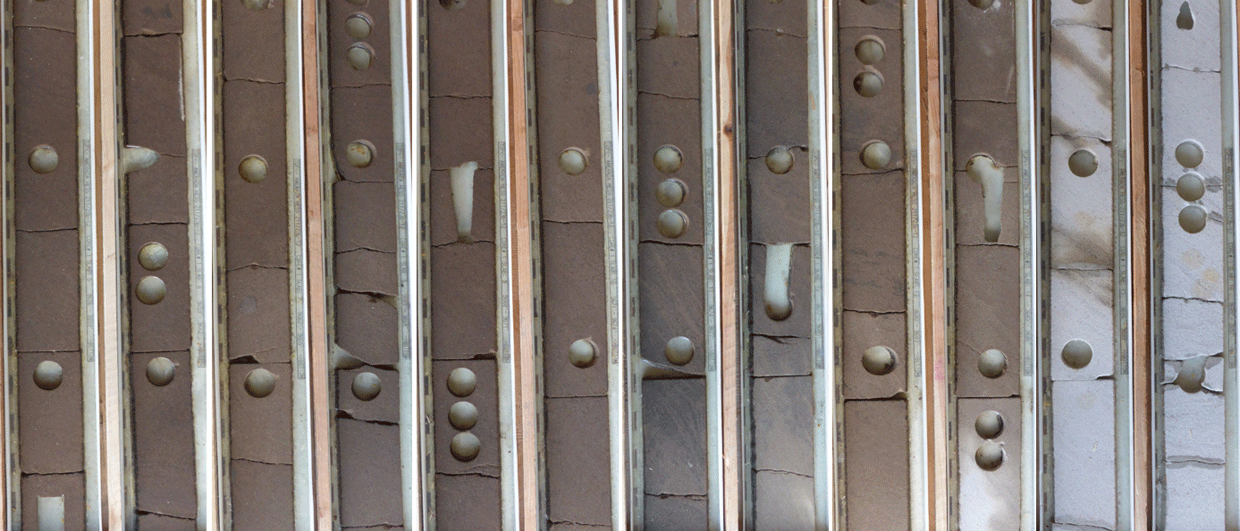
A presumed oil-water contact in well 211/23b-12, Skye discovery, UK Northern North Sea. Photo: Henk Kombrink.
Oil-water contacts don’t exist
The oil industry prides itself on being data-driven, yet one of its most widely used concepts, the oil-water contact, cannot be numerically quantified. Aberdeen-based petrophysicist Steve Cuddy argues that the industry should favour the only measurable contact, the free water level

Steve’s argument goes back to a challenge set by the London Petrophysical Society. They invited petrophysicists to derive a function describing how water saturation varies with depth. Most responses followed the traditional route, searching for increasingly complex saturation vs. height relationships. Steve took a different approach; he focused on bulk volume of water (BVW), a quantity tied directly to measurement. His solution matched the data, and he therefore won the competition.
Logging tools and core analysis measure volumes; they quantify pore space and how much of that space contains water. Water saturation is calculated afterwards by dividing water volume by porosity. It is a ratio of two measurements, a percentage of a percentage, and therefore an interpretation rather than a direct observation, according to Steve. Resistivity tools respond primarily to the amount and connectivity of conductive water, they effectively indicate BVW rather than saturation.
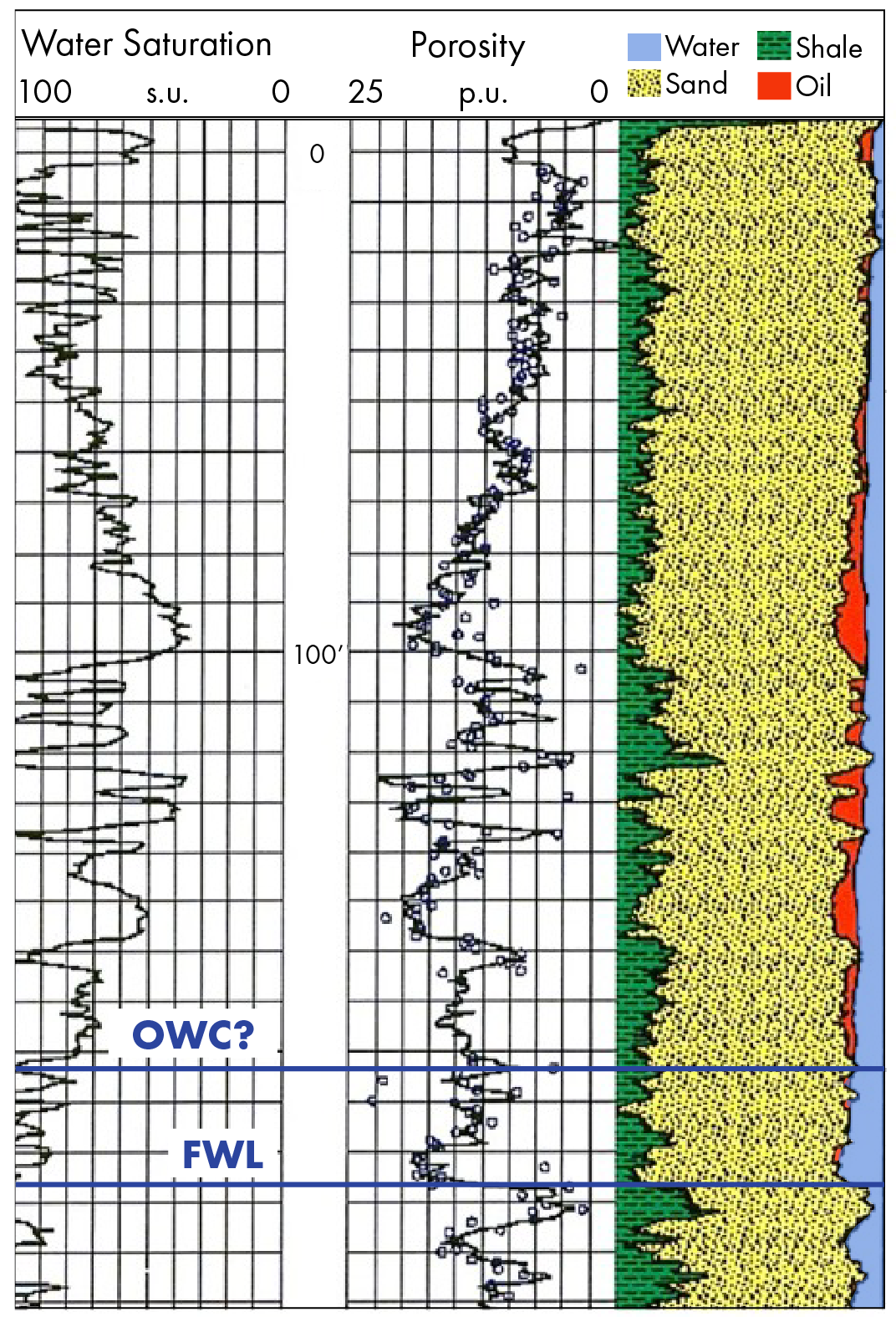
Steve’s theory centres on the free water level (FWL), the depth at which the oil and water pressure gradients intersect. It is a physically meaningful boundary, corresponding to zero capillary pressure, identifiable from pressure data, and often visible as a flattening of resistivity in the water leg. Above this level, oil is the mobile phase while water is held in the rock by capillary forces. The amount of water decreases continuously with height as buoyancy pressure increases.
The oil-water contact (OWC) is often defined as the depth at which oil first visibly enters the pore system. It is an interpretation of the log data, not defined by pressure data. Intervals above the contact can still show 100 % water saturation if the rock is too tight to hold any oil. Nothing physically happens at the depth of the OWC; it is better described as an “oil down to” depth, an interpretation rather than a measurable feature. If fluids are allowed to equilibrate in an open hole, oil sits on water at the FWL, not at the OWC.
From this perspective, reservoir modelling becomes much simpler. Instead of relying on the false concepts of transition zones or irreducible water, fluid distribution can be described using BVW as a function of height above the FWL. Once that relationship is defined, BVW can be estimated throughout the reservoir, and oil in place follows directly as porosity minus BVW.
Steve’s idea is controversial because it challenges long-standing industry practice. But the question it raises is straightforward: Should reservoir models be built on evidence, or on what has long been assumed?