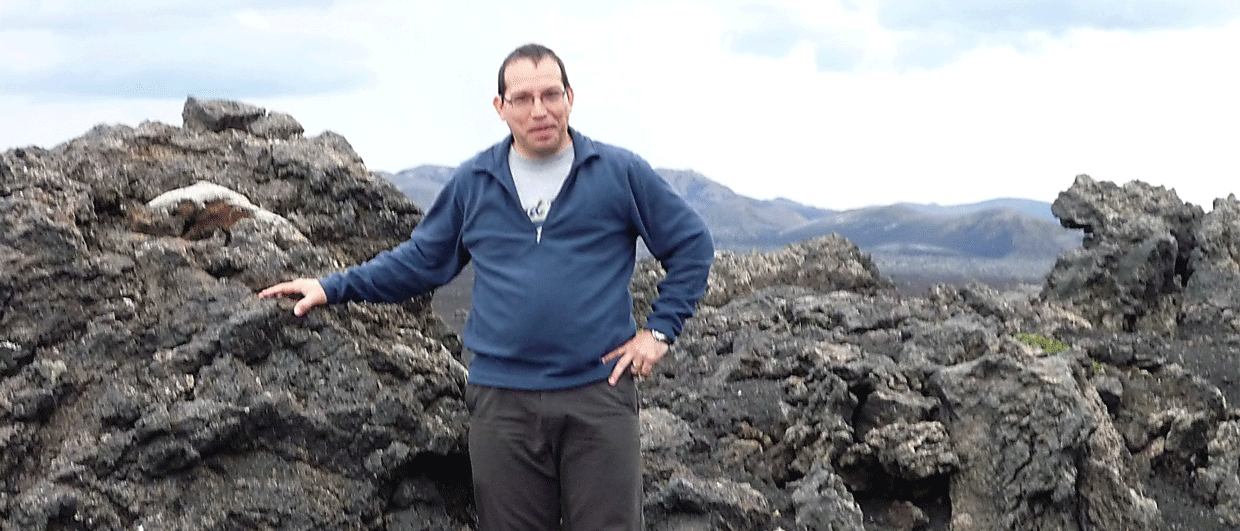
Oscar Miron. Photo Oscar private archive.
“It is quite a risk hiring you”
Every time a round of redundancies is announced, we hear a variety of silver lining statements from those who were let go, such as “this could be a great opportunity to explore new directions.” However, this sounds a lot easier than it is, writes geophysicist Oscar Miron, who transitioned from oil and gas to the shallow seismic business

Yes, some people will break out of the shackles of their former role and flourish in a completely different career. But let’s not forget that for others, there is a long and painful road ahead. Why is that? I think that hiring managers too often ignore the experience built up in previous roles, dismissing that as irrelevant for the position they need to fill.
Here is my experience.
I worked very happily, for 20 years, as a geophysicist in the oil and gas sector – until the day I was made redundant. For six long and painful years thereafter, I pursued hundreds of opportunities outside the oil and gas sector, only to receive an almost equal number of rejections.
Until one day, during a job interview for a role as an interpreter of shallow seismic data. I showed the interviewer the latest results from an oil and gas project that I had worked on. But he could not tell the difference between deep and shallow seismic. Cut a long story short, I was offered the job. Success, at last!
After celebrating for a couple of hours, I burst into tears at the realisation of what I had just done; after six years of hearing excuse after excuse about why I should not be considered for a role in a sector where I had “no experience,” I had just succeeded in securing a job in a new sector.
Certainly, for the first six months, I was a junior in my new role. This is not a surprise, right? New methods, new software, absolutely everything was new. But fairly soon, the balance began to tip in my favour. Within a year, I was interpreting shallow seismic and side-scan sonar, and I did some coding to analyse and reformat topographic and hydrographic data. In addition, I was instrumental in securing very lucrative long-term contracts by creating deliverables for the client that none of the competitors could match.
Flashes of feedback from potential employers still come to mind sometimes: “You are such a risk”, or “I know you will fit in and do well but I can not hire you.” Now I can look back and say, “Risk? What risk? I had already achieved similar things in the oil and gas industry, as my CV had clearly shown. In other words, my ability to succeed was already proven, and it was therefore only a matter of time to achieve the same in my new role; and a short time it was indeed.
Does it really need to be that difficult to change careers? People seeking a change are educated, and have had a successful career full of achievements. Why, then, is shifting from one role to another so complicated for some? Surely, if you have a degree in geophysics and 20 years’ experience in oil and gas in a particular basin, you can apply for a job in another basin, in carbon capture, and even for a basic job in as a geophysicist in archaeology?
This narrow mindset in our profession is what I call the Enemy Within. Successful stories about transferable skills are out there – they do exist. But still, for those who fail to secure roles in a different sector of geology or geophysics, it is often the mindset of technical managers, not candidate unsuitability, that puts obstacles in the way to success.