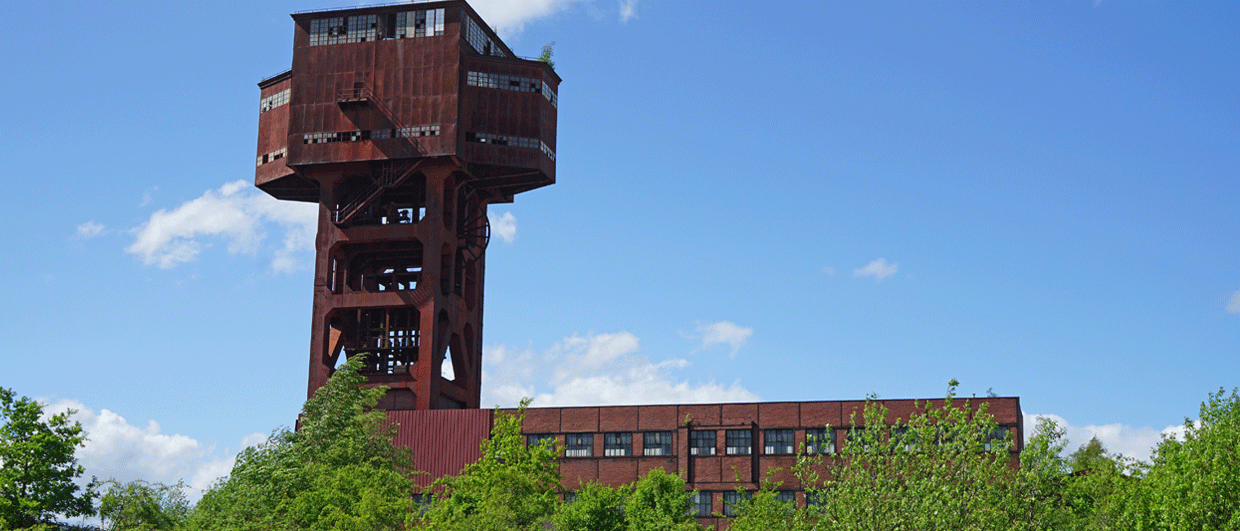
Pithead of a former coal mine in Folschviller. Photo: Wikimedia Commons
Deep hydrogen in Lorraine: An appraisal well or a science project?
Lorraine’s hydrogen potential made headlines again this year as La Française de l’Energie (FDE) has now drilled a dedicated and much deeper appraisal well. But is it really an appraisal well, or rather a scientific undertaking?

Following the discovery in 2023 of hydrogen in Folschviller-1A, a coalbed methane test-well analysed by La Française de l’Energie (FDE), Lorraine’s hydrogen potential made headlines again in March this year with the drilling by FDE of a dedicated and much deeper appraisal well, PTH-2.
Despite minimal information released by FDE beyond the statement that “natural hydrogen was confirmed at numerous intervals”, a reasonably accurate picture can still be reconstructed based on well location and regional geology.
The Permo-Carboniferous Lorraine-Saar-Nahe Basin where FDE is exploring for hydrogen, extends from SW Germany to NE France. The basin was extensively mined for coal and, from the 1990s, explored for coal-bed methane (CBM).
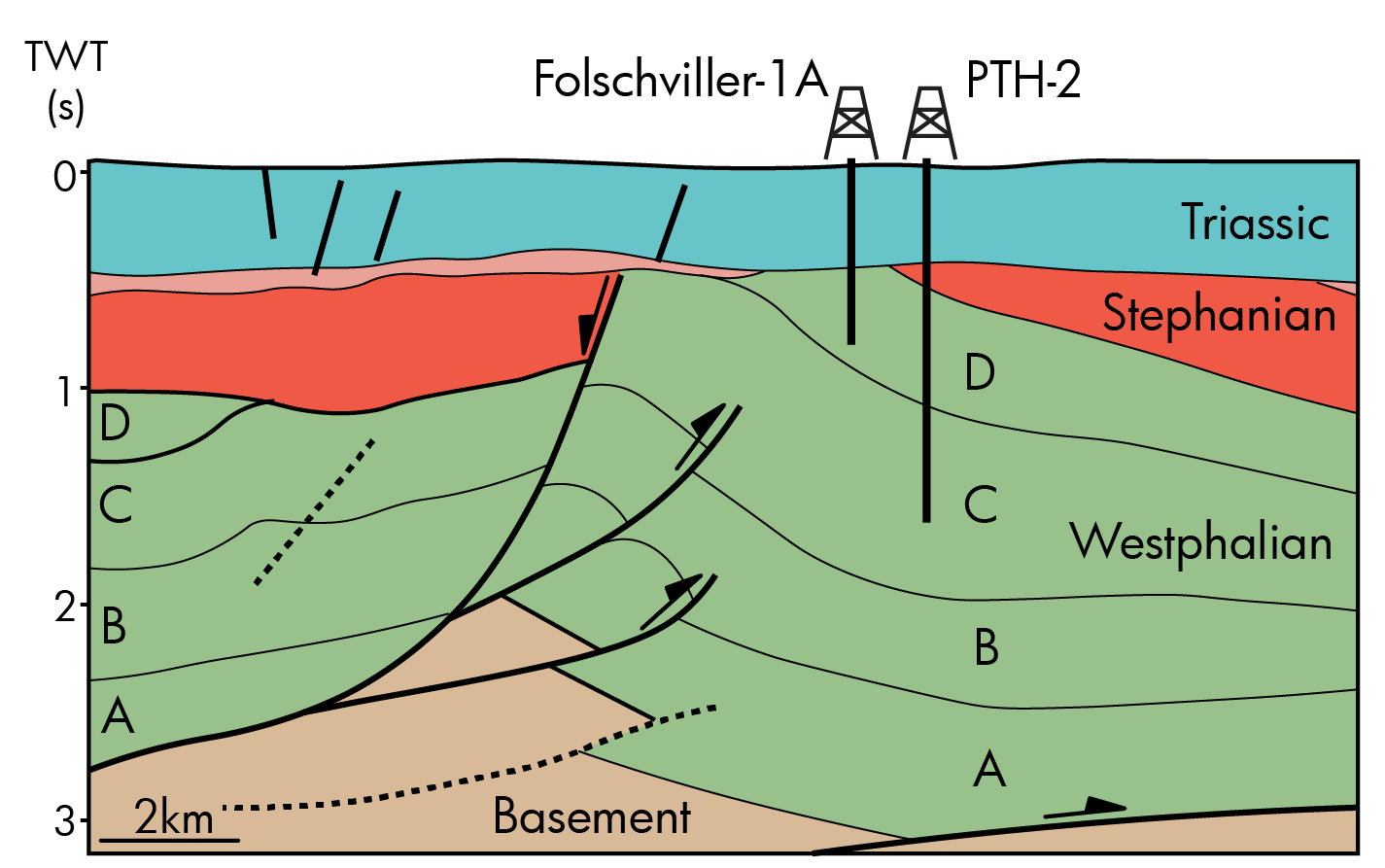
The stratigraphy of the Lorraine segment of the basin is well documented based on numerous shallow boreholes drilled for the purpose of coal mining at the French-German border and a handful of deeper boreholes to the west of the mining area. The Westphalian (up to 3.5 km thick) which forms the lower part of the basin fill, consists of conglomerates and sandstones deposited in a braided river environment alternating with claystones and abundant coal beds deposited on overbanks and in abandonment plugs. The Stephanian mainly consists of sandstone and claystone with minor occurrence of coal beds.
The Lower Permian, which caps the basin succession, consists of sandstone, conglomerate and mudstone red-beds with intercalated volcanics. A number of recently reprocessed and interpreted 2D seismic lines (including some in the vicinity of Folschviller-1A and PTH-2) further document the structure and stratigraphy of the basin.
Based on all this information and consistent with FDE’s pre-drill prognosis, PTH-2 must have penetrated the same Westphalian D succession as Folschviller-1A but deeper buried (and with some Stephanian and possibly Lower Permian on top). The deeper part of PTH-2 will have penetrated into Westphalian C and possibly tagged Westphalian B; a more shale-prone stratigraphy than Westphalian D.
In Folschviller-1A, where wellbore fluids sampled with a borehole probe during static conditions were analysed for dissolved gases, a methane-hydrogen gas mix was found with hydrogen content increasing with depth from just 1% at 600m to 18% at 1,250m. If this trend were to continue in PHT-2, hydrogen content near well TD at 3,660 m could be as high as 90%, but without data release by FDE, this remains a mere speculation.
There is controversy over where the hydrogen actually resides in the Westphalian reservoirs. In an earlier GEO EXPRO article on Lorraine and in related scientific papers, I have argued that hydrogen sampled from stationary borehole fluids in a CBM well is almost certainly derived from gas adsorbed to coal. Coals at this depth and temperature have a very substantial storage capacity for gas, whereas the interbedded sandstones and conglomerates are simply too low porosity (5% on average based on Folschviller well logs and regional data) to store meaningful quantities of dissolved gas. Yet, operator FDE insists that the sampled hydrogen is from dissolved gas in aquifer sands of the Westphalian.
To contrast the two hypotheses in terms of resource potential, I have worked out an indicative in-place resource density of coal-adsorbed hydrogen based on (weighed average) reservoir-properties estimated in Folschviller-1A across the Westphalian D (750 – 1,300 m MD; Figure 2).
| Net coal (m) |
Gas Content (m3/t) | H2 content (fraction) | Raw GIIP (MMsm3/km2) | H2 In Place (ton/km2) |
| 62.4 | 9.5 | 0.13 | 903 | 10,870 |
Similarly, for the same interval in Folschviller-1A I have also worked out volumes of potentially stored hydrogen dissolved in the pore fluids of interbedded sandstones and conglomerates and as residual gas.
| Net reservoir (m) | Porosity (fraction) | Water Saturation (fraction) | Maximum H2 solubility (mol/l) |
H2 content (fraction) | H2 In Place (ton/km2) |
| 206 | 0.067 | 0.97 | 0.07 | 0.11 | 550 |
Challenges with regards to recovery will amplify the differences in in-place volume even further. Because the Folschviller coal seams are relatively thick (4 – 13 m) and permeable (0.5 – 4 mD), a CBM development with dense drilling may deliver gas recovery-efficiency of maybe 50%. Recovery of brine with dissolved gases from the interbedded sandstones and conglomerates would be near-impossible because of low permeability (<0.0001 to 2.9mD based on core data and regional analogues). This comparison of hydrogen-in-place and recovery potential indicates that Lorraine may only be exploitable as a coal-seam gas project, not as an aqueous hydrogen project.
As a gas development, Lorraine would face the same hurdles that hamper CBM developments elsewhere in the world: low well productivity, high surface footprint and high co-production of water. Lorraine coals have not yet been flow-tested but considering their modest permeability, many hundreds or even thousands of wells may be needed to achieve full-scale industrial offtake. Tens of millions of barrels of co-produced water may require treatment and disposal. On top of that comes the technically challenging, energy-intensive, and costly separation of hydrogen from methane.
Whilst coals deeper than ca. 1,200 m, i.e. most of the succession in PTH-2, may have higher hydrogen content, they would be so tight that effective pressure depletion and drainage become near impossible. In fact, no analogue production of such deep coals exists. Porosity and permeability of deeper sandstones is likely even worse than at Folschviller. This renders the PTH-2 well merely a science project, not a useful test of exploitation potential of the play.