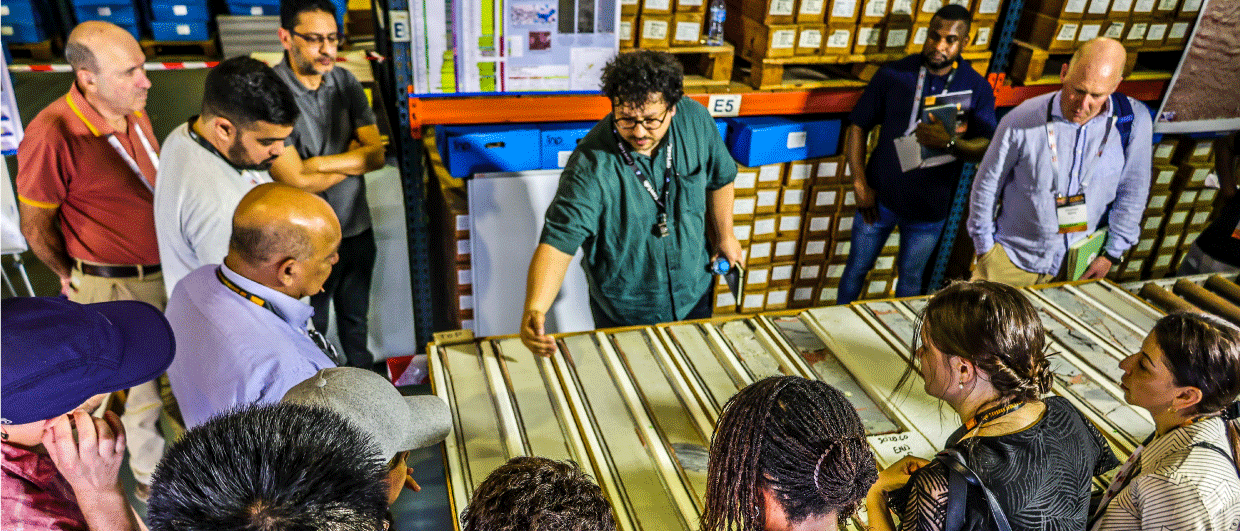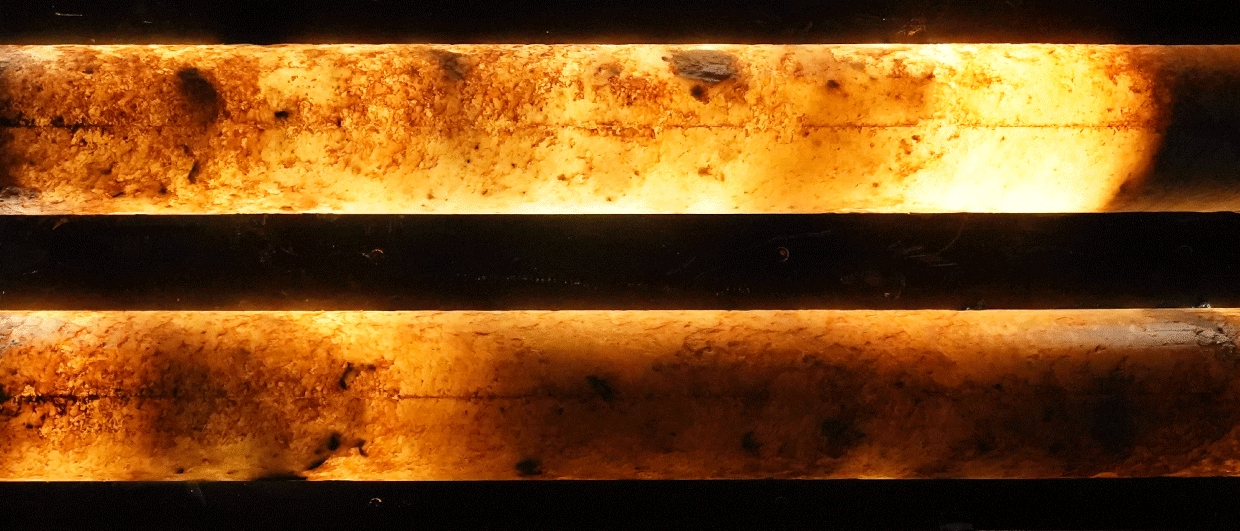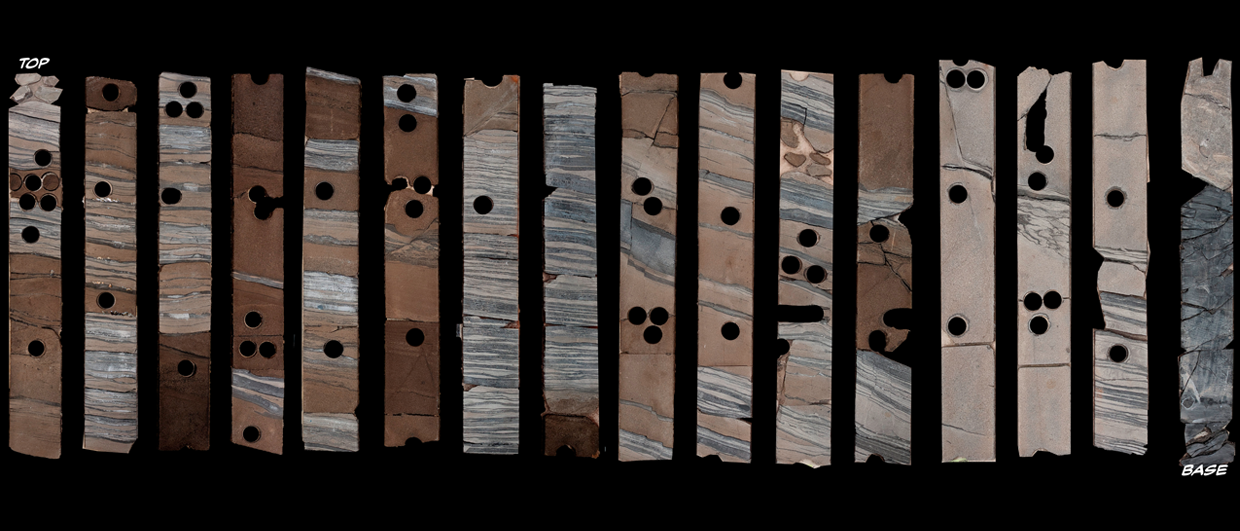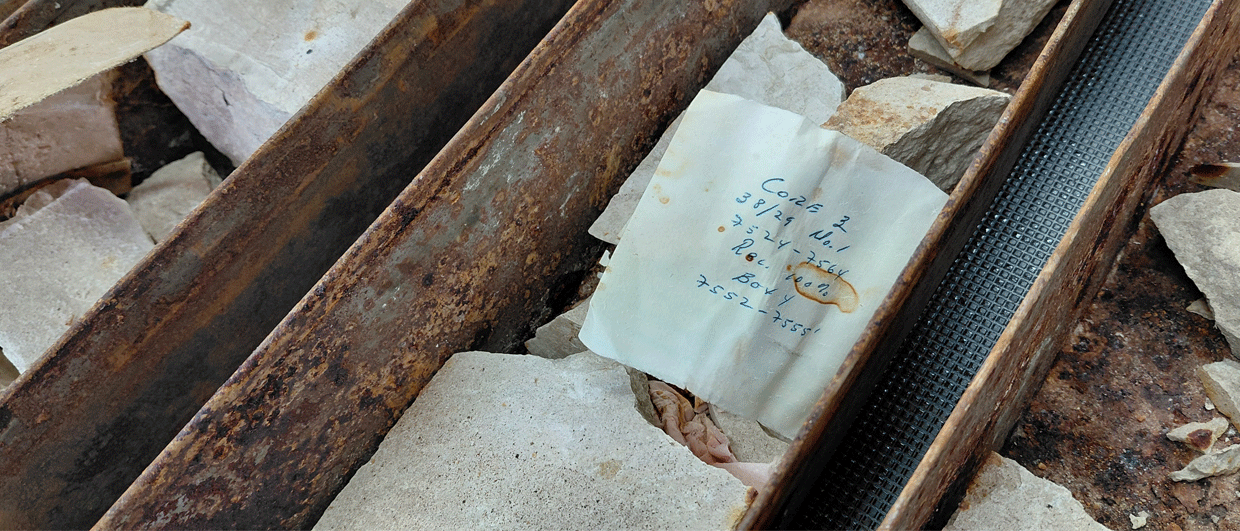
The cores of well 38/29-1 are stored in metal boxes. This way of packaging must have gone out of fashion soon after; wooden boxes became the norm. For good reasons. Photo: Henk Kombrink.
The very first core cut in the UK North Sea
Well 38/29-1 missed both primary targets, but the operator can be forgiven. It was the very first wildcat drilled in British waters

It is boxing day 1964, a day most people in the countries around the North Sea don’t think about spending a day at sea. Yet, the crew of the Global Marine Mr Cap Barge was about to spud a well that would go down in history as the first exploration attempt to find oil or gas in the British part of the North Sea.
What made American Overseas Petroleum decide to drill this well, and why now, in the midst of winter, when the North Sea is often a very choppy place?
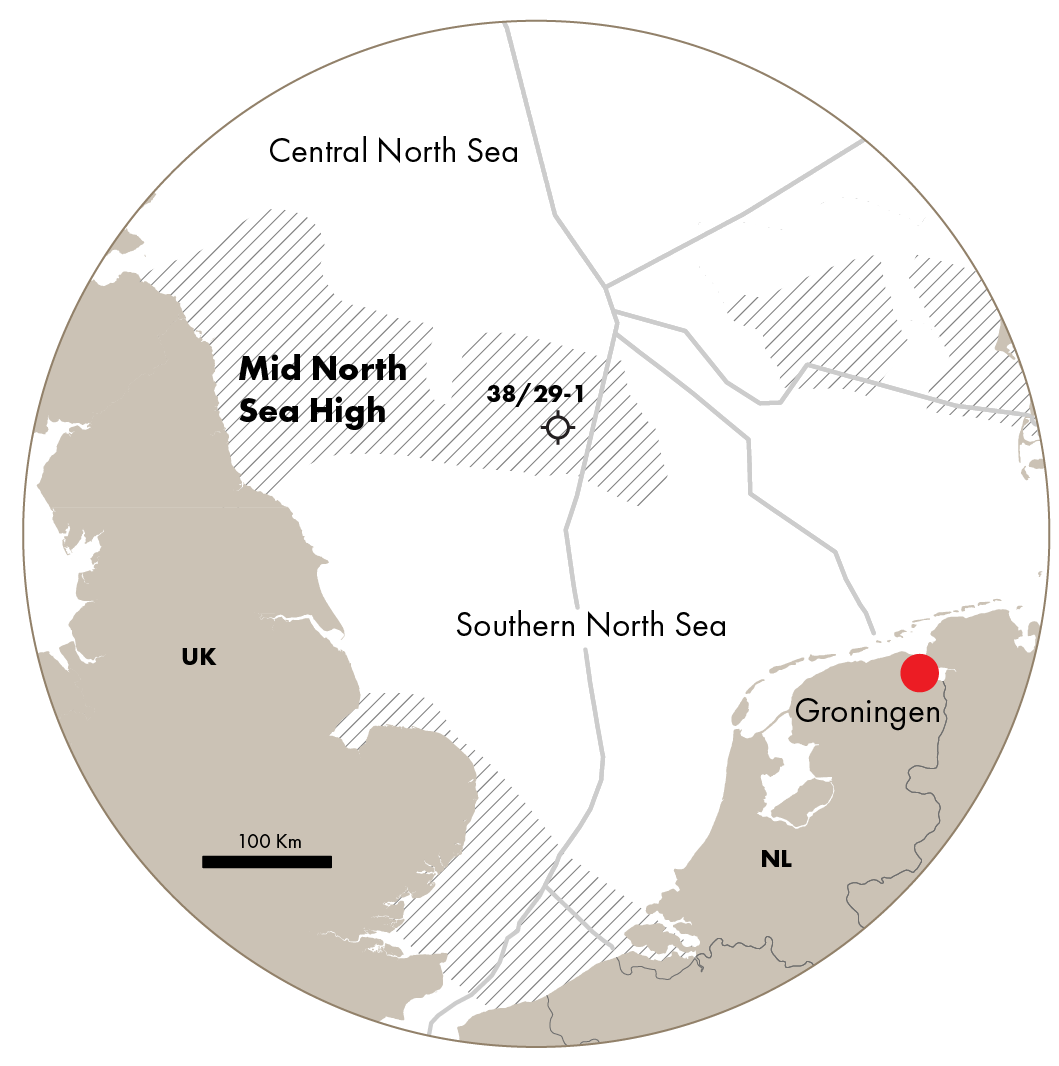 The most likely explanation – a dash for gas. It was only five years earlier that NAM – an Exxon-Shell joint venture – had found the massive Groningen gas field in the north of the Netherlands. Once the giant size of the accumulation became known to other oil companies out there – mostly American ones – a real Wild West scenario unfolded in the countries around the North Sea, because the idea was that the Groningen reservoir could extend into the offshore.
And that idea was correct. However, the location of 38/29-1 was not, even though it is easy to say that with the benefit of hindsight. Going back to the early 1960s, when the North Sea was almost a complete Terra Incognita, where would you go first? In that regard, it is not too much of a surprise that the company decided to spud where they did.
The well was located on what was at the time described as the Northumbrian Arch, now known as the Mid North Sea High. Projected offshore using onshore outcrops in England, this high must have had an expression in the earliest seismic lines that were available to the geologists planning the well. And where do you go when you want to drill for hydrocarbons? A high!
So that’s a structure identified, but a closure could not be interpreted on the seismic data because of the poor quality. For that reason, the well had a fairly slim chance of finding something from the get-go. And it didn’t find anything, indeed.
But, four cores were cut, in the Triassic, two in the Permian Zechstein, and one in the underlying Devonian. The primary targets, the Permian Rotliegend sands that had proven gas-bearing in Groningen and the Carboniferous that was known from onshore UK, were absent.
Looking back at the numerous discoveries made in subsequent decades, the location of 38/29-1 stands out as an area where no fields have ever been found. It is the deep basins on either side of the Mid North Sea High that have proven to be particularly prospective, illustrating how the exploration strategy changed in a short period of time; rather than the big highs, smaller fault blocks in the deeper basins proved to be the places to go.