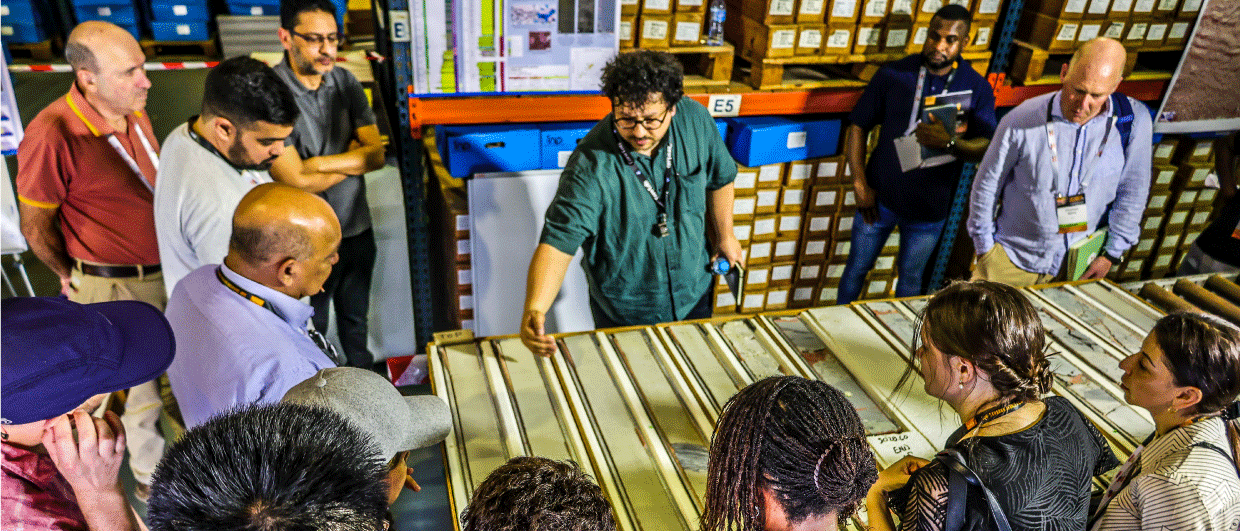
Similar observations were also discussed with industry participants during a recent Core Workshop in Maputo, delivered by Core Laboratories in partnership with the Instituto Nacional de Petróleo (INP) and led by the author.
Beyond turbidites: Core insights from the Rovuma Basin
Few offshore basins have reshaped the global gas landscape as profoundly as the Rovuma Basin offshore northern Mozambique. Home to giant discoveries such as the Mamba or Coral fields, the basin offers a compelling opportunity to examine deepwater depositional systems and their influence on reservoir quality

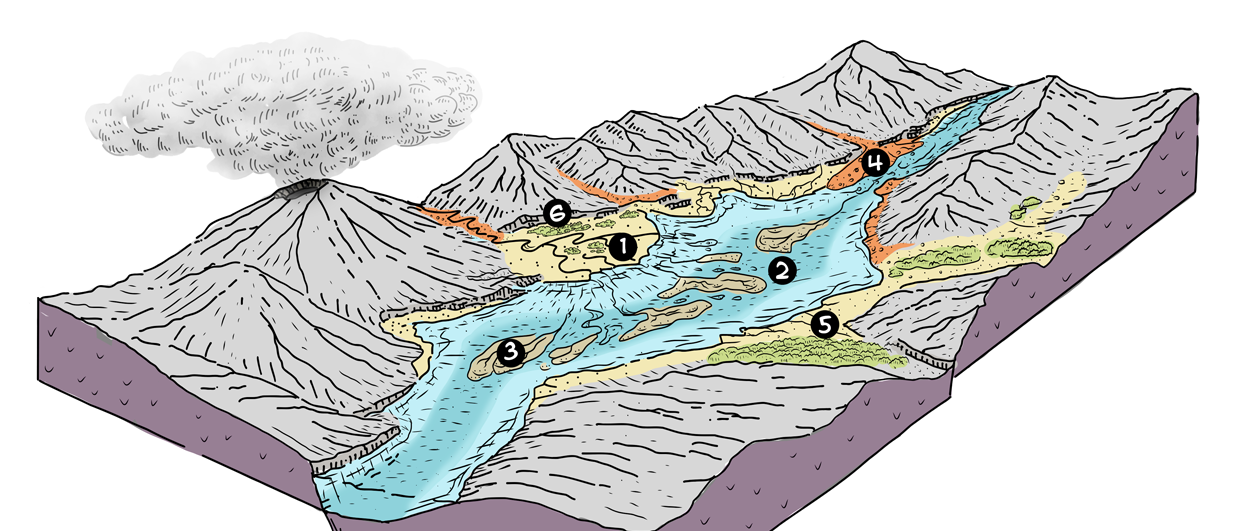
The Rovuma Basin evolved from Early Jurassic rifting into a passive margin by the Mid-Cretaceous, followed by significant clastic infill through the Cretaceous and Tertiary. Uplift associated with the early Paleogene East African Rift System drove substantial sediment supply, feeding deepwater channel systems and fan complexes.
Progressive sediment loading and gravity-driven deltaic tectonics led to collapse of the sediment wedge, forming a linked system of deformation characterised by numerous listric growth faults linked by a regional detachment layer downdip to compressional fold-and-thrust belts in deepwater area. Many major hydrocarbon discoveries are located near the toe of this thrust belt.
Core-controlled insights
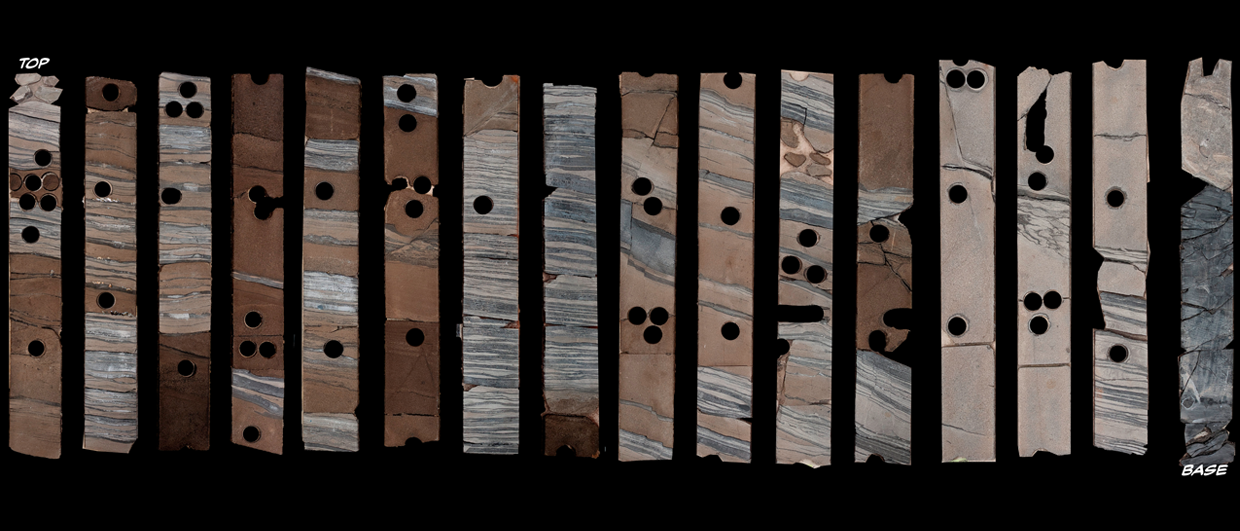
The insights presented here are derived from a regional core-based study undertaken in 2023 by Core Laboratories in collaboration with the Instituto Nacional de Petróleo (INP) in Mozambique. Core material from across the basin captures the full spectrum of the turbidite system – from proximal channel deposits through to channelised or amalgamated lobes and lobe-fringe facies. Several intervals display thick-bedded sandstones with very good to excellent reservoir quality, reinforcing the effectiveness of these systems as primary reservoir targets.
One important aspect in this area is the influence of bottom currents. Rather than acting independently, these currents interact with turbidity flows – either during deposition or through subsequent reworking, creating hybrid facies.
Turbidite – contourite interaction
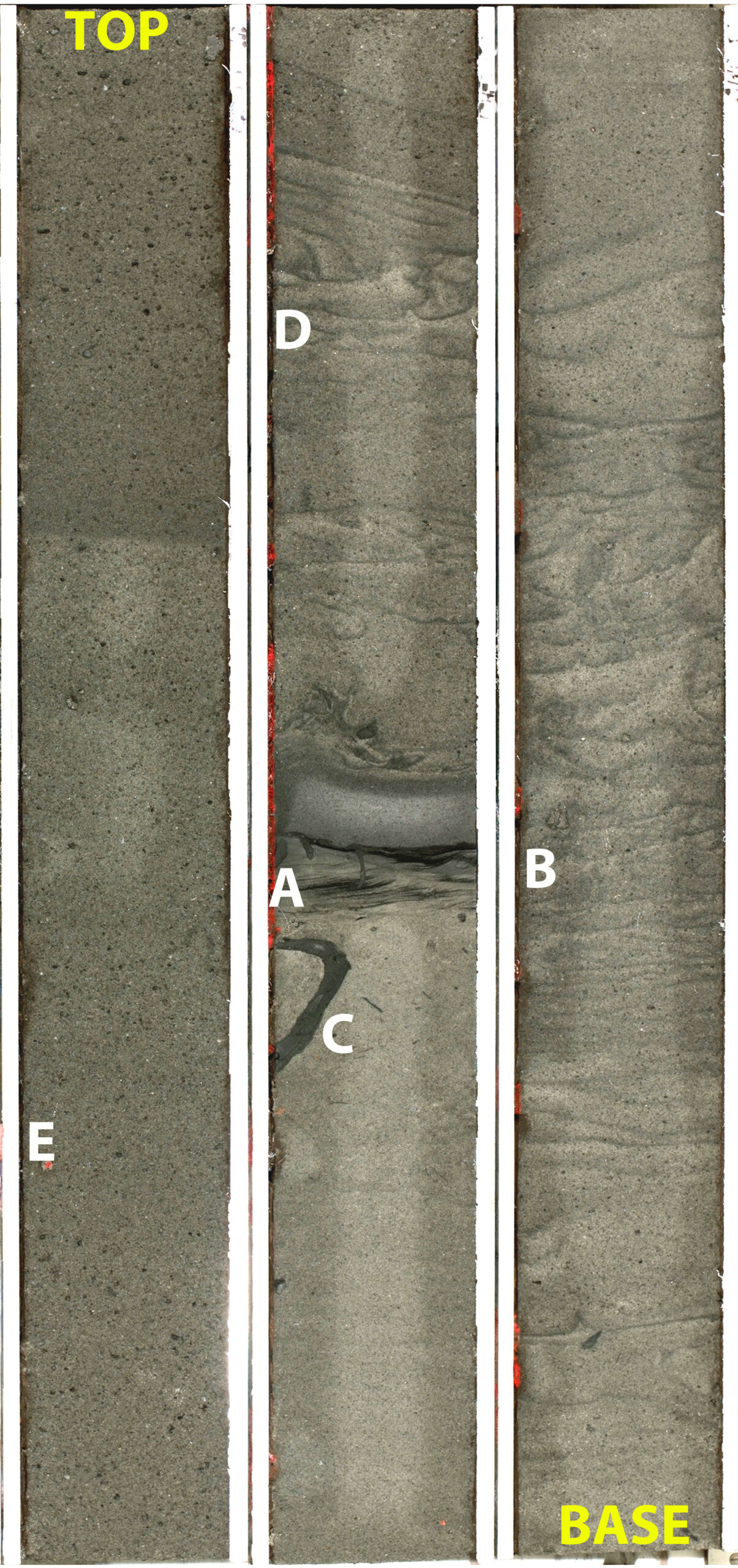
The evidence for contourites in the Rovuma Basin is mainly seen in the presence of unusually thick, stacked sandy turbidite beds, as the contourite currents strip out the finer-grained material and deposit them on the overbank margins of the channels as asymmetric drifts. In core, however, it is possible to observe some evidence of bottom current reworking within thin, finer-grained units locally preserved between the sandy, high-density turbidite (HDT) flows like the ones illustrated in the core photo (left).
Here we see that the HDT deposits, interpreted to form part of a channelled fanlobe, are separated by a thin finer-grained interval (A). The lower HDT (B) comprises coarse-grained, massive to fluidised sandstones with abundant dewatering structures (dish and pillar) and large deformed mudclasts (C), while overlying finer-grained intervals (A) display climbing ripples, clay drapes, and localized bioturbation. Deposition resumes upward with additional fluidized sands (D) and thicker granule-rich units (E), reflecting renewed high-density turbidity flow. In contrast, the thin finer bed (A) represents a low-density turbidity flow, possibly reworked by bottom-currents.
Reservoir implications
Both HDTs exhibit high porosity, with permeability exceeding 1,000 mD in granule-rich intervals. However, the presence of finer-grained layers introduces subtle heterogeneities that can significantly influence reservoir connectivity and flow behaviour.
Although typically below seismic resolution, these features are identifiable in core and are critical for refining reservoir models in structurally complex deepwater settings.