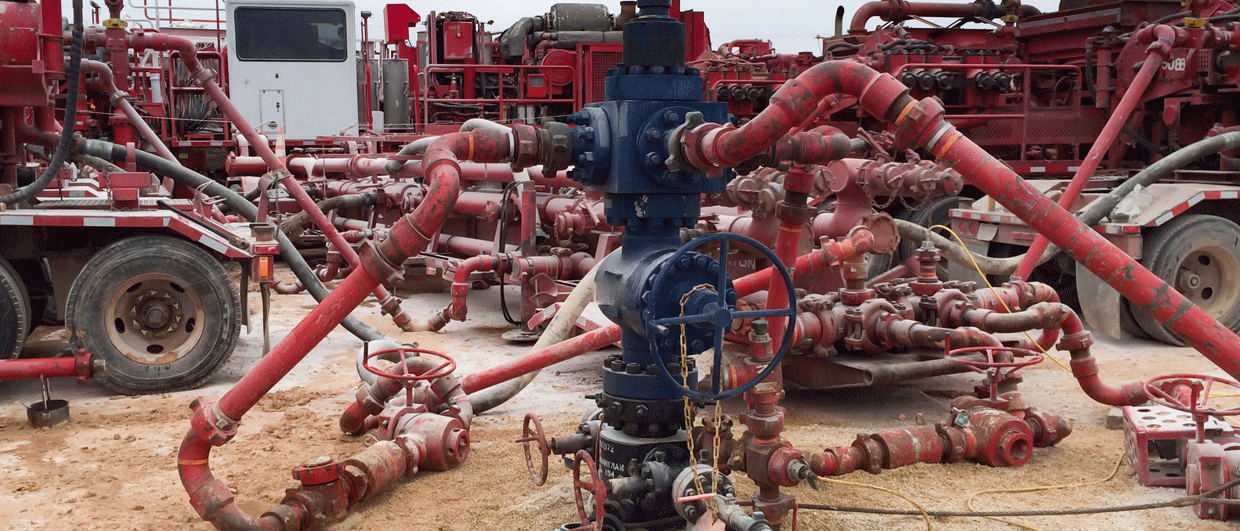
Permian wellhead. Photo: FreezeFrames via Adobe Stock.
Frac hit – how does it work?
A conversation with geologist Jessica Fallon about a mechanism that is familiar to those working in shale, but probably not so much to those in the conventional space

“Let’s start at a situation where we are drilling a 10,000 ft horizontal well in a prospective but yet undrilled shale play,” Jessica Fallon starts her explanation, “and we frac the shale along the full horizontal length of the well. The frac is pumped in isolated stages along the wellbore and can easily take between one and two weeks to complete. Following the last frac stage, there is a period of flowback, then the well is put on production, and everybody is happy.”
Then, some years later, in order to maximise the recovery of hydrocarbons from the lease, companies often drill a child well at a limited distance from the parent well. That’s when problems tend to arise.
“While frac’ing the child well,” Jessica says, “we sometimes observe a pressure spike in the parent well.” In other words, a connection is established between the parent and child well. This can cause the parent well to produce fluid and even sand from the child well’s frac. In some cases, a drop in production rate is observed in the parent well, too, with the ultimate recoverable volumes being negatively impacted.
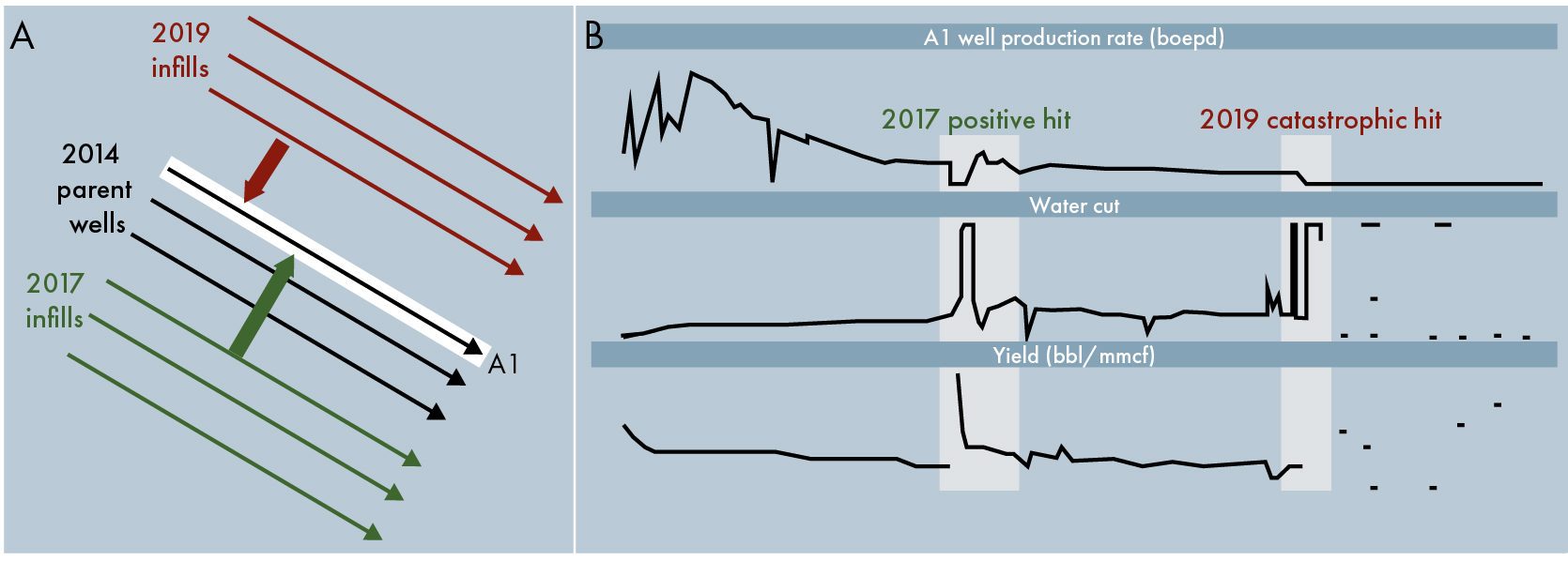
“The way I see it,” says Jessica, “is that production from the parent well changes the stress pattern in the subsurface, creating a “pressure sink” around the parent well. This causes the fractures from the child well to preferentially make their way in the direction of the parent well. These fracs are “captured” by the lower pressure rock around the parent well instead of opening up new rock for the child well.”
To prevent situations like that, wells tend to be drilled at larger distances from each other than in earlier years when this phenomenon was not recognised yet. Around ten years ago, when shale was still in its early days, a distance of around 600 ft was quite common; these days it is more in the order of 1,000 ft.
Another way to prevent the issue is to drill multiple adjacent wells from a single pad and frac them all at once, before any production or pressure depletion occurs. It is also possible to map pre-existing fracture systems in the shale using seismic attributes, and decide not to frac some intervals in the well where you think it is likely for faults to connect, but that always needs to be balanced against the loss of production. “You can imagine that is a difficult discussion,” concludes Jessica.