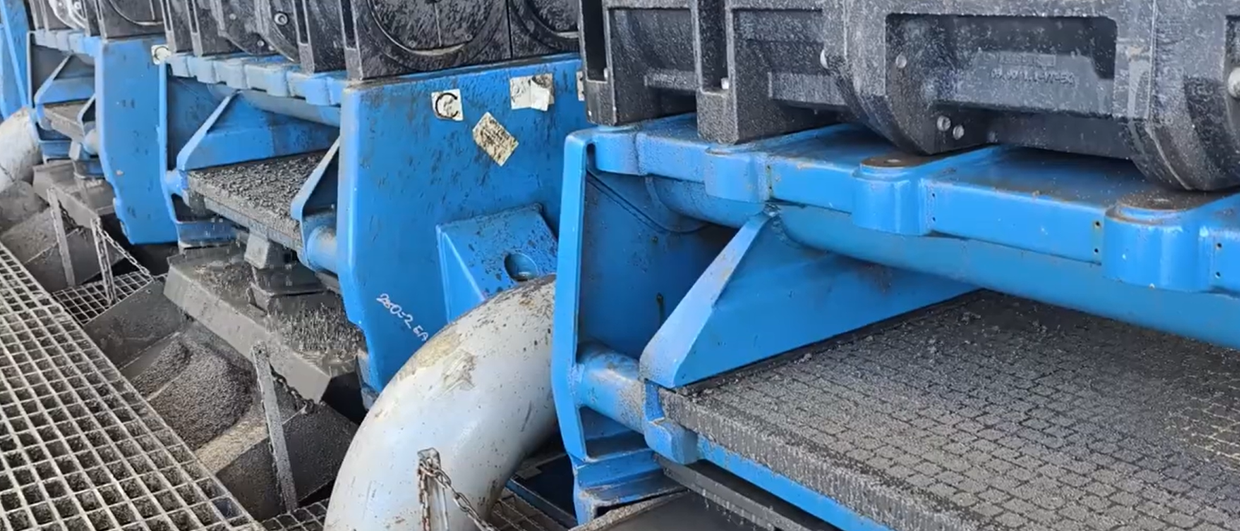
Shakers on a drill site. Source: Drillingformulas.com
If automation and AI are progressing in the way they are, we surely need fewer geologists – not more
That is the only conclusion one can draw after attending the Operations Geology Conference in London last week

Andy Conway from the North Sea Transition Authority started his keynote speech at last week’s Operations Geology Conference – themed “Evolution” – with a nice anecdote. He reminisced about presenting a log correlation he had produced for management from a few wells in the UK Southern North Sea. Until he was made aware by a colleague that the depth scale was upside down, positioning the Carboniferous on top of the Permian. It was a lesson in quality control he never forgot about checking throughout his career.
During his talk, Andy reiterated the transferable skills geologists possess, enabling them to work not only in oil and gas, but also in many other fields such as geothermal and CCS.
But even when these skills are indeed transferable, and there are plenty of new projects to work on, which is a question in its own right, there is another matter that remains: How fast are AI and automation replacing the need to have geological boots on the ground?
Listening to a couple of talks at the conference, in addition to input from conversations I recently had, I now believe that AI is seriously pushing geoscience roles – especially the ones that graduates used to fill – out of the market.
Aaron Swanson from Diversified Well Logging presented about a cutting sampler that not only automates taking the necessary samples for analysis, but also performs the analysis itself. “It potentially saves around 6 bodies on the rig,” he said, “also reducing the carbon footprint that comes with moving people around.” The company has deployed the machine not only in the US, where HQ is located, but also abroad, such as in Saudi Arabia.
Then there was Calvin Holt from DrillDocs, who presented – in a very engaging way – a new and automated process to analyse cuttings and detect cavings using a camera that monitors the materials falling off the shakers. “Rather than taking let’s say three samples an hour,” he said, “our device monitors cuttings continuously.” It doesn’t only result in a much better timing as to when cavings start to appear, the camera and associated software also analyses the shape of the cavings, allowing to make inferences on the geomechanical conditions down the hole. It is yet another task that shifts from human eyes to the eyes of a relatively simple camera.
In both cases described here, there is a clear case for replacing the geologist with smart devices and automated workflows. And let’s face it; who signs up for a job of running up and down stairs to take a sample, wash it, and look at it under the microscope for a few minutes for years on end? I think this development will continue. So, is it a surprise I see graduate geologists struggling to find work? I don’t think it is.
And what will be the long-term consequence of this development? The result is that fewer people who enter the industry have a feeling of what the real and hard data look like. If anything, this should reinforce the need to at least replace this element of practical experience with a level of training.
The industry is changing, and I feel that this is not in favour of the current generation of geoscience graduates entering the industry.