Illustration: GEO EXPRO.
Serendipity maximisation
Using historical exploration data in combination with known and postulated prospects, a new methodology developed by GIS-Pax aims to identify those areas where operators have the best chance of getting lucky

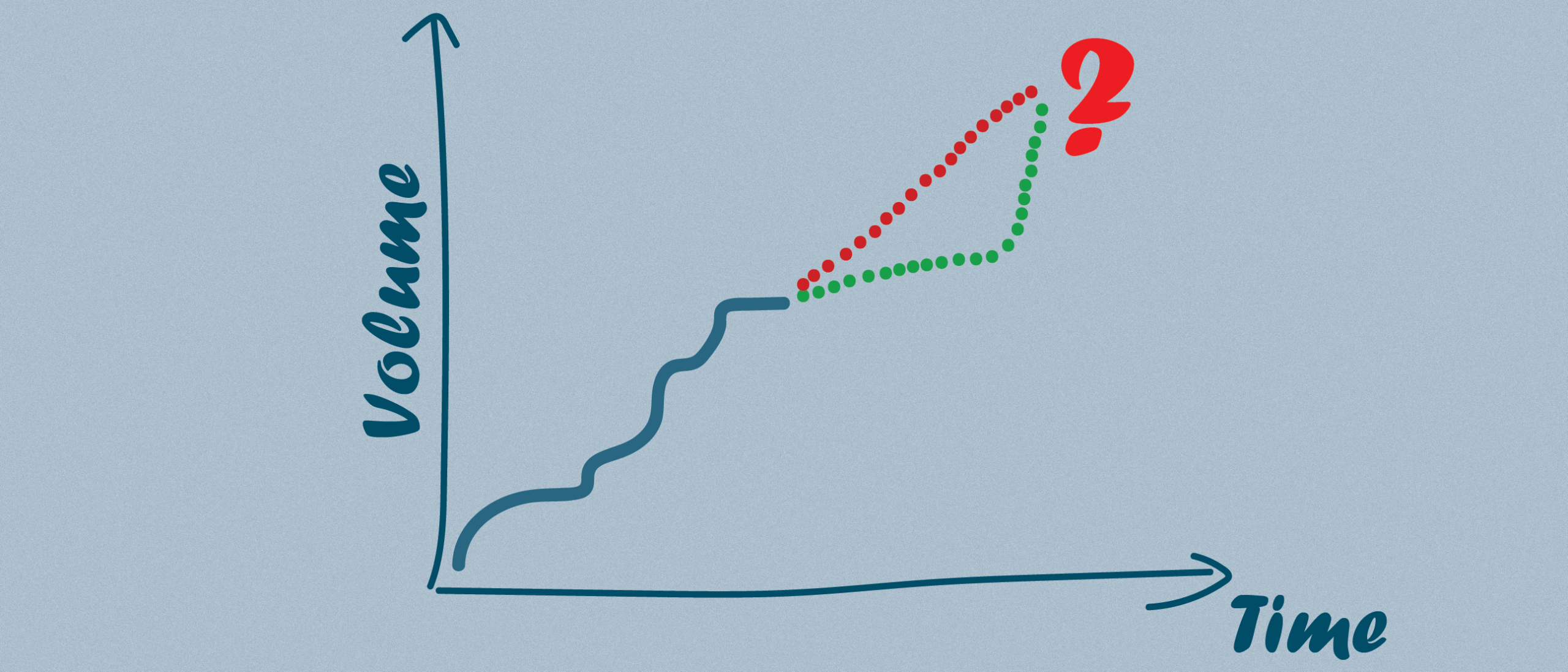
“When people make a creaming curve for a basin,” says Ian Longley from GIS-Pax, “they draw a line, and say that’s going to be the future for the basin.”
“The problem with that methodology is, when you predict to find, let’s say, 500 MMbbl in ten years, there is nothing to inform you about whether this yet-to-find resource will be found as a single 500 MMbbl discovery, or a string of 1 MMbbl finds. All the creaming says is that you end up at a certain point in time, but how you get there is entirely unknown.”
That’s why the team at GIS-Pax decided to approach this from a different viewpoint, all from a desire to make a more informed prediction on the potential size of the volumes to be found, and on a global scale to enable ranking different basins and countries.
“Let’s say the geological success rate is 50 %,” continues Ian, “and we are predicting ten fields of more than 20 MMbbl, there have to be twenty prospects of that minimum size. We distribute those prospects in an area, and subsequently run a stochastic model in which these wells are being “drilled”, let’s say a thousand times. In turn, that will result in a distribution of expected volumes given the number of wells drilled. This will also allow us to apply volume cut-offs, something that is not possible using the simple creaming curve methodology described at the start.”
But of course, rather than defining the prospects themselves, it would be better to use a set of prospects already defined and mapped for a certain country or basin. To tap into that source, the GIS-Pax team formed a partnership with S&P Global, which maintains a worldwide catalogue of prospects. “It is only in areas where there are no mapped prospects in the public domain, such as in Saudi Arabia, where we use the approach of defining a set of prospect polygons ourselves,” says Ian. “At the end of the day, we want to achieve a global and complete overview of prospectivity, as only then can we claim that our approach enables a global screening exercise.”
The global database now uses around 26,000 prospects from the S&P database, and the data gaps are filled with more than 100,000 postulated prospects. “There is a significant spatial and subsurface analysis that stands at the basis of this work,” continues Ian. “In a proven play, we use historical data to estimate the geological chance of success, but as we move deeper, shallower, or away from the source kitchens, we also change the success rates because we rely more on oil migration.”
The methodology also attempts to evaluate basin complexity. For example, if all of the large discoveries are made early and get progressively smaller over time, the basin may be quite simple and new big surprises are unlikely. This contrasts with basins where large discoveries continue to be made through the exploration cycle. It is these more complex basins that have a higher chance of future large discoveries.
“We know that our predictions will be wrong,” concludes Ian. “But what we try to achieve here is to have a consistent approach that can be applied globally, without there being a scatter of different techniques for different areas as we so often see. And through working with volumes, as well as historical performance data, we even try to predict where the next late-stage large discoveries, like Buzzard in the North Sea, might be made. We believe that is predicting the impossible!”