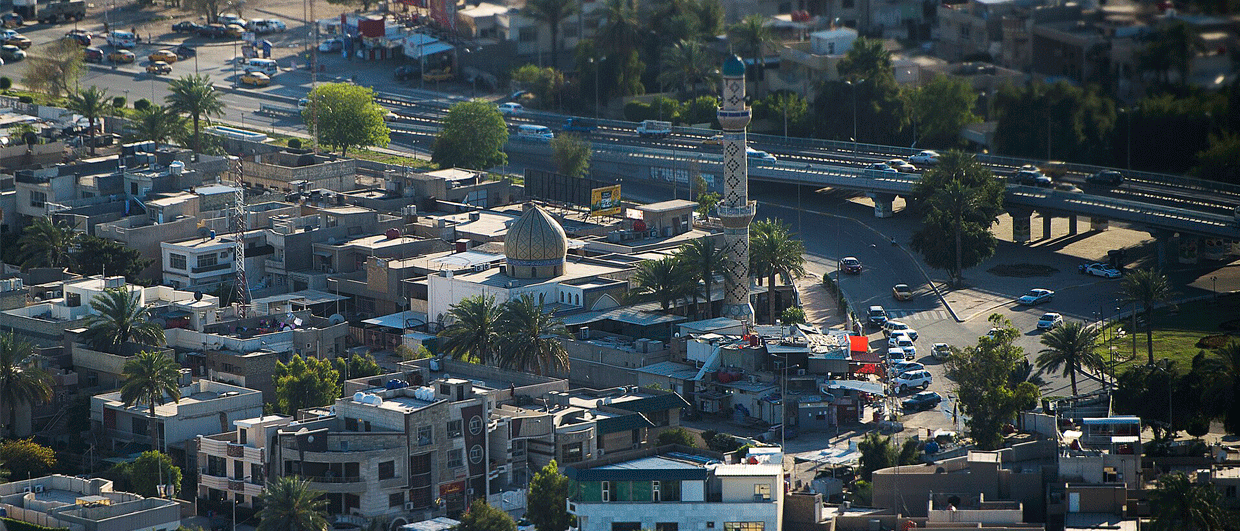
Baghdad, Iraq. Photo: Wikipedia Commons
New oil in an old field
The biggest discovery of 2025 took place in a field that was found in 1976, illustrating how existing assets remain an attractive target for adding new volumes

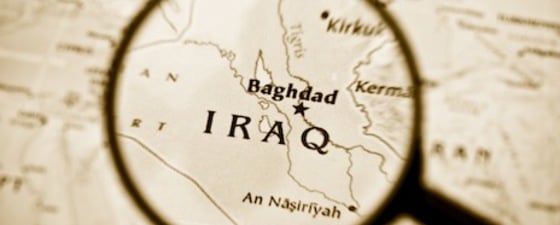
Whilst attending a webinar the other day, Andrew Latham from WoodMac presented an overview of the largest discoveries of 2025. The number one discovery, with an estimated volume of 2 billion barrels, turned out to be the East Baghdad find in Iraq.
This was a new name to me, but I’m sure that in Iraq’s capital, the field name did not appear in the news for the first time last year. The East Baghdad field has been in production for decades, since 1989 to be precise, and has also been published about, including in this magazine. The main field is currently operated by Zhenhua Oil from China.
For that reason, the mention of East Baghdad in WoodMac’s list of 2025 discoveries was a bit of a surprise. At the same time, it is also a confirmation of what the people from GIS-Pax talk about in their communiques; most of the future discoveries that will be made are located in areas close to existing assets. I think the East Baghdad discovery is the perfect example of that.
The operator of the new discovery is not Zhenhua, but the Midland Oil Company, a state-owned oil company that is responsible for the development of recently auctioned fields in the middle of the country.
Munim Al-Rawi, in his article about the East Baghdad Super-Giant field, wrote that it remained very underdeveloped, mainly due to the issues related to the densely populated areas being situated where the field is. Extending over a distance of more than 100 km in a northwest to southeast direction, the field lines up with a central fault trending in the same direction, with smaller secondary faults branching off. For that reason, the field, which hosts around 90 % of its oil in Upper Cretaceous reservoirs, is characterised by many individual compartments showing different contacts.
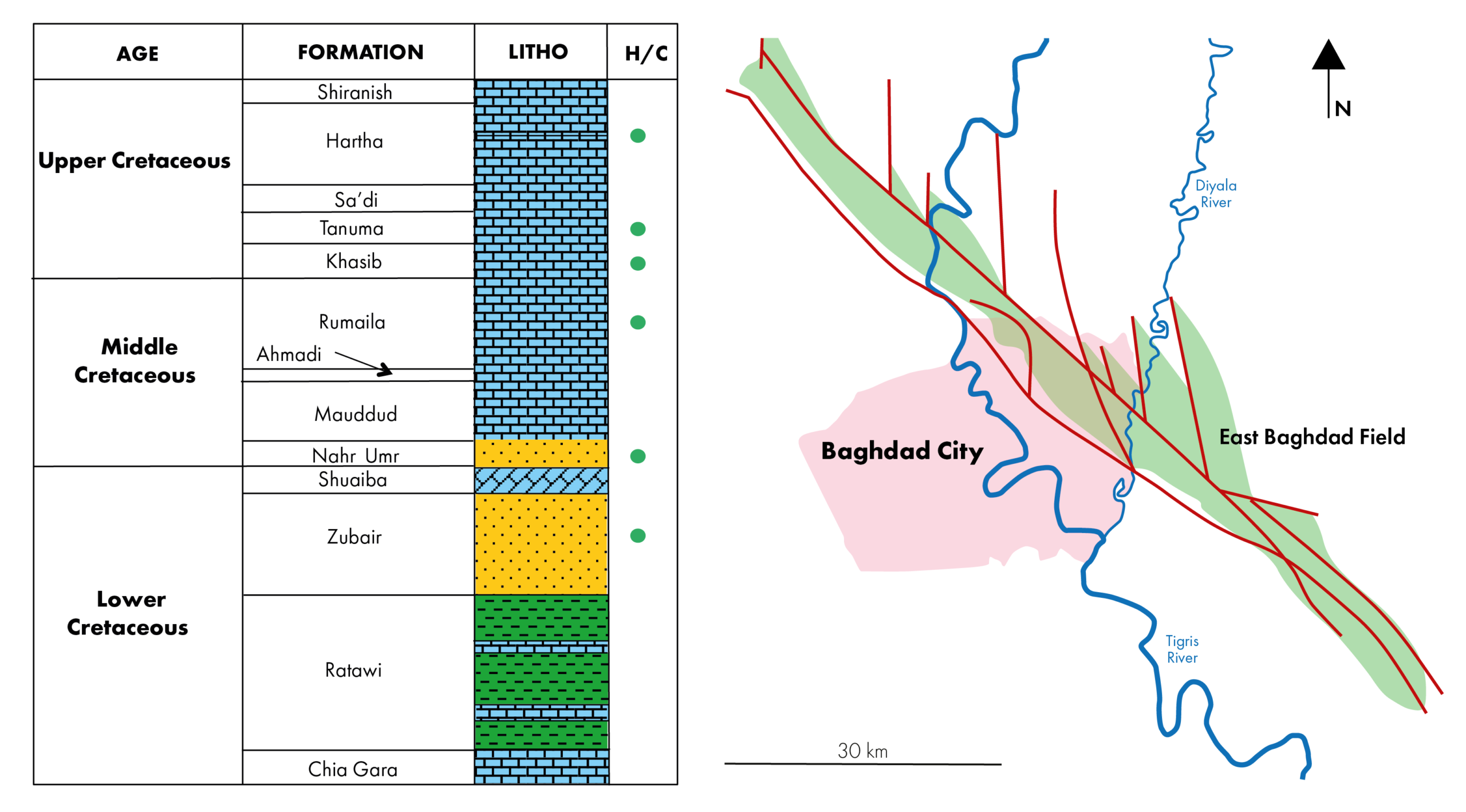
Against that backdrop, it may not be too much of a surprise to see that new drilling has resulted in a better delineation of the part of the field. Through a contact in Iraq, I learned that the increase in reserves is probably due to a better evaluation of the Upper Cretaceous Hartha Formation, in what looks like the youngest reservoirs in the field.
The discovery was probably made close to the southeastern tip of the field. A recent well drilled in that area reportedly showed strong oil indications in the Upper Cretaceous Hartha Formation reservoir rocks. A new seismic survey has also been acquired in this part of the field, aiding in the identification of the new drilling targets. For these reasons, the updated estimate appears to reflect both an improved reservoir understanding of the existing field area as well as the expansion of the field southwards.
All in all, the East Baghdad discovery, which went a little unnoticed in the media last year, is a clear example of the sheer potential that still exists in the giant fields of the Middle East.