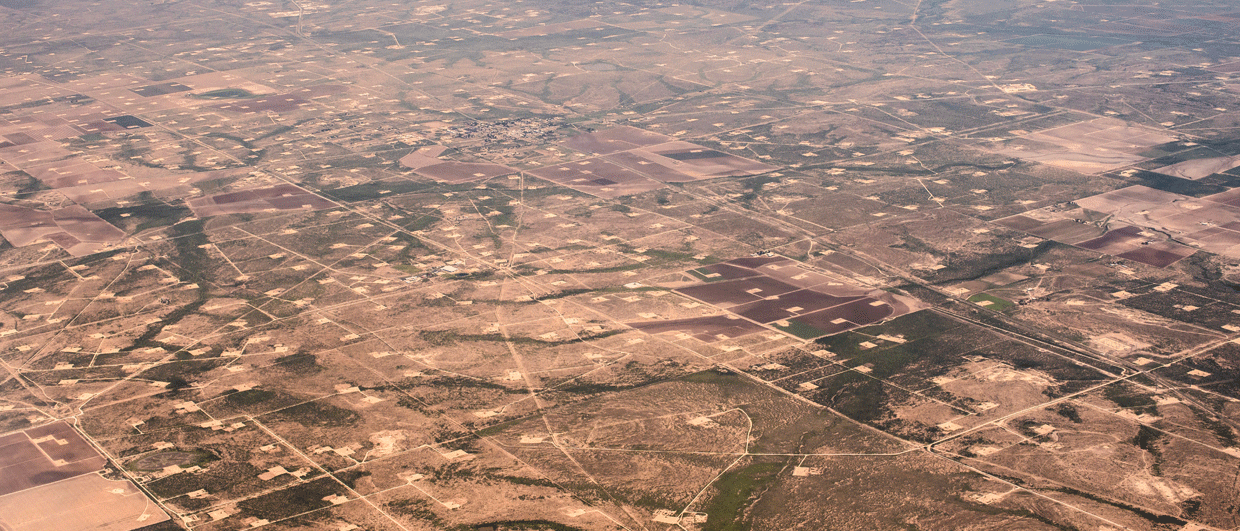
View from airplane of the Permian Basin, Texas. Photo: Cavan via Adobe Stock.
Turning the tide
On the consumption and production of water in the unconventional business, and how the dial is changing towards a complete preservation of local fresh water resources

There is a big difference between conventional and unconventional hydrocarbon production when it comes to water production. When drilling a well in a new conventional oil or gas field, the perforations in the well are always placed in such a way that only the oil or only the gas will be produced. The fact that this is possible is because nature has already done the separation, with clear oil-water and a gas-oil contacts as a result. Of course, over time, there will be mixing as contacts shift and gas may come out of solution, but the initial phase of production tends to be free of water if things are done correctly.
That does not apply to unconventionals. In unconventional resources, the ultra-low permeability of the rock has not allowed the formation of separate oil and gas columns. It is essentially still located in the plankton graveyard where the kerogen matured into oil and natural gas. Once drillers and frac’rs have completed their visit to these unconventional resources and wells start to produce, it means that water, oil and gas are flowing back up the well at the same time. Shale production is intermingled from the start.
But even though water is co-produced from the start, until recently, it was mostly fresh water that was used for the frac’ing operations. In other words, there was no recycling of produced water in an attempt to use it for frac’ing a neighbouring well. This has led many people to claim that frac’ing puts too high a demand on fresh water resources that are already scarce in most parts of the Permian Basin. But how does this compare to other forms of fuel production?
Most bio-ethanols require a boatload of water per product produced. Do you need 27 gal of biodiesel for your “green” truck? To make that requires an Olympic swimming pool of water, meaning that one gallon of bio-ethanol requires almost 25,000 gal of water. Crude oil is orders of magnitude more efficient in its water consumption – on average, in liquid-rich shale basins, about 1 gal of oil is produced over the lifetime of a shale well for every 0.6 gal of water used to frac it.
The good news is that Texan frac’rs are working hard to reduce their freshwater use. At the moment, they are about halfway into replacing that freshwater barrel for frac water with a (produced water) recycled barrel. In 2025, about 45 % of all West Texas frac water was produced water. In the next few years, the expectation is that no fresh water will be used anymore, and production will be unlocked exclusively by recycled produced water.
On balance, the issue of tight water availability in the early days of the Shale Revolution has now completely reversed, and instead of worrying “where to find enough water to frac,” the industry is now hyper-focused on “what to do with the excess produced water”.