AI adaption of traditional Japanese woodblock print of The Great Wave off Kanagawa. Source: Adobe Stock.
Japan retrieves rare-earth-rich mud from 6,000 m in deep-sea’s first
A Japanese test mission has lifted REE-rich mud from the seabed off Minami-Torishima, showing that such deep-sea deposits can be accessed. The samples will now be analyzed, and further trials are needed before commercial extraction can be considered

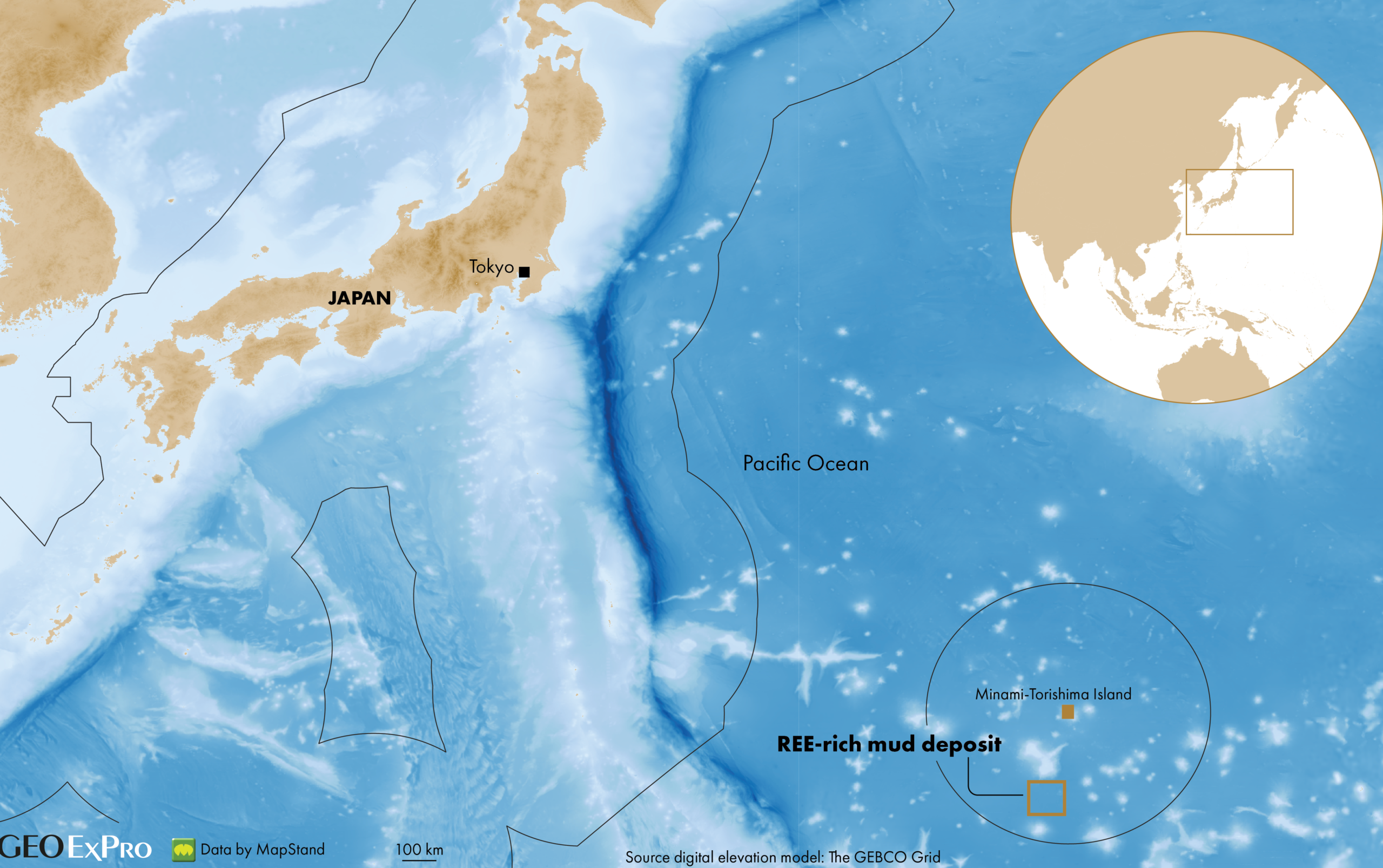
Japan has successfully retrieved sediment containing rare earth elements (REE) from the seabed off Minami-Torishima Island in the Pacific Ocean, some 1,900 km south-east of Tokyo.
At nearly 6,000 m below the sea surface, the mission marked the world’s first test recovery of rare-earth-rich deep-sea muds at such depths. First identified by the Japan Agency for Marine-Earth Science and Technology (JAMSTEC) in 2013, this deposit could provide Japan with a stable, long-term supply of REEs critical to its high-tech, energy, and defence industries.
The deposit
The Minami-Torishima deposit lies entirely within Japan’s exclusive economic zone (EEZ), which simplifies legal and regulatory issues compared to international waters. Early estimates suggest that the deposit may contain 16 Mt of REE oxides. The most promising area (102 km2) and the uppermost 10 m of the mud could yield 1.2 Mt of REE oxide, potentially meeting global demand for yttrium, europium, terbium, and dysprosium for decades.
Core samples obtained during the initial deep-sea research cruise demonstrated total REE grades up to 0.5 %, comparable to many terrestrial deposits. Separation and selective processing could enhance the resource’s economic value by increasing the grade in the lifted mud.
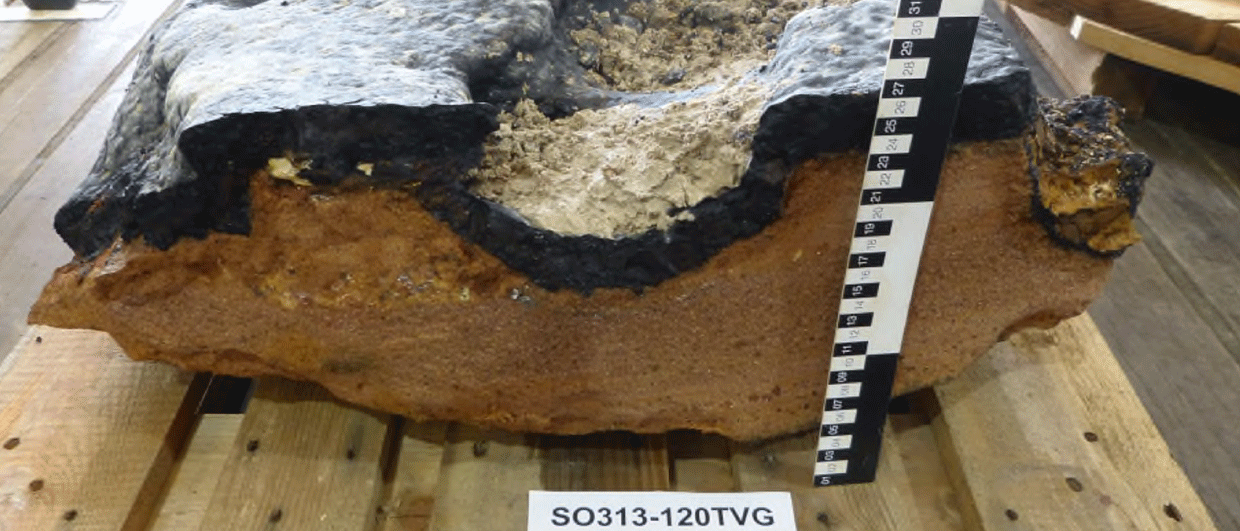
The mud itself is geologically unique. REE-rich muds in the Pacific, like those near Minami-Torishima, contain fish-bone debris composed of biogenic calcium phosphate, which accumulates REEs from seawater. Low sedimentation rates and high biological productivity have contributed to the formation of thick, REE-enriched layers. The mud represents a distinct fourth type of deep-sea mineral resource, alongside nodules, massive sulfides, and polymetallic crusts.
A challenging undertaking
The REE-rich muds targeted in this project have the consistency of clay and cannot be scraped or dredged like harder deep-sea deposits. Japanese engineers are developing a “subsea factory” system: Machinery placed on the seafloor mixes the mud with seawater, mills it into fine particles, and pumps it as a slurry through reinforced riser pipes to the surface.
Building pipes capable of reaching nearly 6,000 m while withstanding immense pressure, abrasion, and constant stress is a significant engineering challenge. On the seabed, machinery must function reliably in near total darkness and extreme pressure to agitate and feed the mud into the riser. Early development work has also highlighted that underlying sediment layers are weaker than expected, which could complicate operations.
Refining rare earths from the complex mud mixture is a separate challenge. Japan’s refining infrastructure needs to be adapted and expanded to handle future output.
If the lab analysis yields positive results, the project partners aim to initiate trial operations in January 2027, using a system capable of extracting 350 tons of mud per day. For now, the January 2026 mission represents a significant proof-of-concept, demonstrating that rare-earth-rich mud can be accessed and recovered from extreme ocean depths. The results place Japan at the forefront of developing deep-sea mining concepts and technologies, even when cost-effective extraction and processing is yet to be proven.